Isokyrö is a municipality of villages and open fields along the Kyrö River in South Ostrobothnia, between the regional centres of Seinäjoki and Vaasa. The river is more than scenery: its banks hold a medieval church, the marks of old settlement and a landscape where farming, local enterprise and cultural memory still meet. Statistics Finland counted 4,261 residents in the municipality on 31 December 2025. That number covers the entire municipality, not just its central church village. Isokyrö is a place to explore by linking dispersed sites rather than expecting a single resort-style attraction district.
The municipality places Lapua, Seinäjoki and Vaasa at roughly 40 kilometres from the centre. Its public services include a library, schools through upper-secondary level, a swimming pool and sports facilities; health and social services are organised by the regional wellbeing services county. For visitors, the practical picture is a working rural centre with everyday services and several distinct heritage stops, plus a drive between them.
A medieval centre whose dates need care
Isokyrö served as the religious and administrative centre of the Kyrö great parish in the Middle Ages. The name Isokyrö has been used for the parish since 1553, and municipal self-government began in 1865. Its clearest landmark is the Old Church, dedicated to Saint Lawrence, on the river landscape. It is one of Ostrobothnia’s surviving medieval stone churches, with a single nave, thick stone walls and a setting that still explains why this river valley became a local centre.
The familiar date 1304 needs a qualification. The parish’s current history says that local tradition assigns it to an earlier wooden church at the site, while the date may instead refer to the late thirteenth century. The present grey-stone church was built later, in the medieval period; it is not accurate to describe its construction in 1304 as a settled fact. The interior is particularly memorable for its 114 wall paintings, commissioned in the 1560s by pastor Jaakko Geet. They work like a painted visual narrative around the church, while medieval wooden figures and later fittings carry different layers of devotional history.
After restoration that began in 2021, the Old Church reopened on 20 June 2026. The parish lists guided summer opening on Saturdays and Sundays from Midsummer through August, 11:00–16:00; outside that season it is open only for events. Those hours are seasonal, so check the parish’s current notice before travelling. Across the townscape, the nineteenth-century main church, the local-history museum and the Asemiesmuseo add other perspectives on community and regional history.
Levänluhta: evidence, not a ready-made legend
At Levänluhta, nearly a hundred people’s remains have been recovered from an Iron Age water-burial site dated broadly to the fourth through ninth centuries CE. In the Iron Age the place was likely a spring-fed pond or small lake; today its red-tinged water and wet ground are reminders of the changing landscape. The find has attracted extraordinary interpretations, including the old idea that it was a sacrificial spring. That is not an established explanation.
Research led by the University of Helsinki has produced a more compelling story precisely because it leaves questions open. DNA from some of the studied individuals resembles present-day Sámi populations, and analysis of tooth enamel suggests that some grew up in the region. Isotope work also points to varied ways of life drawing on land, river and sea. Yet the reason for burial in water, the full identity of the dead and how they related to later communities remain unresolved. Levänluhta is not a proof of a simple, unchanged ethnic map; it is a rare archaeological site whose evidence is still being interpreted.
Napue, Orisberg and a living rural economy
Isokyrö’s other major historical place is Napue. On 19 February 1714, Swedish and Russian armies fought a battle here during the Great Northern War. It was the final major field battle of the war’s Finnish campaign, and Russian victory preceded the occupation period remembered in Finnish history as the Great Wrath. A memorial was unveiled at Napue in 1920, designed by Matti Björklund-Visanti. The battlefield lies across a broad agricultural area, and heritage records caution that it cannot be located precisely to one field. The memorial is the clearest visitor stop; approach it as a place of remembrance, not as a reconstructed battlefield spectacle.
Orisberg adds another scale of history. Its ironworks story began in 1676, and the area’s chapel was designed by C. L. Engel. The museum and village sites show that Isokyrö’s story is not only military or ecclesiastical: it is also one of estates, craft, agriculture and local initiative. Perttilä’s suspension bridge, built around 1910, is another landmark of the Kyrö River landscape. In September 2026 the municipality reported that a repair plan had been prepared but that funding and timing were still unresolved; check access and safety before making the bridge a fixed part of a walk.
The economy is broader than tourism. Municipal listings show grain processing and trading, agricultural supply, metal firms, automotive sales and services, as well as the distillery that has made rye a visible contemporary part of the local identity. Kyrö Distillery welcomes group visits, events and restaurant visits by reservation, Tuesday through Saturday. It is in the former dairy setting on the river, bringing a modern food-and-drink enterprise into an agricultural landscape without replacing the everyday village.
Getting around and planning a visit
Driving gives the most flexibility for combining the church village, Napue, Orisberg, Levänluhta and the recreation area at Kalliojärvi. The municipality marks a cycling route through the area and makes a route map available from its office, but the attractions are spread out and local roads should be planned in advance. Kalliojärvi and Orisberg list accommodation and seasonal visitor services; confirm that a particular café, campsite or rental is operating before relying on it for a meal or overnight stay.
Rail travellers can use Tervajoki station. Kyrö Distillery’s visitor information puts it about 10 kilometres from the station and says trains from Vaasa and Seinäjoki take roughly 15 minutes. Buses from Vaasa and Seinäjoki reach central Isokyrö, about two kilometres from the distillery. The operator recommends reserving bus travel and lists taxi options. This does not guarantee a direct connection to every heritage site: confirm the day’s train and bus times, the onward ride and seasonal opening hours. A well-paced visit might pair the Old Church and museum with Napue on one day, then reserve another for Levänluhta, Orisberg and the river road. Isokyrö rewards that slower, connected approach.
 Isokyrö in three films: the Old Church, Napue and Kyrö Distillery
 This recording preserves the centenary programme for the Napue battle memorial, held in July 2020 at the monument and the Old Church. It is an event film rather than a battle reenactment: the verified programme includes commemorative speeches, music and the presentation of the 1920 memorial’s unveiling speech. For travellers, it adds the way Isokyrö remembers a battle fought here in 1714, while keeping the focus on public memory and ceremony rather than invented scenes of combat.
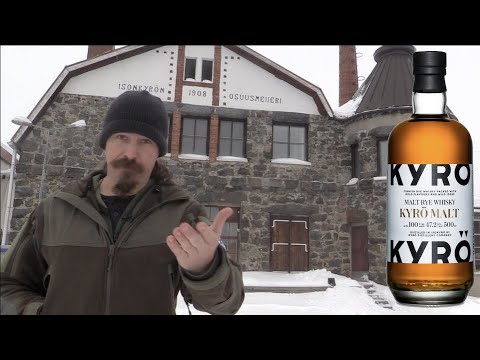 In this visitor’s film, the host of Forgotten Weapons travels to Isokyrö for a tour of Kyrö Distillery and a look at its production. The creator’s account identifies the visit as a behind-the-scenes introduction, not an official current visitor schedule. It offers a different angle from the town’s historic sites: a contemporary rye-based enterprise working in a rural setting. Use it to understand the distillery’s appeal, then consult the operator for current tours, reservations, restaurant service and travel arrangements.