A municipality of villages, not one compact town
Pedersöre is best understood as a large rural municipality in Ostrobothnia rather than a single town centre. Its villages stretch along two river valleys and out toward woodland, lakes and working farmland. The municipality reported 11,284 residents at the end of 2025; that figure covers the whole municipal area, not just the church village or Bennäs. Swedish is the main local language, although Pedersöre is officially bilingual and Finnish place names are useful when planning travel. Bennäs, or Pännäinen in Finnish, is the administrative centre, while Kyrkoby, Sandsund, Esse and Purmo each retain their own local identity.
The rivers explain much of the landscape's long economic history. Timber and tar moved from inland forests downriver toward the coast, and municipal history records local shipbuilders working from the 16th century into the 19th. Farming and water-powered mills also shaped settlement along the rapids. This was never simply an isolated farming district: waterways connected village production with a wider coastal economy. Today agriculture and forestry sit alongside manufacturing, construction, services and small businesses, while the network of villages remains central to daily life.
A name recorded in 1348 and a church older than its famous date
The parish name Pedersöre appears in a written source in 1348, in a royal enactment concerning trade in the parishes of Korsholm, Närpes and Pedersöre. That is a documented reference to the parish, not a claim that the present municipality or a settlement began in that year. The current municipality took shape in 1977, when Esse and Purmo were reunited with Pedersöre. The old parish was once much larger, and its religious and trading connections reached across a broad part of the Ostrobothnian coast.
Pedersöre Church anchors one of the region's most layered heritage settings. The year 1250 is often repeated because it appears as a traditional date associated with the building, but archaeological and heritage records do not treat it as a proven construction year. The Finnish Heritage Agency says an earlier wooden parish church was built in the late 13th century and dates the surviving medieval stone church probably to the 1510s or 1520s. Between 1787 and 1795, architect Jacob Rijf expanded it into a cross-shaped church. A separate belfry was built from 1769 to 1775; one bell is dated 1488. Across the road, old church cottages accommodated people who had travelled from outlying villages, and the oldest surviving examples date from the mid-18th century. The church grounds are more than a landmark: they show how worship, travel and village society were once organised.
Small museums and a living countryside
Pedersöre's local museums preserve working life rather than presenting a single grand narrative. Fagerbacka is a former half-seasonal farmstead. Workers could stay there overnight and tend cattle in the morning and evening, then return to the main farm for daytime work. The municipality also lists Fornstugan in Esse, Lassfolk, Åliden and the Pedersöre-area heritage museum. Collections include tools, furniture, clothes and buildings that explain how households and farms changed over the last centuries. Most museums open on summer Sundays or by arrangement, so visitors should contact the organisers before setting out.
The municipality's long-distance route, Utterleden, offers a very different way to meet the landscape. At a little over 50 kilometres, it links the wilderness centre at Lappfors with Kiisk, Hjulfors, Huvudsjön, Sexsjö, Nars and Vilobacka in Överpurmo. Blue marks guide walkers through old forest, wetland, small lakes, river stretches and former croft sites. Eight shelters and more than two kilometres of boardwalks make a multi-day walk possible; the municipality suggests roughly 15 kilometres per day over three days. The trail passes Lostenen, a striking glacial erratic, and shorter walks can begin at several signed parking areas. Remote sections demand planning: carry water, map and compass, a charged phone, and check trail and road conditions, particularly during spring and autumn thaw.
Useful services and how to arrive
Bennäs brings practical services together: the municipal hall, main library, Culture House Ax and a welfare station are based there. Near National Road 8, the sports centre includes an indoor hall, athletics field, ice arena, nine-hole disc-golf course and skate park. The broader municipality has other service clusters, but distances between villages matter; a car or a carefully planned public-transport connection makes it easier to combine heritage stops with rural walks. Accommodation is spread through the countryside, and guided tours can be booked in Swedish, Finnish or English.
The Jakobstad-Pedersöre railway station is in Bennäs/Pännäinen, with rail connections toward Vaasa, Helsinki and the north. Jakobstad (Pietarsaari) lies about 10 kilometres northwest of the station, with a connecting bus service between its bus station and Bennäs. National Road 8 passes through the municipality, while local routes link villages and trailheads. Train, bus and seasonal museum schedules change, so check the current timetable and confirm opening arrangements before travelling. A rewarding first visit can pair the church landscape with a local museum; a longer stay can follow the rivers inland and spend a full day on Utterleden.
 Pedersöre in three films: the Utterleden trail, Lostenen and the parish church
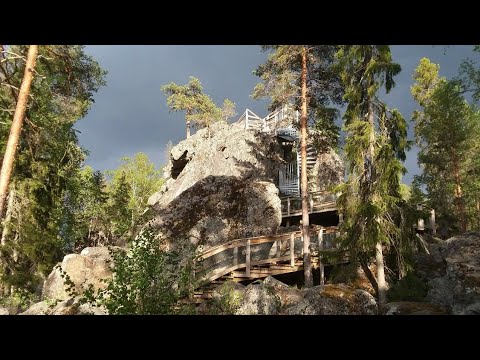 World Travel FIN's short location film takes the viewer to Lostenen, the large glacial erratic on the Utterleden route. This is a focused landscape stop, not a survey of the whole municipality. The municipal description places the boulder beside the hiking network and notes visitor facilities nearby. The film is useful for seeing the scale and setting of the stone; trail access, parking and seasonal road conditions should be verified locally before travelling.
 Kållby När TV's documentary turns from outdoor routes to the history and objects of Pedersöre Church. The subject is a heritage ensemble whose present form includes a medieval stone church expanded in the late 18th century, a separate belfry and old church cottages across the road. The Finnish Heritage Agency distinguishes the medieval fabric from the later rebuilding, which helps keep the often-repeated traditional date of 1250 in perspective. The documentary offers a longer cultural-history complement to the two films about walking and landscape.