Nykarleby is a small town on the Lapuanjoki, the river that opens west towards the Gulf of Bothnia. The municipality had 7,391 residents at the end of 2025, according to Statistics Finland; that figure covers the whole municipality, including the surrounding villages and coast, not just the compact town centre. Swedish is the everyday language heard most widely: the city’s 2024 welfare report says 83.7% of residents were Swedish-speaking, 6.5% Finnish-speaking and 9.8% had another mother tongue. Finnish-language Uusikaarlepyy is the official parallel name. The distinction helps explain the place: it is at once a quiet riverside centre, a network of farming and coastal communities, and a living part of Swedish-speaking Ostrobothnia.
A town founded for trade, reshaped by fire
Nykarleby received its town privileges in 1620, during the reign of Gustavus Adolphus of Sweden. Its site near the lower rapids and river mouth linked inland farms with the coast. The old town’s economy later depended on commerce and shipping; local museum material still tells that maritime story, while the city’s red-tar-barrel emblem recalls the tar trade that once travelled from the region to port. This was a planned trading town in the Swedish realm, not an ancient settlement with a Roman or Greek foundation.
The present street pattern also carries a clear break. A major fire in 1858 destroyed most of the old town. St Birgitta’s Church, completed in 1708, was among the buildings that survived; the city’s historical account also identifies the old customs house and a small number of other structures. The rebuilt centre took on a more regular plan, and much of the wooden architecture visitors see belongs to the decades after the fire. The Finnish Heritage Agency’s built-environment inventory notes both the surviving older wooden houses south of the church and the post-fire grid. The result is not a fully preserved medieval quarter but a readable small-town landscape where the church, river, wooden houses and later civic buildings sit close together.
St Birgitta’s is a useful first stop. Its church paintings are associated with Daniel Hjulström and Johan Alm, and its riverside position explains why it appears so often in views of the town. In the wider municipality, the stone church at Munsala was begun in 1777 and consecrated in 1792; Jeppo’s church was built by local villagers in 1860–61. These are active places of worship, so visitors should respect services and check access before entering.
Topelius at Kuddnäs
The best-known literary address is Kuddnäs, the white wooden home where Zacharias Topelius was born in 1818 and grew up beside the river. Topelius later became a journalist, professor of history and one of Finland’s best-known writers of stories and books for children. Kuddnäs presents the household and domestic world of nineteenth-century Ostrobothnia rather than a generic author shrine: the house and garden let visitors consider how a provincial family lived and how memory and landscape entered a writer’s imagination. The municipality describes the main building as preserved in its original setting and the museum grounds as a group of Topelius-related buildings. Opening is seasonal, while groups may arrange visits ahead of time; check the current calendar before travelling.
Topelius’s stories helped shape the town’s cultural reputation, but literary invention should remain distinct from local evidence. The city itself points out that the 1808 Battle of Jutas became especially famous through Johan Ludvig Runeberg’s poem about General Georg Carl von Döbeln. The battle and its memorial are historical; the poem is a work of literature that later gave the event a dramatic national afterlife. A monument stands at Jutas, about three kilometres from the centre according to the city’s visitor page. It is a worthwhile excursion for anyone interested in the Finnish War, provided the verse is read as art rather than a substitute for military history.
Small museums with different points of view
Nykarleby Museum, also known as Josef Herler’s Museum, occupies the former northern customs house on Jakobstadsvägen. Its rooms are arranged as a bourgeois home and its collections include furniture, clothing, toys and material connected with the town’s seafaring and trade. Local museum history says the oldest part of the building may date from the seventeenth century and that it escaped the 1858 fire. The museum association began building the collection around the turn of the twentieth century and has operated the museum since 1953. Visiting here complements Kuddnäs: one concentrates on a literary household, the other on town life, commerce and domestic objects.
At Kovjoki, several kilometres from the centre, Nykarleby Jernväg brings a small section of railway heritage into motion. The volunteer-run museum railway operates on a roughly two-kilometre, 600-millimetre narrow-gauge line, with historic passenger cars and working steam locomotives. The original route connected Kovjoki station with Nykarleby and served the town from 1899 to 1916; the present railway is a living museum, not the town’s modern passenger service. Steam days and rides are seasonal and event-based, so confirm dates before making the trip. The museum material also describes how railway engineering and the history of the line’s industrial equipment are interpreted in the workshop and engine shed.
Juthbacka Manor gives a further angle on civic life. The house was built in 1855, soon before the fire, and now serves visitors as a venue and seasonal café. The nearby Andra sjön recalls the town’s changing connection to water and transport. Other small museums and heritage houses are spread through the villages, including rural collections in Munsala and Pensala. It is better to select one or two by opening date than assume every local museum is open on an ordinary weekday.
From riverbanks to the outer coast
Nykarleby’s municipality extends well beyond the central streets. Jeppo, Munsala, Ytterjeppo, Vexala, Monäs and other communities give a visitor a wider picture of the region: cultivated river valleys, farms, woods, small harbours and low coastal land shaped by the uplift of the Gulf of Bothnia. The city’s visitor itinerary suggests combining a guided town walk with a visit to Kuddnäs, the railway or the Jutas monument; its nature programme offers paddling, walking and excursions to the sea. These activities are not all centred in town, so a car, a bicycle or advance transport planning makes a longer day easier.
There are several marked walking options, but maintenance is divided among associations, private actors and the city. The municipal recreation page lists routes in Ytterjeppo, Pensala, Monäs, Vexala, Jeppo, Munsala and around the centre. Storsand’s coastal network has three marked choices of about five, six and seven-and-a-half kilometres; the Ytterjeppo routes are about five and ten kilometres. Those figures describe route options, not a promise about surface or accessibility. The city states that many hiking routes are maintained by groups other than the municipality. Check the latest map and local notice, and do not assume that a trailhead, fire site or seasonal service is open just because a route appears online.
The coast is a good place to slow down rather than collect viewpoints. At Storsand and the villages around Vexala and Monäs, walking leads through pine and shore landscapes toward the water. On a windy day, the Gulf is more an expansive working seascape than a sheltered resort bay. Local routes are a chance to see where the small town’s agricultural hinterland meets fishing, boating and summer recreation; pack for exposed weather and leave time for the drive between villages.
Work and services behind the visitor image
The town’s economy is not built around tourism alone. Nykarleby’s business information describes a strong small-enterprise culture alongside fur production and export manufacturers including KWH Mirka and Prevex. Agriculture and food production remain part of the surrounding countryside, while the region’s service businesses link the city with Jakobstad, Pedersöre, Vörå and Kokkola. The municipality’s 2026 business reporting also shows that the local economy changes with international markets and regional industrial investment; visitors should not mistake a current economic headline for a permanent forecast. The broader point is that the town’s appeal rests on a working community, not a staged heritage setting.
For travellers, the centre provides the practical base: food and accommodation options, a public library, sports facilities and a seasonal calendar of town events. Nykarleby’s three public library locations are in the town, Jeppo and Munsala; the city also runs events and cultural programming with local associations. Kuddnäs has a café and museum shop during its open season, while Juthbacka and Brostugan appear in municipal visitor itineraries as places to pause for a meal or coffee. Confirm service hours and reservations, especially outside summer. If arriving after the main season, it is sensible to book a room and meals before setting out for the villages.
Getting there and making a useful day
Bus is the clearest public-transport option into town. Matkahuolto lists the Vaasa–Nykarleby–Jakobstad–Kokkola corridor, and municipal school-transport information also shows regional services and local connections between the centre and villages. Those documents establish routes, not a guaranteed departure every day or a tourist-friendly connection at every hour. Search the exact date, stop and return journey in the current ticket planner. By train, the nearby Jakobstad-Pedersöre station is in Pännäinen; the final leg to Nykarleby needs a separate bus or other transfer, which should be checked before buying a rail ticket. Driving from Vaasa or Jakobstad follows the same coastal-region road network, while a car is useful for reaching Jutas, Kovjoki and the outer villages.
A first visit can stay compact: walk the centre and St Birgitta’s, spend time at Kuddnäs, then cross the river landscape toward Juthbacka. A second day can be reserved for the Jutas memorial and a coastal or village walk, or timed to coincide with the steam railway. Nykarleby rewards that slower itinerary. The river explains its site, the fire explains much of its present architecture, Topelius gives it a literary voice, and the outer villages show how much of the city lies beyond the main street. Together these layers make it a distinctive Ostrobothnian town rather than a checklist of attractions.
 Nykarleby in three videos: the town in 1982, Kuddnäs before 1860 and steam trains
 Erkki Finni’s title presents an image of Kuddnäs before the 1860s. This is an artist’s reconstruction of the setting associated with Zacharias Topelius’s childhood home, rather than surviving footage or a building survey. Its value is imaginative: it invites viewers to compare the remembered literary landscape with the house and grounds that can be visited today. Treat visual details as interpretation unless independently documented. The museum itself explains the actual family home, its preserved rooms and seasonal opening, which is the right reference for planning a visit.
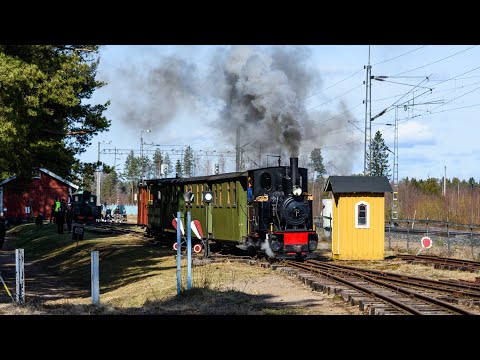 Junakuvat’s compilation records steam locomotives running on Nykarleby Jernväg on 1 May 2025. The video description identifies the line as a roughly two-kilometre, 600-millimetre narrow-gauge museum railway at Kovjoki and says all three working steam locomotives appear. It gives a direct sense of the sound and motion that a static railway display cannot offer. The footage documents one event day, not a permanent timetable; rides depend on volunteer operation and seasonal dates, so check the railway association’s current announcements before travelling.