Aulnat is a compact commune on the Limagne plain, immediately east of Clermont-Ferrand, where an old village core shares its horizon with the regional airport and the wider metropolitan area. INSEE records 4,139 municipal residents for the whole commune in its 2023 reference population, effective from 1 January 2026; the total is 4,176 when 37 people counted separately are added. The municipal boundary covers the entire town, not only the historic streets or the airport. Aulnat feels like a lived-in urban neighbourhood with its own memory rather than a detached rural stop: shops and services, residential streets, transport links and community facilities are part of the visit.
The most legible historic walk begins near the church on Rue du Commerce and turns into the old collective fortified quarter. The municipality dates this village fort to the 14th and 15th centuries, when insecurity encouraged residents to protect people and property together. It is arranged around a natural rise; Rue du Fort, Rue de la Tour and Place du Fort still preserve the name and shape of that district. A reading table made with the Amis du Vieil Aulnat association helps visitors imagine how the place once combined worship, learning, trade and public gathering. This is a village fort, not a surviving feudal castle: the municipal account distinguishes the community refuge from a seigneurial stronghold.
Water, archaeology and everyday life
Water is another thread through the town. The Artière and other branches of the Tiretaine system crossed Aulnat and caused repeated flooding. After a particularly damaging storm in 1979, the Artière was covered in 1981. Place Gabriel Fournier now keeps that buried stream in local view through paving that traces its course; farther along avenue Pierre de Coubertin, the boat sculpture Quë Degu2, installed in 2013, marks the same connection. The church, fort quarter, paved water trace and boat form a manageable centre-to-centre walk on public streets. Use the city map, allow for roadworks, and do not assume every pavement is accessible without steps.
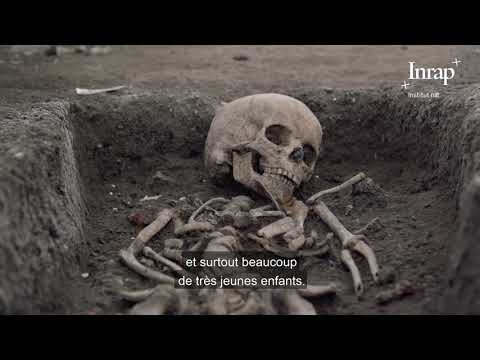
Archaeology adds a much longer timeline, but two discoveries should be kept distinct. At Cours de la Liberté, Inrap documented a cemetery used in the Middle Ages and part of the modern period, with 600 burials reported during the excavation. At the airport, state-prescribed digs before runway works in 2020–21 recorded occupations from the First Iron Age through Antiquity, the Early Middle Ages and later periods. Among the finds was an Augustan–Tiberian infant burial accompanied by a young dog and an exceptional group of grave goods. These discoveries are documented research, not ruins open to wander through. A joint airport–Inrap exhibition presented some results in 2025 and was intended to travel to the town media library; check whether it is currently on display.
Present-day Aulnat is shaped by the airport, small businesses and metropolitan services. A municipal report received in 2025 describes the Ronzières artisan area, the commercial avenue Jean-Jaurès and transport- and logistics-related activity. For residents and visitors, the town offers a community media library, cultural programming, a music school, sports grounds and courts. Nearby Clermont-Ferrand supplies the larger museum, dining and heritage circuit, while Lempdes and other Limagne towns sit close by. Do not treat Aulnat solely as an airport terminal: the historic core and daily public spaces are accessible on their own terms.
Getting around
As listed by the municipality and T2C in 2026, bus line B reaches Aulnat Saint-Exupéry and line S14 links that terminus with Romagnat Les Sports; SNCF also lists the Aulnat Aéroport rail halt on Rue Youri Gagarine. The airport is on the commune, but a flight terminal is not a substitute for the town-centre route. Check live timetables, construction diversions, airport access and opening hours before travelling. The municipal heritage page is the best starting point for the fort-quarter walk.