Artonne occupies a hillside between the Limagne plain and the Combrailles, a position that makes the village feel like a balcony above central Auvergne. INSEE counted 912 residents in the commune in 2023; the figure covers the whole municipal territory, not only the old centre. From the upper lanes, the landscape opens toward the plain, while the lower ground follows the Morge through meadows and trees. That meeting of agricultural slope and river corridor explains much of Artonne’s character.
A wine-growing village shaped by its hillside
Artonne’s built heritage is more than a picturesque shell. The mairie describes a long wine-growing past visible in the small stone huts known locally as tonnes, old vineyard terraces and the houses of wine workers. The village’s fountains and wash places also record how water was managed in a settlement spread across a slope. The municipality counts many historic fountains in the centre; their variety rewards a slow walk through the lanes rather than a quick stop at one monument.
The collegiate church of Saint-Martin anchors the older centre. Municipal history places a chapter there in 1048, founded by Guillaume, viscount of Thiers, with an abbot, cantor and twelve monks. The church incorporates changes from different periods, so its present appearance should not be reduced to a single date. Claims about early saints or a Roman foundation belong to the realm of tradition unless supported by evidence; the local story is already compelling through its documented religious and wine-growing history.
From the village lanes to the Morge
A short heritage circuit links the church, surviving traces of the old enclosure, wine-growers’ houses and viewpoints. The municipal visitor route is about 1.3 kilometres and is designed for a leisurely, roughly two-hour discovery walk, with interpretation at points of interest. Wear shoes suited to uneven streets and slopes. The Puy Saint-Jean offers a higher outlook over Limagne and the volcanic chain beyond; visibility depends on weather.
For a greener walk, follow the Morge valley. The municipality records five former mills along this stretch, now represented by fragments of walls and old mill dams among wooded riverbanks. The sensitive natural area was designated in 2007 and covers 140 hectares on both sides of the river. A marked path and interpretation panels help visitors read the landscape without treating it as untouched wilderness: the valley bears the traces of past work as well as present conservation.
Planning a visit
Artonne is a small heritage stop rather than a resort with a large visitor-services base. The official heritage network places it roughly fifteen kilometres from Clermont-Ferrand, and identifies access by road and rail; plan the final connection in advance and check current local transport. The municipal planning document describes nearby towns as the source of complementary shops and services. Allow time to combine the old centre with the river path, and check in advance whether the church or any seasonal activity is open when you arrive.
 Artonne in three films: village lanes, drone views and the Puy Saint-Jean
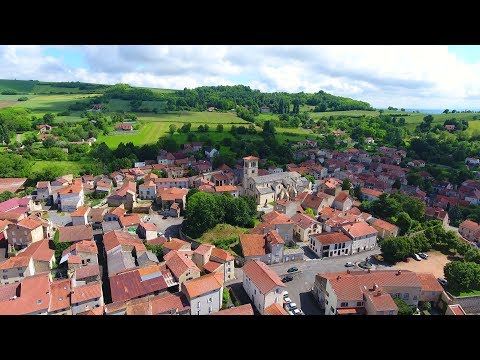 Dron’Air’s 2018 aerial film gives a different scale: the roofs, hillside and setting are visible together, making clear how Artonne sits above the Limagne plain. It complements a ground-level heritage walk. The elevated view makes the village’s relation to the surrounding plain easier to read, while a ground visit reveals details that the drone cannot show.
 Amta’s 2022 panorama focuses on the Puy Saint-Jean slope. The short landscape view connects the village’s wine-growing hillside with the broader plain and is useful for planning a walk beyond the centre. The panorama is most useful for understanding the slope and open horizon; it suggests a wider walk without pretending to map a marked itinerary.