Le Crozet is a small hilltop settlement whose scale makes sense only when you notice how much history is packed behind its old entrance. The whole commune had 252 municipal residents in 2023, according to INSEE; the figure covers the surrounding commune as well as the historic village. Its position near the N7 once mattered to movement across the northern Roannais, and the ridge still gives visitors a broad view over the plain toward the Morvan and the Lyonnais hills.
A fortified place, not a frozen set
The municipal history presents Le Crozet as a castle settlement developed between the eleventh and thirteenth centuries. It says the Counts of Forez later fortified the town with walls, towers and a drawbridge and granted it a charter in the thirteenth century. That account gives a useful framework for reading the lanes, but it is the town’s own summary rather than a detailed archival study. Roannais Tourism describes the place as one of four former strongholds in the region and recalls its fairs and position between the Roannais plain and the Madeleine hills.
Enter through the Great Gate and look for the coats of arms associated with Forez and Bourbon. The timber-framed Maison du Connétable, the Tour à bec and its inner courtyard, the Maison Dauphin and the Renaissance Maison Papon show how stone, timber and later alterations accumulated in the same compact street plan. A keep rising above the roofs gives the settlement its vertical marker. The old church survives only in part; its remains face later buildings, making the village legible as a lived-in place that changed over time rather than a single preserved monument.
Inside the village and beyond its walls
The Musée des Arts et Traditions Populaires occupies a sixteenth-century turreted house. Its displays connect household objects, former trades and the story of the N7 with everyday life in the region. Roannais Tourism describes it as the only house in the village open to visitors. Individual visits use a paper guide available at the entrance; guided visits are arranged in advance with local heritage volunteers. Confirm opening and booking arrangements before travelling, especially outside the main visiting season.
The old centre is compact enough for a slow walk, but the surrounding landscape invites a longer outing. A marked 13.8-kilometre loop linking La Pacaudière, Le Crozet and Changy passes through the village and continues across the plain and nearby hamlets. The keep’s outlook is another reason to climb the village streets. The glass identity is also more than a label: a festival marking its twentieth anniversary took place in August 2026, showing how craft and local events continue to add to the heritage story.
A small commune with a visitor economy
INSEE counted nine employer establishments active at the end of 2024: five in commerce, transport and other services, three in public administration, education, health and social action, and one in agriculture. This is a defined count of employer establishments, not a complete picture of residents’ work. It does, however, underline the scale of the place. The village’s practical offer is modest and seasonal, so plan meals and services rather than assuming a full high-street choice.
Getting there and planning a visit
Le Crozet lies close to the N7, near La Pacaudière and the northern edge of the Loire department. A road planner places it about 30 kilometres from Roanne, mainly by the N7 and Route de Paris; allow for traffic and follow current navigation for the final approach. The municipal visitor page provides guide materials but no current bus timetable, so check regional transport and arrange the last leg before relying on public transport. Parking is available for visitors. A rewarding half-day pairs the old lanes and museum with the keep viewpoint; walkers can make the longer circuit only after checking its route notice and conditions.
 Le Crozet in three views: fortified streets, a heritage feature and a village portrait
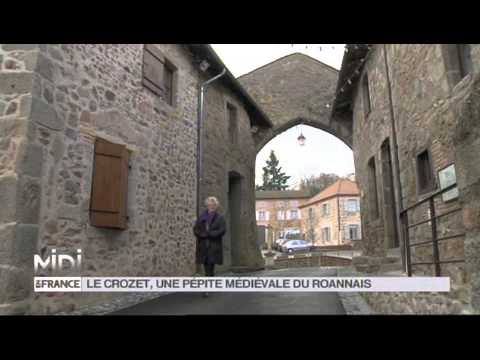 Midi en France’s 2014 guide is explicitly about Le Crozet as a medieval Roannais village. Its published description calls attention to the fortified setting and surviving tower. It offers an older television-era introduction; current labels, museum arrangements and visit details should be checked with the local tourism office.
 Tourisme et Découverte France labels this feature with Le Crozet and its regional location. It is a separate general village portrait alongside the heritage-network and television pieces. Compare it with the official walking guide to place the visual impression in context, and use current municipal information for opening times and access.