A small town shaped by two rivers
Charolles is best read from the water. The Arconce and Semence meet here, with a canal joining their courses through the historic centre. Footbridges, old mills and narrow streets make a walk feel less like a standard main-square circuit and more like a gradual crossing of a town built around water. The local nickname “little Venice” is easy to understand, but the real story lies in the practical landscape: channels powered mills and gave the settlement a distinctive shape.
The commune had 2,772 residents in 2023, according to INSEE’s municipal population count; 286 additional people were counted separately. These figures cover the whole municipality. Charolles is also the subprefecture and a service centre for the surrounding Charolais-Brionnais. INSEE counted 2,031 jobs in the commune in 2023. Public administration, education, health and social services accounted for the largest sector group, while commerce, transport and other services provided another substantial share. This everyday role sits alongside the area’s internationally recognized livestock and food heritage.
A castle town whose towers still mark the centre
The municipal visitor guide records a castle on this rocky outcrop by the tenth century. The Dukes of Burgundy strengthened the town in the fifteenth century, when fortifications and towers made the site a political and defensive centre. The Tour Téméraire dates from 1471–1474; the nearby Diamond Tower shows another face of late-medieval military architecture. The castle gradually gave way to later buildings, and the municipality bought the site in 1868 to install the town hall. Public government still occupies a place once designed for ducal authority.
Elsewhere, buildings tell their stories through changing use. The former convent of the Clarisses, dating from the fifteenth and sixteenth centuries, now houses the tourism office. The Madeleine Priory was established in 929 and attached to the Cluniac order in 1103. After the Revolution it became national property and later served as a school; since 1994, the restored complex has housed the Musée du Prieuré. Its collections include local faience, paintings such as works by Jean Laronze, sculpture and objects connected with regional life. Check the municipal culture page for current seasonal opening arrangements before visiting.
From pottery workshop to living ceramic craft
Charolles carries an industrial craft as well as a pastoral identity. The local pottery lineage dates to 1844, when Hippolyte Prost took over his father’s workshop. The manufacture’s current story includes later changes of location and ownership: the municipal guide notes the old factory at the Madeleine site until 1970, while the present brand operates from a separate workshop and boutique in town. Its survival in the local imagination is not just a heritage label; ceramics remain a visible link between domestic skill, design and the town’s name. The manufacturer’s website lists current shop details, but does not promise factory visits.
Understanding the Charolais landscape
Outside the centre, hedged pasture and broad fields explain why Charolles is so closely associated with white Charolais cattle. The Maison du Charolais turns that connection into a visitor experience rather than a display of folklore: its discovery rooms explain the breed, the pastures and hedges, the work of breeders and how the product reaches the table. Family audio guides and activities are available, and farm visits can be arranged when a participating breeder is available. The nearby restaurant and tasting space offer another way to understand the local food economy, including the protected Bœuf de Charolles designation.
It is worth keeping the countryside and the town together in an itinerary. The museum sits outside the tight historic core, while the old centre’s shops, public services and weekly routine belong to a working subprefecture. INSEE’s end-2024 count of 163 employer establishments shows the balance: commerce and services dominate, while construction, industry and agriculture are also present. Seasonal events and markets change, so ask the local tourism office what is happening during your dates.
Getting to Charolles
The current Mobigo regional coach network lists line LR709 between Digoin, Paray-le-Monial, Charolles and Cluny. Timetable frequency and operating days vary, so use the live route planner before travelling. By road, the RCEA/N79 serves the town at exit 12. Visitor information for the Maison du Charolais describes approaches from Mâcon Sud and rail arrival through Mâcon-Loché TGV or Le Creusot/Montchanin; check the connections before booking, since there is no basis for assuming a same-day bus link at a particular time.
Start with a walk along the rivers and around the towers, then leave time for the priory museum or the Maison du Charolais. In summer, the tourism office offers scheduled city walks and can advise on group visits; outside the season, opening days may be more limited. Nearby Paray-le-Monial, Cluny and the smaller villages of the Charolais-Brionnais make natural extensions for travelers exploring southern Burgundy’s Romanesque heritage and bocage country.
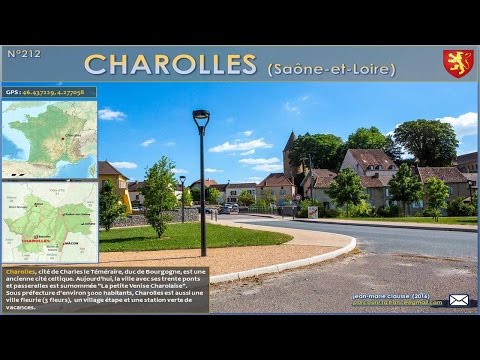 Charolles in three videos: town walk, Charolais cattle and bocage country
 Miam in Bourgogne’s short feature introduces Charolais cattle through the Maison du Charolais. Its description covers the breed, feeding, the breeder’s work and cooking, so it complements a visit to the museum’s exhibits on pasture and farming. The clip dates from 2015; current museum access, farm visits and tasting arrangements may differ. Check the Maison du Charolais for today’s opening hours and available activities before making plans.
 This episode of the Saône-et-Loire Route71 web series explores the broader Charolais-Brionnais area. The publisher describes a regional road trip with landscapes and local encounters, rather than a dedicated guide to Charolles. It adds useful context for extending a stay beyond the town into the bocage, but the review does not attribute unverified stops to the film. Check local operators for current access, events and routes when planning a wider trip.