Třebíč extends along both banks of the Jihlava River in the Vysočina Region. Above the river stands a former Benedictine monastery and St Procopius' Basilica; nearby are the historic Jewish Quarter and cemetery. The intertwined, and sometimes difficult, histories of Christian and Jewish residents make a visit more than a walk through attractive streets. The documented beginnings of the town are medieval, rather than Roman, Greek or Phoenician.
The monastery, town and river
Moravian princes founded a Benedictine monastery on the left bank of the Jihlava in 1101. That date is often used for the beginning of Třebíč, but it is not the precise foundation date of the town across the river. The monastery became an important centre of learning, economic activity and settlement. In the thirteenth century its community established a town on the right bank. The generous scale of the plan remains visible in spacious Karlovo Square. The earliest town charter, from 1277, already refers to Třebíč as a town.
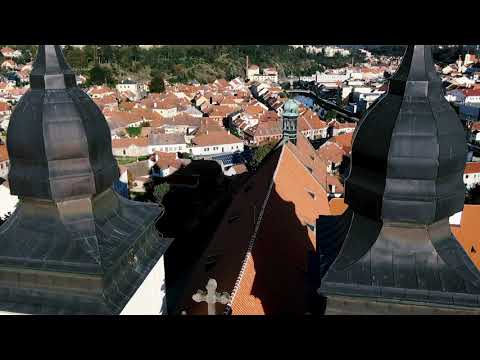
The Romanesque-Gothic basilica, begun around the middle of the thirteenth century, survived the end of the monastery and later transformations. The town received permission to build defences and to follow the model of Znojmo's municipal law in 1335. Fragments of the walls can still be seen, but much of Gothic Třebíč was destroyed in the war of 1468. Fires and later alterations changed many houses. The two Renaissance sgraffito houses on Karlovo Square are therefore valuable witnesses to an appearance that has largely disappeared elsewhere.
The Jewish Quarter and UNESCO heritage
On the left bank lies the old Jewish Quarter, with a dense network of lanes, houses and synagogues. The nearby Jewish cemetery is a separate place of memory. These locations should not be reduced to a picturesque backdrop: they recall a community that lived here for centuries and its destruction during the Nazi genocide. Visitors can walk the lanes and see buildings open to the public, while respecting the cemetery's commemorative purpose and visiting rules.
In 2003 UNESCO inscribed a group comprising the Jewish Quarter, Jewish cemetery and St Procopius' Basilica on the World Heritage List. Its exact extent matters: the designation does not cover every building throughout Třebíč. UNESCO describes the group as testimony to long coexistence and cultural exchange between Jewish and Christian traditions. The former monastery, basilica, quarter and cemetery are close together, but most of a day is better than a quick circuit if their different stories are to be understood. Tourist information centres operate by the basilica, near the Rear Synagogue and on Karlovo Square.
Further walks, food and arrival
On the right bank, explore Karlovo Square and neighbouring streets and look towards the tower of St Martin's Church. Viewpoints above the town reveal the relationship between its two banks. The castle complex contains a museum whose exhibitions add regional context. Nature outings into the foothills of the Bohemian-Moravian Highlands are another possibility, but they are separate from the short heritage circuit. According to the Czech Statistical Office, the municipality of Třebíč had 34,476 residents on 31 December 2025. The figure covers the entire administrative municipality, not only its heritage quarter.
Hotels, guesthouses and restaurants operate in Třebíč, so visitors need not stay elsewhere. The town's tourist portal lists accommodation and places to eat; confirm current availability and hours before travelling. Public transport and roads connect Třebíč with Brno and Jihlava, although a particular journey may require a transfer. Anyone planning a day trip from Prague or Austria should compare the latest timetables first. An overnight stay gives enough time for the basilica, quarter and museum without rushing. The information centre on the square can help with a general visit, while the centre beside the Rear Synagogue focuses attention on the Jewish Quarter. Museums and religious sites have different visiting arrangements.