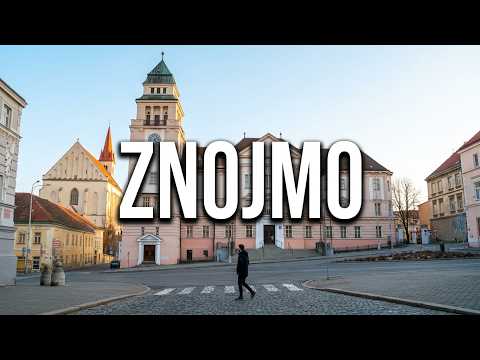
Znojmo stands high above the Dyje River valley in southern Moravia, close to the Austrian border. St Nicholas's Church, the castle promontory and the town hall tower dominate the first view; beneath the streets lies an extensive system of cellars and passages. The municipality's historical account traces the present centre from a Přemyslid castle founded around 1100 to the recognition of its growing settlement as a royal town between 1222 and 1226. Older occupation in the region does not make the surviving town a Roman, Greek or Phoenician foundation. Its most visible early layers are Romanesque and Gothic.
From a rocky castle to a royal town
Around 1100 the Moravian prince Luitpold moved his administrative centre from Hradiště svatého Hippolyta to a more defensible rocky spur above the river. A castle took shape there. The Romanesque Rotunda of Our Lady and St Catherine, with important wall paintings, survives from that early complex. To the east, a settlement developed with churches dedicated to St Michael and St Nicholas. The municipal study dates its elevation to royal-town status to the years 1222–1226. This careful range matters: the available account does not establish one indisputable founding day.
Znojmo's position on the edge of southern Moravia and Lower Austria gave it strategic and commercial importance. The city history describes a Vienna–Prague route crossing one from Linz and Krems towards Brno. Craftspeople arrived from the Austrian Danube region and German lands. Walls, gates, monasteries and markets grew with their work. The late Gothic Church of St Nicholas and the nearly seventy-metre town hall tower, built in 1445–1448, express the prosperity of the later Middle Ages. The network of streets and houses deserves as much attention as these landmarks.
Underground and later changes
The Znojmo underground was excavated below houses and streets during the medieval period. The municipal history describes its use for refuge and escape in times of danger. Visitor tours now open only part of the system. It is genuine historic infrastructure, not evidence of an ancient secret city beneath Znojmo. Fires and wars repeatedly changed the town above ground. The Thirty Years' War brought military requisitions and Swedish plundering. Recovery took many decades, and Baroque churches and houses joined the older fabric.
By the nineteenth century the walls had lost their defensive function. Some gates were removed and public gardens laid out along parts of the former fortification. Znojmo gained long-distance rail connections in 1870–1871. The city history also records losses of older buildings during modernisation. What survives is therefore not a completely unchanged medieval town, but a place where a Romanesque rotunda, Gothic church, Baroque castle building, parks and railway all belong to successive chapters.
Walking the town and valley
Begin at the town hall tower, then walk to St Nicholas's Church and the viewpoints above the Dyje. Continue to the castle grounds and St Catherine's Rotunda. The South Moravian Museum warns that entry to the rotunda depends on the season and the interior microclimate, so visitors should not assume it is open every day. A tour of the underground offers a different perspective. With more time, visit Louka Monastery, now also associated with wine, and take a walk towards the edge of Podyjí National Park.
Winemaking is part of the present Znojmo region. Wine bars, restaurants and accommodation are available within the city. The regional tourism directory lists Wine House Znojmo in the old centre and Hotel Premium in a northern district. Confirm tastings, menus and opening hours directly; individual cellars cannot be assumed to operate year-round. Roads and public transport connect Znojmo with Brno. Travellers also approach from Vienna across the Austrian border or from the Jihlava direction. Select the particular bus or rail connection from a current timetable.
The Czech Statistical Office recorded 34,172 residents in the municipality of Znojmo on 1 January 2025. This is the whole municipality, not just the narrow streets above the river or the larger district. The old centre and one guided visit can fill a day; the underground, rotunda, monastery, wine and a river walk reward a longer stay. The town makes most sense when seen in the order suggested by its setting: the buildings on the rock, the history beneath the streets, and finally the landscape surrounding them.