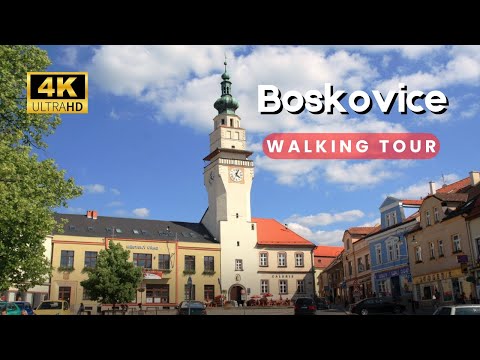
Boskovice stands in South Moravia about 40 kilometres north of Brno, where the Boskovice Furrow meets the Drahany Highlands. A visit need not revolve around a single monument. A fairly compact walk can take in the main square, former Jewish quarter, château grounds and the climb to the castle ruins. This remains a working regional town rather than an open-air museum. The Czech Statistical Office recorded 12,457 residents on 31 December 2025 for the whole municipality, which also includes Bačov, Hrádkov, Mladkov and Vratíkov. The municipal area is approximately 27.8 square kilometres.
From medieval estate to modern town
The earliest written reference cited by the municipality dates to 1222: Jimram of Boskovice appears in a charter issued by King Přemysl Otakar I. A nobleman's name in a document does not establish the exact day on which a settlement was founded. The hilltop castle was built in the middle of the thirteenth century and is documented in writing in 1313. Boskovice was a market town by the middle of the fourteenth century at the latest. In 1463 King George of Poděbrady granted it the right to hold an annual market. These records support a medieval history; they do not establish a Roman, Greek, Phoenician or Celtic foundation. Evidence for older occupation in the wider area would be a different claim from the founding of the present town.
The lords of Boskovice held the estate for centuries. The Morkovský family of Zástřizly became its owners in the second half of the sixteenth century and added Renaissance features to the castle. Ownership subsequently passed by marriage to the Dietrichstein family and later the Mensdorff-Pouilly family. Those changes remain visible in the built landscape. The castle ruins recall a defensive residence and its successive alterations. The Empire-style château was created in 1819–1826 from a former Dominican monastery, founded in 1682 and closed in 1784. The château and the castle are therefore two distinct sites.
The castle also has a 26-metre-deep well with a wooden treadwheel. From the hillside, the position of the town between lower streets and wooded uplands becomes easier to read. Check opening periods with the castle and château operators before travelling; their seasonal schedules need not coincide. Masaryk Square below the hill offers another layer of history, with its town hall, Church of St James the Greater and houses of the old centre. According to the municipality, the urban conservation area designated in 1990 contains 36 protected immovable cultural monuments.
The Jewish quarter and the people who lived there
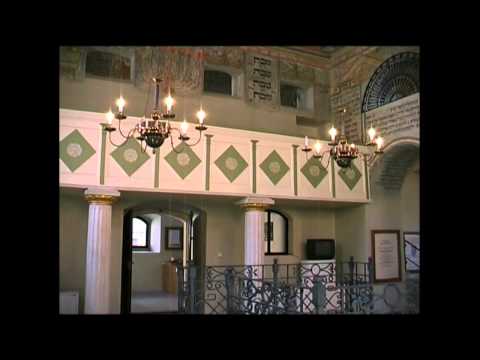
South of the square, at the foot of Castle Hill, a substantial Jewish quarter survives. The municipality dates the first reference to Jewish settlement to around 1343; the enclosed ghetto took shape only after 1727. Visitors can still identify the street pattern, a former gate, ritual bath, cemetery and the Maior Synagogue. The synagogue was built in 1639 by Silvestr Fiota of Chiavenna, and its interior retains wall paintings from the seventeenth and eighteenth centuries. After a long period of other uses, it was restored between 1989 and 2001 and is now operated by the Boskovice Regional Museum.
A walk here also carries a painful history. The municipal account records a fire in 1823 that destroyed much of the quarter. It also records the deportation of 458 Jews from Boskovice and its surroundings to concentration camps on 15 March 1942; only fourteen returned. These figures describe that group from the town and nearby area, not the entire population of Boskovice. The houses and cemetery deserve a thoughtful visit rather than serving simply as a backdrop for photographs. The municipality and museum provide visitor information and details of any guided tours.
Museum, walks and a longer stay
The Boskovice Regional Museum introduces the history of the town and its surroundings. The town's visitor guide mentions, among other displays, Minerva sewing machines and activities for children. A longer stay can combine the monuments with the Oborský, Hradní and Doubravský walking circuits listed by the municipality. Sportpark Boskovice and local trails offer mountain biking, while Červenka outdoor pool, the municipal baths and the ice rink add seasonal choices. Families may also consider the Western town attraction. Check current opening times and admission before setting out.
Accommodation is available in Boskovice itself. The municipal directory lists Hotel Slavia on Komenského Street, Hotel Pod Zámkem on Hradní Street, several guesthouses and a campsite near Červená zahrada. For food, its restaurant list includes Záložna on Masaryk Square, Eden on Svatopluka Čecha Street and Rabínův šenk on Plačkova Street. These are examples of places to investigate, not endorsements of their quality. Availability, prices and opening hours should be confirmed with each operator.
Getting to Boskovice
Rail is a practical starting point from Brno. The IDS JMK integrated transport system's S2 line runs to Skalice nad Svitavou, where the short S21 line connects to Boskovice; connecting buses are also available. Exact services depend on the day and engineering works, so check the timetable shortly before travelling. For visitors arriving from other countries, Brno is a useful interchange; the rest of the route depends on the starting point. Drivers can approach through Brno and the regional road network, but should check parking arrangements in the centre. A day is enough for a first look at the principal monuments; a two-night stay allows time for the museum and the countryside around town.
Sources
- City of Boskovice: town history
- City of Boskovice: town and visitor attractions
- City of Boskovice: castle and château
- City of Boskovice: Jewish quarter and Maior Synagogue
- Czech Statistical Office: municipal population at 31 December 2025
- City of Boskovice: accommodation and restaurants
- City of Boskovice: walking routes and IDS JMK: S21 railway timetable