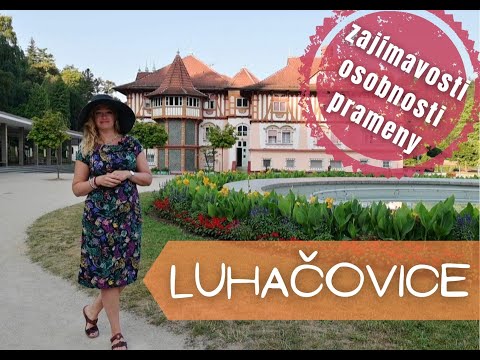
Luhačovice sits in the Šťávnice valley in the Zlín Region, among the hills of southern Moravia. Its springs, colonnade and parks form a spa quarter connected to an ordinary working town. According to the Czech Statistical Office, the municipality had 5,029 residents on 1 January 2025; that figure covers all its municipal parts, not just the spa centre. Visitors can explore several layers of history here: a medieval settlement, an aristocratic spa, early twentieth-century architecture and later public buildings.
From settlement to spa town
Archaeological finds at nearby Obora indicate Slavic occupation in the wider area in the seventh and eighth centuries. They do not prove that the present town has existed continuously since then. The municipal history says the borderland was not permanently inhabited for long stretches and gives 1412 as the first written record of Luhačovice itself. Its documented origin is medieval; the sources do not support a Roman or Greek foundation. Even the name has more than one suggested explanation, including a personal name, Luhač, and the local wet meadows.
Gabriel Serenyi acquired the estate in 1629. His family subsequently helped develop the mineral springs. The place had earlier depended on cattle raising and fruit growing as well as its surrounding land. A spring later named Amandka was improved under Count Ondřej Serenyi, while Vincentka recalls another member of the family. An inn with guest rooms opened near the waters in 1789. St Elizabeth's Chapel, completed in 1795, remains the oldest structure in the spa centre. By the mid nineteenth century, ten named spa houses provided 83 rooms. The growing resort then faced complaints about deteriorating facilities in the 1890s.
A joint-stock spa company formed in 1902, with physician František Veselý as its director. The railway from Újezdec u Luhačovic made arrival easier, and architect Dušan Jurkovič reshaped parts of the resort. Luhačovice was officially raised to town status on 3 July 1936. The Second World War interrupted its growth; the town's own history records the deportation of Jewish and Roma residents. After the war, a new colonnade and Vincentka hall added another architectural layer. It is useful to see these buildings in sequence rather than imagine that the whole resort was built at one time.
Springs, buildings and walks
Begin at the spa square with Jurkovič House. In 1902, the architect rebuilt the older Jan House, joining two structures into a colourful composition. Nearby Chaloupka and the Jestřabí villa also show his interpretation of regional architecture. The music pavilion and Sun Baths add to the ensemble. The city's architectural guide identifies a later phase in the White Quarter and other interwar buildings. Discussions of a potential UNESCO nomination should not be mistaken for an existing World Heritage inscription for these Luhačovice structures.
The colonnade leads to the Vincentka hall and spa park. Aloiska and Ottovka offer other stops on a longer walk, as does St Elizabeth's Chapel. Check local information for the current access and operating hours of springs and spa facilities. Above the town, the reservoir at Pozlovice was filled in 1928 and provides a different outing, particularly on foot or by bicycle. It lies outside the historic colonnade area and is best treated as an additional half-day excursion rather than another spring on the promenade.
Staying, eating and getting here
There are hotels, guesthouses, apartments and spa houses within Luhačovice, so an overnight visitor does not need to commute from Zlín. The municipal directory includes accommodation in the historic Jurkovič House and in Jestřabí. The local food guide lists Racek above the colonnade and Elektra in the town centre, alongside restaurants attached to hotels. Menus and opening hours can change seasonally; check them before travelling.
Zlín is the nearest larger city and Uherský Brod is another useful approach point. The municipality describes a road route from Brno on the D1 and through Uherské Hradiště and Uherský Brod. From Bratislava, the suggested route passes Trenčín and Starý Hrozenkov; from Ostrava it passes Valašské Meziříčí and Zlín. Luhačovice has its own train and bus stations. Rail travellers should check whether their service requires a change at Újezdec u Luhačovic, and verify current timetables. Staying for two days allows time for the architectural centre and a separate walk towards the reservoir.