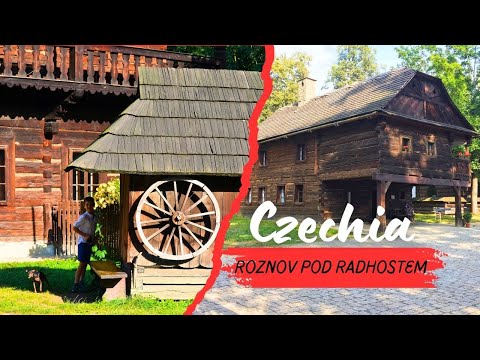
Rožnov pod Radhoštěm lies on the Rožnovská Bečva River between the Moravian-Silesian Beskids and the Vsetín Hills. Many visitors know it for the Wallachian Open Air Museum, but the town has its own long history, industrial heritage, square and routes into the mountains. Its municipal strategic plan gives an area of almost 40 square kilometres for the whole town, not just its walkable centre. Rožnov is a base for exploring Wallachia and for a separate excursion towards Mount Radhošť.
Medieval beginnings and local crafts
The first probable written mention of Rožnov dates from 1267. Municipal research attributes the foundation or enlargement of the settlement to Bishop Bruno of Schauenburg in the thirteenth century, while allowing for earlier inhabitants. A record of a medieval town is different from a precise date for the first people to enter the valley. There is no basis in these sources for calling Rožnov a Roman or Greek foundation. The castle on Hradisko protected the Moravian frontier in the Middle Ages. Its ruins above town recall the valley's strategic position, even though it is no longer a large intact castle.
The Žerotín family controlled the Rožnov estate from 1548 into the nineteenth century. The municipal strategic plan associates their period with economic growth. Records mention a paper mill by 1687 and a brewery by 1712. Weaving, glassmaking and later industries supported local livelihoods. In the early nineteenth century, Rožnov still consisted largely of timber buildings. It also had a period as a spa, but that activity declined in importance in the early twentieth century. After the Second World War, the Tesla factory and new housing estates changed the town substantially. Present-day Rožnov is therefore the result of a medieval settlement, craft town and industrial centre, not simply the setting for a museum.
Why the open air museum was created
Brothers Alois and Bohumír Jaroňek worked to preserve Wallachian timber architecture and customs. The museum first opened to the public in 1925. It now has three principal areas: the Wooden Town, the Wallachian Village and the Mill Valley. The first presents town buildings and public space, the second a more extensive rural setting with farm structures, and the third water-powered technology. The National Open Air Museum states that the collection includes both original buildings moved here and copies or reconstructions. Visitors should not assume that every structure has stood on its current plot for centuries.
The Mill Valley demonstrates a water mill, sawmill and fulling mill; it opened in 1983. Craft displays and cultural programmes take place across the museum, while access to individual areas varies by season. Allow more time than a quick stop if you want to understand the differences among its three parts. Afterwards, a walk can continue through the town park, Masaryk Square and towards the river.
Mountains, a place to stay and the route here
Mount Radhošť and Pustevny are well-known destinations in the surrounding Beskids, not streets within Rožnov. A mountain trip requires its own transport plan, appropriate clothing and a weather check. Closer to town are the Hradisko ruins and paths by the Rožnovská Bečva. The municipal visitor site lists other walking and cycling choices. In winter and during special events, paths and services may operate differently.
Visitors can stay within Rožnov itself. The official tourism portal lists Hotel Horal, Energetic, Villa Rosenaw, guesthouses and apartments near the museum. Its food guide includes Brasserie Avion, the Hotel Horal restaurant and the local brewery. Confirm opening hours and book when needed. Public transport commonly passes through Valašské Meziříčí, where onward services go to Rožnov. Drivers may also approach from Ostrava via Frenštát pod Radhoštěm or from Zlín via Valašské Meziříčí. Check the current connections, museum parking and any mountain transfers for the chosen day.