
Svedala is a practical, lived-in town on the agricultural plain south-east of Malmö. Its centre is compact enough to explore on foot, but its history is written across several scales: a medieval church site, a railway junction, brick workshops, a sugar factory and machinery-making. In Statistics Sweden’s 2023 data, the SCB-defined statistical built-up area (tätort) of Svedala had 13,433 registered residents on 31 December 2023. This is the population of that statistical area, not the entire municipality. The municipal story records layers of growth rather than a single founding date, so it is more accurate to follow those turning points than to assign the town an invented birthday.
From church village to rail junction
The earliest core lies around the church, where the municipality says a stone church stood in the thirteenth century. The town expanded dramatically with two railways: the Malmö–Ystad line opened in 1874, followed by the Lund–Trelleborg line in 1875. Their junction helped pull the centre toward the station and made it easier for agricultural produce, people and industrial goods to move. The change was not only transport infrastructure. It altered where shops and public life clustered, and it brought new industry into a place whose surrounding fields had long supported farming.
A working town in brick and machinery
Several strands of local work left a distinct built landscape. Åbjörn Andersson began the industrial concern in 1882 that the municipality identifies as the foundation of its largest industry. Svedala’s sugar factory followed in 1894 and operated until 1948, using the railway and water supply as advantages. Brickmaking added another layer: an experimental brickworks and a brickmasters’ school, active from 1904 to 1972, helped make brick a familiar material and skill. Today the centre still has turn-of-the-century brick houses, commercial fronts and patrician villas alongside workshops, station buildings and Folkets Hus. Storgatan and the squares Stortorget and Marknadstorget remain the everyday heart, with shops and places to eat. The town’s appeal is in this mixture, not in a preserved period set.
The church and a landmark mill
Svedala church was designed by C.G. Brunius and built in 1852 on the site of its medieval predecessor; the parish records its inauguration on 17 October that year. Its present profile is partly later: a taller tower was built in 1901–1902, and the apse gained Erik Lindholm’s fresco in 1965. Two panels from the medieval altarpiece survive in the porch, linking the present building to the earlier church. South of the centre, Aggarps kvarn stands in open fields as a reminder of the district’s grain economy. This Dutch-type windmill was completed in 1896 and worked until 1951. The adjacent miller’s home adds a domestic counterpart to the machinery. Visits are tied to scheduled heritage openings, not dependable daily access; check before making a special trip.
Green space, routes and day trips
For a pause inside town, Statsparken combines planted areas and a playground, while the outdoor bath and nearby event grounds make summer a busier season. The municipality’s 36-kilometre Kulturslingan heritage route links about ten historical points across the wider municipality, using country roads, cycleways and paths; Skåneleden also crosses the area. Consult the current route map rather than treating the full loop as an urban stroll. A wider excursion leads to Torup’s beech forest and castle estate, a large recreation area with walking and exercise trails; the estate is owned by Malmö municipality even though it lies within Svedala municipality. Pude bathing lake and Statarmuseet are other municipal day-trip options, each with its own access and seasonal schedule.
Getting around
Svedala station is centrally placed on the Pågatåg line between Malmö and Ystad/Simrishamn. Municipal information also lists buses toward Malmö, Lund, Trelleborg and Malmö Airport. This gives the town a useful base for exploring both the coast and inland Skåne, but planned works, connections and departures can change. Confirm times and tickets in Skånetrafiken’s journey planner. In the centre, allow time to move from the church to the station and along Storgatan, then extend the day by bike or on a mapped walking route. That short progression brings together Svedala’s strongest qualities: easy movement, visible industrial history and a close relationship with the farmland beyond its streets.
 Tre Svedalafilmer: centrum, stationen och SommarRock
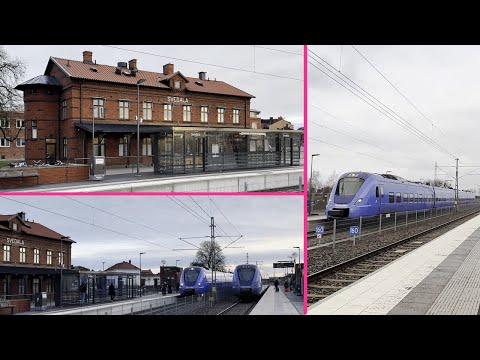 Mats Ormhed’s “Svedala station - december 2024” was published on 30 May 2025 and runs 11:44. Its description identifies the rebuilt station, trains and surrounding area, and says it reopened on 14 December 2024. Useful for understanding the transport hub, but not a source for today’s departure times.
 SommarRock Svedala’s official 2026 aftermovie was published on 3 September 2026 and runs 4:26. It is a short record of the festival edition named in the title; the source does not provide a detailed description. Use it as a dated cultural snapshot and check official pages for future dates, access and tickets.