St Kinga’s town, the Poor Clares and new walks among the trees
Stary Sącz lies in the Sącz Basin near the meeting of the Dunajec and Poprad rivers, in southern Małopolska. Its small old town combines the history of Duchess Kinga and the Poor Clares with museums, concerts and contemporary nature trails. Nearby Nowy Sącz is a separate, larger town and a useful transport hub, rather than another name for the same place.
| Municipality | Stary Sącz |
|---|---|
| Whole municipality population, GUS 30 June 2026 | 23,377 |
| Town population within urban boundaries, GUS 30 June 2026 | 8520 |
| Whole municipality area, GUS 1 January 2026 | 100.88 km² |
| Town area, GUS 1 January 2026 | 15.0 km² |
The whole-municipality figure includes other settlements; it is not the population of this individual town or village.
Kinga and a thirteenth-century town
The year 1257 is the first central date in the written history of Sącz. Duke Bolesław the Chaste granted the Sącz lands to his wife Kinga, a Hungarian princess. Earlier settlement in the valleys does not provide a precise town foundation year or establish an ancient urban origin.
Development was connected with the route towards Hungary and religious foundations. Kinga endowed the Poor Clares’ convent in 1280. After her husband’s death she settled in Stary Sącz, later entering the order herself; she died here in 1292.
Stary Sącz and Nowy Sącz distinguish two neighbouring centres with their own histories. The older town retained a strong connection with the convent and regional trade. It is not simply an old district absorbed into its larger neighbour.
The convent and Holy Trinity Church
The Poor Clares’ complex is the main historic focus. Gothic Holy Trinity Church contains later Baroque furnishings, the chapel associated with St Kinga and a distinctive pulpit depicting the Tree of Jesse.
This remains a religious community. Visitor access to the church does not mean unrestricted access throughout the enclosed convent. Relics and artworks should be viewed with respect for services and the community’s rules.
John III Sobieski visited Stary Sącz after the Vienna campaign in 1683. In 1999 John Paul II canonised Kinga at a gathering on the edge of town. Both events form part of its pilgrimage history, though separated by centuries and very different political circumstances.
The market, a destructive fire and the regional museum
The market and adjoining streets preserve the medieval urban plan, but the buildings contain later layers. A major fire in 1795 destroyed much of the town, including its town hall. Not every present frontage should be described as medieval.
The Seweryn Udziela Regional Museum at Rynek 6 occupies Dom na Dołkach. Exhibitions cover town history, archaeology, burgher and craft culture, and the singer Ada Sari. Another section explores the life and thought of the priest and philosopher Józef Tischner.
The museum also recalls Jewish residents, the ghetto established under German occupation and the Holocaust. This belongs to the town’s history alongside its religious foundations. In 2018 the old-town ensemble and Poor Clares’ convent became a national Historic Monument.
Music and the papal gathering site
The Ada Sari Centre of Culture and Art presents concerts, events and education. The early-music tradition and intimate scale of the town provide reasons to stay beyond a brief architectural walk.
Consult the programme for the intended dates. A festival mentioned in an archive guide is not a daily attraction, and galleries maintain their own opening days.
The Papal Altar and associated museum occupy a separate complex on Papieska Street. They record the gathering of 16 June 1999. Allow time to reach this site from the market rather than looking for it inside the convent.
Forest Pier, Bobrowisko and Orbisfera
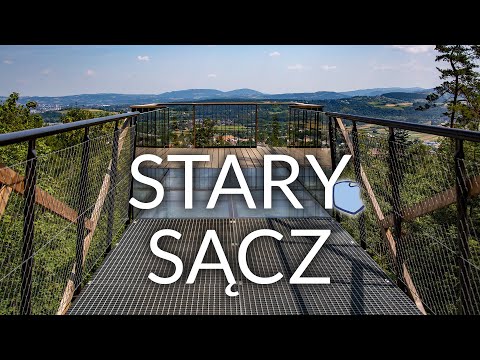
Miejska Góra extends a walk above the roofs. Leśne Molo, the Forest Pier, runs among the trees and offers views across the Sącz Basin. It is contemporary recreation infrastructure rather than the remains of a historic riverside pier.
Orbisfera opened on 10 June 2026 through cooperation between Stary Sącz and Levoča in Slovakia. Its circular elevated walkway and fifteen educational stations combine nature, play and physical activity. The municipality lists free admission and year-round access; current restrictions still apply during ice, maintenance or other adverse conditions.
Bobrowisko occupies lower ground around ponds and river-valley wetlands. Boardwalks and observation points provide opportunities to watch birds and the surrounding habitat, without guaranteeing that a beaver will appear at a particular time.
Wola Krogulecka, with its spiral viewing platform, is a separate village. Velo Dunajec and EuroVelo 11 also belong to a wider cycling network, not a single short circuit within the market.
Places to stay within and beyond town
Zajazd u Misia at Rynek 2 offers accommodation in the historic centre. Its own listing includes rooms for one to four people with private bathrooms, alongside a restaurant serving regional dishes. It is a local inn rather than a large chain hotel.
OPOKA pilgrim house at Papieska 10 provides hotel services, group accommodation and a restaurant beside the papal complex. This is a different part of town from the market frontage. Museum visits and recreational equipment hire can be combined with a stay according to the operator’s offer.
Accommodation in Barcice, Gołkowice or Skrudzina may suit a valley holiday or mountain walks, but those places are outside Stary Sącz itself. Check the actual address when a listing uses the wider municipality’s name.
Restaurants and everyday meals
Beyond the inn’s restaurant, the local directory lists Marysieńka at Rynek 12 and Pracownia Pieroga at Daszyńskiego 9. These provide specific possibilities for a meal within town without returning to Nowy Sącz.
Personall Kraft combines food with craft brewing. Restaurants around the Stawy bathing complex occupy another location, and parts of the waterside offer can be seasonal.
Szklarnia restaurant is at Gołkowice Dolne 257, outside the town. A place in the municipal directory does not put it beside the market. Confirm hours and kitchen availability, especially around holidays or larger events.
Employment, housing and current public works
Stary Sącz supplies administrative, commercial, educational and tourism services. The economic activity zone on Wielki Wygon lies within the town and brings together businesses in several sectors. Employment is therefore not limited to pilgrimage and summer visitors.
GUS records 8,520 residents within the town and 23,377 in the whole municipality on 30 June 2026. Figures from a municipal permanent-registration record may use a different method and date; they are not automatically the same population measure.
An old-town renewal project is scheduled to finish in October 2027. Planned work includes infrastructure and walking and cycling connections across the Moszczenica stream. Those plans should not all be treated as completed facilities. For a move, compare a specific property’s transport, services and planning provisions rather than relying on an unsupported average rent.
Arriving through Nowy Sącz and from the south
Nowy Sącz is the nearest larger service and transport centre. Stary Sącz has its own station on the Tarnów–Leluchów line; a journey from Kraków or Tarnów requires selecting the relevant service or interchange from the current timetable. MPK’s agglomeration network connects the area, with the appropriate stop depending on whether the destination is the market, station or OPOKA.
Drivers from Kraków can approach through the Nowy Sącz area. From Nowy Targ, regional road 969 follows the Dunajec valley. From Slovakia, the Poprad valley and Piwniczna area provide a natural southern approach; geographical proximity alone does not establish a direct bus service.
Separate a stroll around the relatively level market from an ascent of Miejska Góra. Map distance does not account for every climb, and a river-valley cycling trip requires different preparation from an indoor museum visit.
Sources and practical information
- Gmina Stary Sącz: historyczne etapy rozwoju
- Klasztor Klarysek: Kinga i fundacja konwentu
- Muzeum Regionalne im. Seweryna Udzieli: wystawy i dzieje miasta
- Gmina: kościoły i muzeum przy rynku
- Gmina: otwarcie Orbisfery w czerwcu 2026 roku
- Orbisfera: dostępność i stacje edukacyjne
- Informacja turystyczna: Leśne Molo, Bobrowisko i plan miasta
- Centrum Kultury i Sztuki im. Ady Sari: aktualny program
- Zajazd u Misia: restauracja i pokoje
- Centrum OPOKA: ołtarz papieski, muzeum, noclegi i restauracja
- Gmina: restauracje i ich rzeczywiste lokalizacje
- Gmina: strefa gospodarcza przy Wielkim Wygonie
- Gmina: zakres prac planowanych do 2027 roku
- MPK Nowy Sącz: komunikacja aglomeracyjna
- PKP PLK: rozkład pociągów do Starego Sącza
- GUS: ludność według gmin, tablica 11, stan na 30 czerwca 2026
- GUS: powierzchnia gmin i miast, tablice 19–20, stan na 1 stycznia 2026