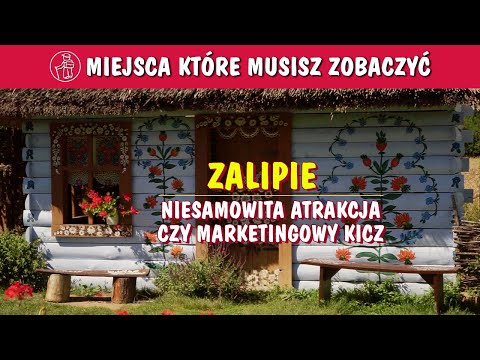
painted farmsteads, living folk art and a village in rural Małopolska
Zalipie is a village in Olesno municipality, Dąbrowa county, Małopolskie. Hand-painted flowers decorate houses, wells, farm buildings and everyday objects. The settlement is dispersed, and residents continue their daily lives between the places open to visitors. A rewarding visit combines three different experiences: a historic museum farmstead, creative work at the House of Painters and a walk along the village’s public roads.
| Municipality | Olesno |
|---|---|
| Whole municipality population, GUS BDL 2025 | 7,595 |
The whole-municipality figure includes other settlements; it is not the population of this individual town or village.
A settlement older than its painted reputation
Municipal records identify 1674 as the first written reference to Zalipie. This establishes its existence in the early modern period; it is not proof that the village was founded in that exact year. Its name is associated with lime trees. There is no basis for giving the present settlement a Roman or Celtic foundation.
The municipality’s archived village description gives the sołectwo an area of 805 hectares, equivalent to 8.05 square kilometres. That helps explain why the decorated houses are not all clustered around one square. The current population in the table covers the entire municipality of Olesno, rather than Zalipie alone.
The village belongs to the Powiśle Dąbrowskie countryside. Its art developed within households and farms before becoming a visitor attraction. Understanding that sequence matters: the settlement was not created as a stage set for tourists.
How the floral tradition developed
Decoration grew from efforts to brighten smoke-darkened interiors with whitewash. Simple marks gradually developed into more elaborate flowers on walls, stoves and paper hangings. The museum places the emergence of the familiar tradition especially in the late nineteenth century.
Materials and domestic life changed over time. Earlier pigments differed from modern paints, and decorations needed regular renewal. There was no single compulsory stencil. Bouquet arrangements, colours and flower shapes allowed individual painters to develop recognisable styles.
Władysław Hickel described this work in the journal Lud in 1905. Researchers helped bring it to wider attention, but local women sustained the practice. Related decoration also existed in surrounding villages, so the regional tradition should not be reduced to Zalipie’s administrative boundary.
Felicja Curyłowa’s farmstead
The museum at Zalipie 135 is a branch of the Museum of the Tarnów Region. Preserved rooms present Curyłowa’s work within the setting of her household, furniture and domestic routines, rather than as paintings detached from their original surroundings.
Decorated ceilings, the stove, paper ornaments and ordinary objects demonstrate how extensive that transformation could be. The cottage of Stefania Łączyńska introduces another leading painter. Comparing them reveals individual invention within a shared local tradition.
The museum charges admission and follows seasonal hours. November falls under its winter timetable, with Monday closure. Groups must also observe limits on simultaneous admission. These arrangements concern the museum itself, independently of a walk on public roads through the village.
The House of Painters
Dom Malarek, the House of Painters, is at Zalipie 128A. It serves as a cultural and creative centre. The idea of a shared place for meeting and passing on skills was closely associated with Curyłowa’s activity, and its present work keeps the tradition in practice.
Group workshops include painting on paper, ceramics and wood, alongside traditional tools and seasonal ornaments. Arrange participation with the organisers; arriving in the village does not automatically secure a workshop at any chosen time.
The House of Painters has its own calendar. From October to April it lists Monday–Friday opening, 8am–4pm. This differs from the museum farmstead’s timetable. In winter, planning the sequence of visits is particularly useful if both places are priorities.
The painted-house competition and parish church
The first regional decorative-art competition took place in 1948. Later editions of Malowana Chata helped preserve and develop painting in Zalipie and neighbouring villages. Its festivities follow an annual programme rather than operating as a permanent daily attraction.
St Joseph’s Church was consecrated in 1949. In 1966 local painters led by Curyłowa executed floral compositions designed by Józef Szuszkiewicz. Subsequent renewal and new designs demonstrate that the decoration is a continuing activity.
In early 2024 existing paintings were restored and new work added to the ceiling and side walls of the chancel. St Blaise’s Chapel also displays floral embroidery on liturgical vestments. This is the residents’ functioning parish church, so interior visits must fit around worship.
Walking and cycling through the countryside
Decorated farmsteads occur in different parts of the settlement. A locally obtained map helps distinguish places welcoming visitors from ordinary private homes. Flowers on a façade are not permission to enter a garden or house.
A bicycle can connect scattered stops with the surrounding agricultural landscape. The regional tourism portal also describes a larger route from Tarnów through the Dunajec valley and Powiśle Dąbrowskie, passing Zalipie. That is a countryside excursion, not a short circuit between the museum and House of Painters.
Dąbrowa Tarnowska and Tarnów add services and further heritage for another day. Combining these places creates a more varied stay than concentrating entirely on photographs of the best-known cottages.
A village stay or a hotel outside it
Gościna u Babci offers accommodation in Zalipie itself. The owners describe a separate flower-decorated house for up to five guests, with two rooms, bathrooms and basic kitchen facilities. Their current website gives Zalipie 165; an older tourist directory uses number 8. Follow the owners’ current details when arranging arrival.
The Tarnów Tourist Information listing also describes meals that can be ordered from the hosts. This is prearranged catering, rather than a public restaurant where an unannounced visitor can assume service.
For conventional hotel facilities, Cristal Park at Sportowa 2A in Dąbrowa Tarnowska is an option outside Zalipie. Its Powiśle restaurant provides an alternative for dining. Include the journey between the hotel and village, especially after workshops or an evening meal.
Approaching from Tarnów and Kraków
The museum places Zalipie approximately 35 kilometres north of Tarnów. From Kraków, a road approach uses the A4 towards Tarnów and then regional roads towards Żabno and Borusowa, followed by the local approach to the village.
Rail services to Tarnów provide an arrival stage from Kraków and other large cities, but do not deliver visitors to the farmstead. The museum identifies Euro Pławecki Trans minibuses from Krakowska–Planty on the Tarnów–Gręboszów–Bieniaszowice route. Approximately one and a half kilometres of walking remain from the stop. Check both outward and return departures in advance.
For a potential resident, the whole connection matters more than the train journey to Tarnów alone. Zalipie offers a rural setting and an active artistic tradition; a wider choice of jobs, shopping and services requires considering the surrounding towns as well.
Sources and practical information
- Gmina Olesno: pierwsza wzmianka i powierzchnia sołectwa
- Gmina Olesno: historia miejscowości
- Dom Malarek: tradycja malowania i jej twórczynie
- Dom Malarek: aktualne warsztaty i godziny sezonowe
- Dom Malarek: konkurs Malowana Chata
- Muzeum Ziemi Tarnowskiej: Zagroda Felicji Curyłowej
- Muzeum: historyczne wnętrza i chata Stefanii Łączyńskiej
- Kościół św. Józefa: dekoracja i odnowienie w 2024 roku
- Gościna u Babci: aktualny adres i zakwaterowanie
- Tarnowskie Centrum Informacji: posiłki na zamówienie
- Cristal Park w Dąbrowie Tarnowskiej: hotel i Restauracja Powiśle
- Muzeum: dojazd z Tarnowa i odległość od przystanku
- Tarnowskie Centrum Informacji: dojazd z Krakowa
- VisitMałopolska: trasa rowerowa przez Powiśle Dąbrowskie
- GUS Bank Danych Lokalnych: ludność gminy, dane roczne 2025