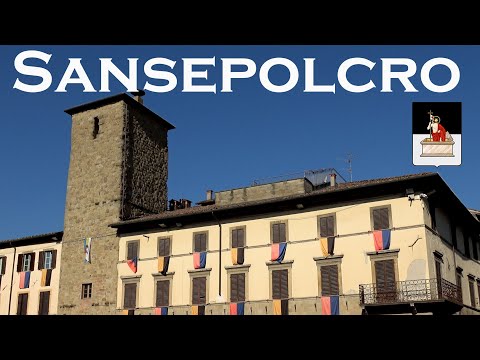
Piero della Francesca, the crossbow Palio and an art town in the Upper Tiber valley
Sansepolcro stands in the Tuscan Upper Tiber valley close to Umbria. Piero della Francesca has made it an international painting destination, while museums devoted to plants, historic palaces, square-based traditions and a theatre season give a stay more variety. The compact centre is rewarding on foot, and the valley setting allows outings across regional boundaries.
| Municipal population at 1 January 2026 (estimate) | 15,192 |
|---|---|
| Municipal area at 1 January 2025 | ≈ 91.19 km² |
ISTAT population estimate at 1 January 2026, aligned with the provisional 2025 demographic balance. Area at 1 January 2025, from the classification updated in February 2026. Both figures cover the whole municipality, including outlying settlements, rather than only the historic centre.
A monastery documented in 1012
The earliest documentary reference to the monastery dates from 1012, followed by papal and imperial privileges in 1013. The account of pilgrims Egidio and Arcano returning from the Holy Land with relics belongs to foundation tradition. Borgo Sansepolcro grew around the religious complex, with a market recorded from 1038.
After medieval struggles between competing authorities, the town entered the Florentine sphere in 1441. It became a city and bishopric in 1520. These stages explain a development from monastic settlement to a centre of trade, artistic patronage and institutions, rather than an unchanged Roman town beneath a later name.
Piero in the civic museum
The Resurrection and the Polyptych of the Misericordia anchor a visit to the Museo Civico. Their setting in a building connected with civic government gives painting and place a particularly close relationship. The collection is part of the town’s own history of commissions and preservation.
Public patronage, acquisitions and transfers from churches contributed to its formation. The polyptych entered the picture gallery in 1901, while the museum expanded during the twentieth century. Leave time for other rooms as well as the celebrated works. They help explain how a community accumulated and cared for an artistic inheritance across several periods.
The co-cathedral and the inhabited centre
San Giovanni Evangelista developed from the abbey church and underwent repeated enlargement and alteration. It contains the Volto Santo and recalls Piero, who was buried here in 1492. Twentieth-century restoration also contributed to its present appearance; every visible surface does not belong to the earliest medieval phase.
Nearby streets connect palaces including the Laudi and Aggiunti buildings, former tower houses and other churches. Walls and sixteenth-century defences recall a border town. Moving between lanes, squares and museums gives a fuller experience of an inhabited centre than treating the streets only as an approach to one masterpiece.
Plants, books and Aboca Museum
At Palazzo Bourbon del Monte, Aboca Museum displays herbals, mortars, ceramics, scales and historic pharmacy spaces. Objects and books introduce the changing relationship between people and plants. It is a historical and cultural visit rather than individual medical advice.
Aboca Experience presents cultivation, laboratories and the company’s contemporary activities. The De Divina Proportione route introduces Luca Pacioli and Renaissance connections between mathematics and nature. Together these experiences show a local relationship between production, research and public interpretation, offering a subject distinct from the civic museum’s paintings.
The Palio and the present cultural calendar
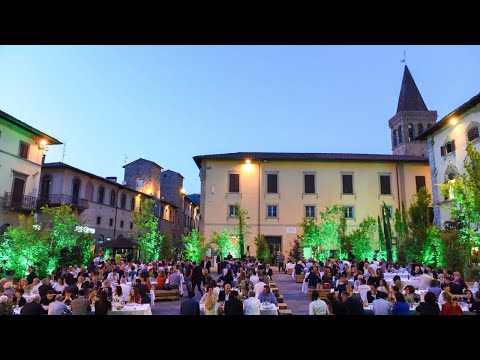
The crossbow Palio renews a rivalry with Gubbio, involving Piazza Torre di Berta, processions and flag performers. The September 2026 festivities brought together several events. Photographs and earlier films introduce the tradition, while the programme for a chosen year establishes what visitors can actually attend.
Cultural life continues outside the Palio season. The municipality announced the opening of Teatro Dante’s 2026–27 season for 2 December 2026. Checking the programme can add an evening performance to a winter stay built around museums and restaurants. Do not carry one edition’s event dates forward automatically to another year.
Crops and the wider valley
Woad, used to produce blue dye, was an economic resource from medieval into Renaissance times. Tobacco later became a notable feature of the valley landscape. Activities connected with medicinal plants now provide another link between farming, processing and knowledge.
Montecasale hermitage lies about six kilometres away according to regional destination information, offering an outing into Franciscan country. Anghiari and Città di Castello extend the trip; the latter is already in Umbria. Treat these excursions separately from the town walk, arranging roads, onward transport and access to the particular sites before combining them in a day.
Eating and sleeping within Sansepolcro
Ristorante Fiorentino stands in Via Luca Pacioli near the museum. Its offering includes handmade pasta, local traditional preparations and house-made desserts. Historic dining rooms provide a way to combine cooking with architecture. Locanda del Giglio has rooms above the restaurant’s halls.
Borgo Palace on Via Senese Aretina offers another hotel option near the E45, with a restaurant and conference facilities. Staying in the old centre or on its edge changes parking, access and evening journeys. Confirm room availability and specific services directly, particularly when a meal or accessibility requirement is essential to the planned stay.
Exploring the possibility of living here
Sansepolcro provides an urban service role for the Upper Tiber valley, with shops and productive activities alongside hospitality. Museums and theatre are only part of everyday life. Ordinary weekdays help reveal services and journeys at the hours when they would actually be needed.
Compare addresses in the centre, outer neighbourhoods and countryside before considering a move. Map distance alone does not describe a working day. Investigate available homes and the connections serving the chosen settlement. Hotel and inn rates are useful for planning an exploratory trip, but they are not a measure of average residential rent.
Connections through Arezzo and Perugia
The E45 is the principal valley road, while the Arezzo connection provides access to the A1. Municipal information places Arezzo station about 37 kilometres away, with onward buses operated by Autolinee Toscane or Baschetti. Check the actual travel date and allow for the transfer after leaving the train.
Perugia is listed roughly 70 kilometres away and Città di Castello about 15–18 kilometres, depending on the route. Rome and Florence offer other road and rail gateways. Compare complete itineraries, including the final stop and arrival at accommodation, rather than assessing only the main train journey.
Sources
- Diocesi: documenti del monastero e storia della concattedrale
- Comune: vicende politiche, centro storico e tradizioni
- Museo Civico: formazione delle collezioni e opere di Piero
- Regione Toscana: monumenti, paesaggio e Montecasale
- Aboca Museum: strumenti, erbari e storia
- Aboca Museum: produzione e ricerca contemporanee
- Aboca Museum: Pacioli, guado e colture del territorio
- Comune: Feste del Palio 2026
- Comune: stagione teatrale 2026–27
- Ristorante Fiorentino: cucina e sede storica
- Locanda del Giglio: camere nel centro
- Borgo Palace: hotel, ristorante e ubicazione
- Comune: collegamenti e distanze
- Aboca Museum: indirizzo, apertura e collegamenti
- ISTAT: resident population estimate, 2026
- ISTAT: classifications and municipal area