Citerna sits on a ridge above the Upper Tiber Valley, close to the border between Umbria and Tuscany. Its streets look outward across cultivated hills and the valley floor, but the most distinctive part of the village is below them: vaulted rooms, passages and water cisterns formed a second layer beneath the medieval settlement. Istat estimated 3,383 residents for the whole municipality on 1 January 2026. That total includes the outlying settlements, especially Pistrino, as well as the hilltop centre. Italian is the official and predominant written language of the municipality and local visitor services, so it is also the local edition of this guide.
A borderland, not a foundation legend
Regional tourism sources describe Citerna’s beginnings in the Umbrian-Etruscan world, but they do not establish a precise founding date. The town’s more securely traceable story is medieval: in 1221 it submitted to Città di Castello, seeking protection from neighbouring communes, and remained connected to that city’s political fortunes until it entered the Papal States in 1463. A brief period of municipal independence is recorded for 1231–32. The border setting was more than a line on a modern map. Fighille, one of the municipality’s settlements, occupied a historic customs position between Tuscan and papal territory, while Citerna’s hill controlled a route across the Upper Tiber landscape.
The town’s walls and gates preserve that defensive character. Citerna Turismo dates the earliest enclosure to the eleventh century, with extensions in the late twelfth and early thirteenth centuries. The southern Porta Romana and northern Porta Fiorentina still help explain how visitors enter the old settlement. Later noble families reshaped the centre, but the defensive line remains part of everyday orientation rather than an isolated ruin. From Piazza Scipione Scipioni, a panoramic terrace opens over the valley; the civic tower nearby contains a mechanical wooden clock dating to the fifteenth century, a small piece of working civic history that is easy to miss if one only follows the main viewpoint.
The walkway and the spaces beneath the streets
A narrow arch near Palazzo Prosperi-Vitelli leads to the medieval walkway along the inside of the walls. Its arched openings and timber beams create a sequence of loggias, alternating enclosed passage with open views. The route gives a practical reading of the settlement: the wall was both defence and edge, while the covered path allowed movement along that edge. Near the walkway, the Pozzo Vecchio stands above the Grande Cisterna.
Below ground, the spaces known locally as the ammassi make Citerna unusual. The visitor information describes rooms and passages on a lower level, including a cistern that collected rainwater from house roofs. In a hilltop town, storing water was a matter of resilience, not picturesque folklore. The name “Citerna” is sometimes connected to these cisterns, but the regional tourism account presents that derivation as a proposal by some authors, not a settled fact. Treat it as an interesting hypothesis rather than a proven origin of the place-name. Access to parts of the underground level is arranged through visitor services; confirm what is open before planning a visit.
San Francesco and a carefully qualified Donatello
The Church-Museum of San Francesco combines a religious building with a concentrated collection of Umbrian art. The church and Franciscan convent were built within the walls between the fifteenth and sixteenth centuries. Inside, the regional visitor information lists works associated with Raffaellino del Colle, Niccolò Circignani, known as Pomarancio, and other artists. Frescoes and altarpieces reward a closer look than a brief stop at the doorway.
The best-known work is the polychrome terracotta Madonna and Child in the sacristy. It was found in the church in 2004 during research on Renaissance terracottas and, after restoration at Florence’s Opificio delle Pietre Dure, was attributed in 2010 to Donatello’s youthful period. The attribution is the scholarly conclusion presented by the local museum information, not a reason to erase the history of study behind it. Restoring the sculpture also revealed layers of later repainting and brought its original colours back into view. The sacristy is accessed through the municipal information point; the church is generally visitable at set weekend and holiday times, while weekday visits require arrangements. Check the current procedure and book ahead.
More than the hilltop centre
Citerna’s municipality includes places with their own stories. Pistrino, the largest outlying settlement according to local tourism information, has the Church of Santa Maria Assunta, whose origins are placed in the twelfth century and whose interior preserves a series of frescoes. Fighille was known as a medieval ceramics-production centre; today it also has a contemporary-art identity. Its Piccolo Museo grew from the FighilleArte painting competition and displays a changing collection of donated and award-winning works. The local museum describes more than 250 works by over 140 artists and says it can be visited by reservation, so contact the organisers rather than assuming walk-in access.
These settlements make a longer visit worthwhile. The hilltop centre is best explored on foot, while Pistrino, Fighille, the former monastery of SS. Crocifisso at Cerecchio and other rural churches are easier to combine by car or on a planned walking route. The landscape is not merely scenery: the valley, small villages and hill roads link the municipality to Città di Castello and Sansepolcro. The Upper Tiber’s food culture includes truffles, Chianina beef, pork products and Vin Santo, as noted by regional and chamber-of-commerce visitor material. These are regional products and traditions, not a claim that every item is produced within Citerna itself.
A pilgrimage route and a local tradition
Citerna is a stage on the Via di Francesco. The official route portal describes the walk from Sansepolcro as 11.66 kilometres, with a climb of about 230 metres, mixed paved and unpaved surfaces, and a published walking time of roughly three and a half hours. The onward stage from Citerna to Città di Castello is about 19.9 kilometres, with substantial ascent and descent. These are route-planning figures, not promises about an individual walker’s time; check current trail markings, weather and water availability. The hilltop’s visitor office can provide the pilgrim credential and local guidance.
A local Franciscan tradition says that in 1214 Saint Francis preached outside the settlement and commanded ants on an oak tree to move so they would not disturb him. The story belongs to devotional memory and is not independently documented as a verifiable event. It can be told as a legend because it reveals how local religious identity has been attached to the landscape; it should not be presented as established biography. Nearby sites linked to that tradition, including the Fonte Degna and the former convent at Montesanto, can be visited as part of a broader walking itinerary where access permits.
Getting there and making the visit work
By car, the Citerna visitor service recommends leaving the E45 at San Giustino and following signs uphill. From Arezzo, its directions lead through Monterchi before the final turn toward the village. The historic centre is restricted to resident vehicles; public parking is available outside the walls. A separate motorhome area about 500 metres from the village is described as having loading and unloading facilities, a bar and toilets. Check current local parking and access arrangements before arrival.
Busitalia’s E389 connects Città di Castello with Pistrino, Citerna, Le Ville and Lippiano; it offers a public-transport approach from the valley, but services and school-day patterns change, so consult the operator’s current timetable. The nearest rail journey needs an onward bus or road transfer; do not assume that a train station is within the hilltop village. The municipal information point on Corso Garibaldi can help arrange visits to the Church-Museum and the Madonna. Nearby Sansepolcro and Città di Castello make natural extensions, while Monterchi adds another small town on the Tuscan side of the valley.
Allow several hours for the wall walk, viewpoint, church and underground spaces, and longer if you plan to see Pistrino or Fighille. Paths and historic interiors can include steps, uneven paving and narrow passages; ask the visitor office about accessibility before setting out. Citerna’s strongest experience is the way its layers meet: a borderland settlement, a medieval ring of walls, a water system hidden beneath houses, and a museum where an important attribution remains visible as the result of research and restoration.
 Citerna in three perspectives: medieval lanes, the hidden underground and the Tiber Valley
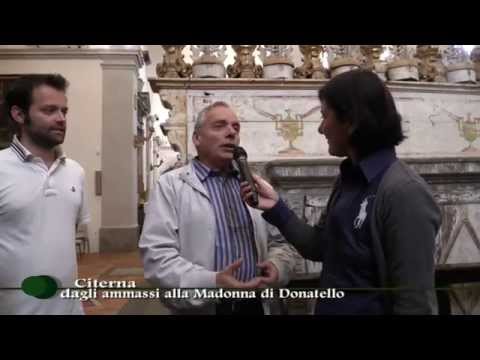 This local television report takes viewers inside the ammassi and then to the polychrome Madonna and Child in the Church-Museum of San Francesco. Its value is its close, place-specific focus: it connects a hidden part of Citerna’s built fabric with the artwork that made the village widely known beyond the Upper Tiber Valley. The report was published in 2014, after the sculpture’s restoration and attribution to Donatello’s youthful period. It offers historical context from that moment; current access to the sacristy and the status of the attribution should be checked with the museum and specialist sources.
 Tipicamente Umbria’s “Ritratti di Storia” broadens the view from Citerna to the Upper Tiber Valley, following a route through several towns and landscapes rather than presenting a detailed village tour. It helps prospective visitors understand why Citerna belongs in a wider itinerary linking hilltop settlements, river valley and historic routes. The film is best used as regional context; it cannot replace the local wall walk, museum visit or route information for the Via di Francesco. Its exact YouTube upload date was not independently confirmed, so no date is given.