Moustey is a dispersed village in the Landes, in the pine country of south-western France. Its centre is modest, but a short visit brings together several layers of the region: sandy-soil building stone, a landscape once organized around open farmsteads, the long-distance route to Santiago de Compostela, and the wooded valley where the Petite and Grande Leyre meet. INSEE records 798 municipal residents for the whole commune in the 2023 reference year; that figure includes Biganon, a separate settlement attached to Moustey in 1965, and should not be read as the population of the centre alone.
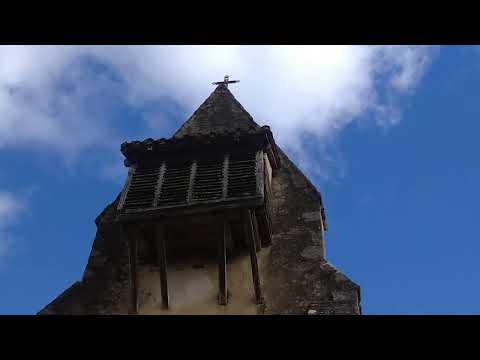
The parish centre has an unusual visual signature: Saint-Martin and Notre-Dame stand only a few metres apart. The municipality dates Saint-Martin to the 12th century and describes its later flamboyant-Gothic character and a carved wooden doorway. Notre-Dame, built in the local iron-rich stone called garluche, has a bell-gable and painted decoration in its choir; the paintings were uncovered in 1985 and restored in 1989. The municipal heritage account describes Notre-Dame as a former place for exhibitions, while the regional inventory records its use as a museum devoted to religious heritage and popular belief. Visitors should check current access rather than assume that either interior is open.
Why are the two churches so close? Moustey’s own historical page offers competing explanations. Local tradition links them to rivalry between neighbouring lords; a more cautious hypothesis is that one served as the parish church and the later Notre-Dame as a chapel connected with a pilgrim hospice. The town presents both as interpretations, not settled proof. The route itself is more tangible: Moustey lies on the Way of Tours, and a marker beside Notre-Dame gives the remaining distance to Compostela as 1,000 kilometres, a symbolic milestone for walkers. Nearby Biganon, six kilometres from the centre, adds a third church. Saint-Pierre-ès-Liens is an 11th-century Romanesque building; the Ministry of Culture lists the church and the adjacent Sainte-Ruffine fountain as a protected historic ensemble. Medieval wall paintings survive inside. The fountain’s reputed healing powers belong to local devotional tradition, not modern medical advice.
The setting explains the village’s other story. Before the large-scale planting of maritime pine, the municipal history describes an agro-pastoral landscape of open airials, livestock and small plots. The 1857 law accelerated conversion of the Landes heath into planted forest; resin and timber later became important to the wider Haute-Lande economy. Today the commune remains rural, with local shops and services alongside work in construction, retail, accommodation, food service and professional activities. INSEE counted 66 active non-agricultural commercial establishments in 2023; this is a dated business count, not a complete portrait of household work. The town lists a primary school, mairie, bakery and a village shop that also hosts a postal agency. Confirm opening hours and services directly before relying on them.
For a short outing, the departmental tourism office describes the Confluence des deux Leyre walk: an easy, one-kilometre trail of about 20 minutes from Moustey to the meeting of the Petite and Grande Leyre. The riverside landscape changes from pine plantation to a greener gallery of waterside trees. The broader Leyre is also a canoe route, but current water levels, access rules, weather and fire restrictions matter; use the latest local guidance before launching. Roads connect Moustey with Pissos and nearby Landes villages. Public transport and onward connections should be checked for the intended date, as rural schedules and opening times can change.