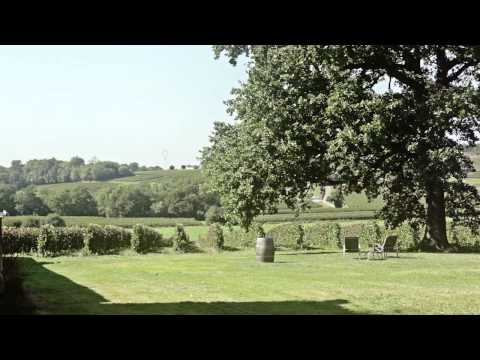
Villegouge sits in the heart of the Fronsadais, in Gironde, Nouvelle-Aquitaine. The commune is not only a collection of wine estates: the town hall describes a settled village centre surrounded by vineyards, while its planning report identifies the meeting of built-up streets and vines as a defining local landscape. INSEE counted 1,325 municipal residents across the whole commune in 2023, at 95.7 inhabitants per square kilometre. The municipal website gives indicative journeys of under ten minutes to Libourne and Saint-André-de-Cubzac and about twenty-five minutes to Bordeaux by the A10 or A89; traffic and route choice can change those estimates.
+Wine country with working farms
+Viticulture is the most visible visitor-facing activity in the sources checked. The municipality lists Château Boutinet, Château Castagnac and Tour de Bellegarde among local wine addresses, and advertises visits or tastings at Boutinet and Castagnac. The Fronsadais tourism office describes the region as a vineyard landscape, but a tasting is an appointment to arrange rather than an assumed walk-in service. INSEE’s end-2024 count identifies 29 employer establishments in the commune: 13.8% are in agriculture, forestry or fishing, 44.8% in commerce, transport and services, and 20.7% in construction. Those are shares of employer establishments, not shares of jobs or wine output; they show a small local economy that includes more than vineyards.
+What the records say about the past
+The Fronsadais tourism office reports that remains of a Neolithic camp were found on the Tertre de Thouil, including hut locations, food debris and pottery. It also points to Gallo-Roman finds around Meyney and Canet, and says medieval documents suggest the village suffered during the Hundred Years’ War. These are useful local leads, not a complete archaeological chronology. No foundation legend is established by the sources consulted, so the account stays with the claims they actually make.
+Saint-Pierre is Villegouge’s central historic landmark. The Ministry of Culture’s Mérimée notice dates the main building campaign and its Romanesque portal to the thirteenth century and records the portal’s partial protection on 1 December 1908. The local tourism office describes the church as built over a broader span from the eleventh to nineteenth centuries. Read together, the sources point to successive building and restoration phases rather than a single uncontested date. A municipal planning inventory also identifies the Tertre de Thouil as a limestone slope with juniper scrub and orchid-rich dry grassland; it is a protected ecological interest area, not a promise that flowers will be visible on every visit.
+Paths, caves and useful services
+The Fronsadais Tourist Office’s 2025–2026 guide lists the Boucle de Queynac from Villegouge at 15.53 km, with a walking estimate of four hours. Check the current map, access permissions, waymarking and ground conditions before setting out. Underground quarries are part of the wider Natura 2000 network and provide important bat habitat; the municipal plan also warns of localized ground movement above abandoned workings. They are not visitor caves to enter without authorization. In the village, the mairie publishes its reception hours and the public library sits beneath it at 3 Place du Général-de-Gaulle. Hours, winery appointments and route conditions can change, so confirm them before travelling.
+