Grottammare makes more sense when you see its two centres together. The medieval Borgo Alto climbs above the Adriatic; below it, a coastal town expanded from the eighteenth century and became a bathing destination after the railway arrived. Between the two are gardens, villas, civic museums and a long seafront. The municipality reported 15,970 residents at the end of 2024, a figure for the whole commune rather than only the old village. Grottammare also sits on the 43rd parallel, a marker the town uses as a point of orientation along its coast. It is a year-round community with a summer visitor economy, not simply a beach resort that closes when the season ends.
Read the town from hill to shore
Begin in the Borgo Alto, where the steep lanes lead to Piazza Peretti. Brick façades, stone paving, arches and loggias frame a view toward the lower town and sea. The square is not an isolated scenic set: the old town hall, civic tower, Church of San Giovanni Battista and Teatro dell’Arancio meet around it. The theatre was built in the final decade of the eighteenth century by Pietro Maggi. Its brick front, civic tower and loggia belong to a period when the square was both a place of government and a social centre. The statue of Felice Peretti, later Pope Sixtus V, stands on the façade; the clock in the tower was donated by Pius IX in 1857.
Grottammare’s museums add several different perspectives. The Sistine Museum in San Giovanni Battista gathers objects associated with Sixtus V and the Peretti family. The Torrione della Battaglia, beside the old defensive line, houses works and studies linked to sculptor Pericle Fazzini, including a model for the monumental Resurrection in the Vatican. The civic system also includes Il Tarpato, devoted to the naïve painter Giacomo Pomili, and the Contemporary Illustration Museum, or MIC. The MIC is at Palazzo Kursaal by the waterfront; its collection places Italian illustration from the early twentieth century beside later and local artists. Some spaces open with events or by request, so check the current museum schedule before making a special trip.
Ancient traces, medieval walls and a national encounter
The municipality’s own historical account is careful enough to describe more than one proposed origin for the settlement. One interpretation links archaeological remains near the Church of San Martino to a sanctuary of Cupra; a marble inscription there records a rebuilding of the temple under Hadrian in the second century CE. Another hypothesis places an ancient pagus, called Pater-Janus in local accounts, on Colle delle Quaglie. These clues do not establish a single, certain founding point for today’s town, and they should not be turned into a simple claim that Grottammare was founded by one ancient people. The clearest visible historic form is medieval: the high castle of Grupte, settlement on the slope below it and, later, the surviving fortified village.
The coastal position brought both trade and danger. The town was associated with Farfa Abbey in the Middle Ages, passed under Fermo’s control in 1259, and had a harbour that eventually silted up and disappeared. After a pirate incursion and occupation in 1525, Grottammare strengthened its gates and walls and built the Torrione della Battaglia. Felice Peretti was born here in 1521 and became Pope Sixtus V; his connection remains present in the old square, the museums and the town’s public memory. Another important date is 12 October 1860, when Victor Emmanuel II received a Neapolitan delegation at Palazzo Laureati. The coast was joined to the Adriatic railway in 1863, accelerating the shift toward seaside holidays.
A resort town built in layers
The seafront tells the later story. A bathing establishment opened in 1873, the same year that marks the beginning of the Kursaal’s history as a seaside structure. It later became a celebrated dance hall in the 1950s and 1960s and now houses exhibition and cultural spaces, including the MIC. The coastal expansion followed an urban plan approved under Pius VI in 1779 and designed by Pietro Augustoni. In the late nineteenth and early twentieth centuries, holiday villas grew along Viale Marino, now Viale Colombo; some retain the Liberty and neoclassical details that distinguish this stretch from the newer residential areas.
The beach itself changes along the municipality’s roughly seven kilometres of coast. The local shoreline plan distinguishes broad sandy areas, shingle near the Tesino mouth and a rocky stretch where the cycle path runs beside the sea and railway. Seasonal facilities add bathing services, boat and board rentals, SUP and other activities. In summer 2026 the municipality also planned free beach-sport areas and an information point at the Kursaal beach. Its tourist information page lists a high-accessibility free beach and sea-going chairs available by reservation; confirm the service and opening dates for the season you plan to visit. Grottammare’s coast is therefore useful for more than a day under an umbrella: walking, cycling and water activities can be combined with the old village and museums.
Food, services and a wider coastal itinerary
Tourism and hospitality have become a visible part of local life, especially in summer, while the lower town remains the everyday centre for shops, transport and municipal services. The old borgo has restaurants and evening activity, and the town’s official pages list places to eat, bike hire, a library, local information points and seasonal medical assistance. These services are spread across different parts of town. The summer tourist shuttle, when operating, connects the shore with the old settlement; check its seasonal timetable instead of assuming it runs all year.
Grottammare works well as a base for a short section of the Adriatic coast. San Benedetto del Tronto borders it to the south; Cupra Marittima is the neighbouring coastal town to the north. The regional tourism portal describes a roughly twenty-kilometre coastal cycling route linking the San Benedetto–Porto d’Ascoli area with Grottammare, Cupra Marittima and Pedaso. Inland, Ascoli Piceno and Fermo offer larger historic centres and cultural sites, making them different day trips rather than extensions of the beach promenade. The best choice depends on whether you want an easy seaside ride, a village-and-museum day or an inland visit.
How to arrive and get around
Grottammare has its own station on the Adriatic railway. Trenitalia’s regional timetable lists stops on the Pescara–Ancona corridor, making the train a practical way to come from San Benedetto del Tronto, Pescara or the northbound coastal stations; select a service that actually stops at Grottammare. The station opened in 1863, and the railway helped establish the town’s early seaside tourism. For local buses, the municipality points visitors to Start. By car, use the A14 Grottammare motorway station or the SS16 Adriatica for the coast; roadworks and night closures are possible, so check Autostrade updates for the travel date. In town, walking works best in the hilltop lanes, while the seafront cycle path and seasonal shuttle help connect the shore and old centre. Check train, bus, museum and beach schedules before travelling, especially outside summer.
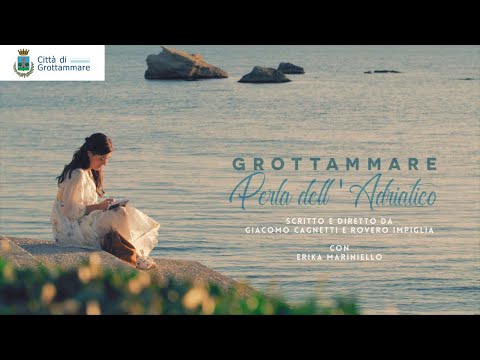 Grottammare in three videos: the Adriatic town, Sixtus V and the seafront
 “Sixtus V – Il Papa Tosto” is the most history-focused selection: its subject is Felice Peretti, born in Grottammare in 1521 and later elected Pope Sixtus V. The roughly six-minute film offers a cultural counterpoint to the beach material and helps connect the town’s public memory with its historic centre.
 The municipality’s short “Lungomare” film is the most tightly focused of the three, concentrating on the seafront rather than the hilltop lanes or a single historical figure. At just over a minute, it is a quick visual introduction; use the current municipal tourism page for seasonal services, access and activities.