From the ridge, Civitella del Tronto reads as one connected place: a long fortress following the crest, a close-knit historic centre beneath it, and a much wider countryside running toward the Monti Gemelli. Its position near the present Abruzzo–Marche boundary once put the town on a far more consequential line: the frontier between the Kingdom of Naples and the Papal States. The military story is visible in the stone, but the town is more than a monument. Churches, family collections, local food and routes into the Salinello valley give a visit several different scales.
A municipality larger than its hilltop centre
Civitella del Tronto is in the province of Teramo, Abruzzo. ISTAT counted 4,539 residents in the municipality on 31 December 2024. That figure covers the whole comune, including its rural settlements; it does not describe only the historic centre gathered below the fortress. The distinction matters when planning a visit: the main sights are walkable in the old town, while the caves, gorges and scattered localities require separate transport and more preparation.
The landscape helps explain the town’s character. A steep travertine ridge narrows the routes through the centre and gives the fortress an open view across the valleys. Its compact lanes reward a slow circuit on foot. Some passages are exceptionally narrow, but their interest lies in how the street plan adapts to the rock, not in an unverified national record.
What the evidence says about the town’s beginnings
The beginning is not settled. Archaeological material found at Ripe di Civitella and in Grotta Sant’Angelo documents human presence in the surrounding area from prehistoric periods, including the Upper Palaeolithic and Neolithic. Those finds do not establish that the present town was founded then. A local-origin theory places Civitella over the Picene settlement of Beregra, but the National Park presents that as a belief rather than a proven identification. The first documentary evidence instead describes a fortified settlement in the 10th or 11th century; by the 13th century the town had walls.
Its later importance is easier to trace. The border between Naples and the Papal States made Civitella a strategic stronghold. In 1557 it resisted an assault by French forces allied with Pope Paul IV. After that conflict, the name Civitella del Tronto came to mark its role in the Guerra del Tronto, and the Crown granted tax relief to the inhabitants. In 1589 Philip II of Spain gave the town the title Fidelissima. These episodes explain the civic pride attached to the fortress without turning a contested ancient origin into fact.
The site faced French forces again in 1798 and 1806. During the four-month siege of 1806, Irish Major Matteo Wade led the defence before the garrison capitulated on 22 May. The final siege came during Italian unification. Piedmontese troops took the fortress on 20 March 1861, three days after the new Kingdom of Italy was proclaimed. Civitella was therefore one of the last Bourbon strongholds to fall, a distinction preserved in its architecture and local memory.
Inside the fortress and the streets below
The fortress follows the ridge for more than 500 metres and covers about 25,000 square metres. The visible complex reflects major works ordered by Philip II in the second half of the 16th century, replacing an earlier Aragonese stronghold; the Ministry of Culture treats some earlier design attributions as probable rather than certain. Its length is part of the experience: a visit moves along ramparts, courtyards and defensive spaces rather than through a single castle room. After a major restoration completed in 2026, the site reopened to visitors that summer. Check the operator’s current opening calendar, ticket arrangements and access conditions before setting out.
The fortress’s Museo delle Armi occupies former service rooms and displays arms and cannons spanning the Renaissance to the battles of 1806 and 1860. It gives the military narrative material form, but the streets below provide a different counterpoint. The church of San Lorenzo dates to the 13th century. During the 1557 siege it was adapted as a defensive bastion, then rebuilt inside the town walls and remodelled in Baroque style in 1777. San Francesco, from the 14th century, retains a stone rose window and a 15th-century walnut choir. At Santa Maria dei Lumi, the sanctuary’s wooden Madonna is dated to 1489; the monument to Matteo Wade, commissioned by Francis I of the Two Sicilies, was erected in 1829.
A few streets away, Museo NINA widens the idea of what a frontier town collected. Its more than 3,000 decorative-art objects include textiles, clothing, fashion and household pieces from the late 18th century through the postwar period. The collection turns away from sieges and asks how people dressed, furnished rooms and moved through social life. Together, the arms museum and NINA make a useful pair: one interprets a defended boundary, the other the material culture that crossed it. Check NINA’s current hours and ticket arrangements before visiting.
Beyond the walls: caves, water and the Monti Gemelli
The Salinello Gorges are the area’s most dramatic outdoor counterpart to the fortress. The river has cut a narrow passage through limestone beneath the Monti Gemelli; the National Park describes the setting as rugged and isolated, with the Sant’Angelo cave and former hermitage sites among its points of interest. Archaeological layers in the caves record human activity across long prehistoric periods and later Bronze Age phases. That evidence belongs to the caves and their surroundings, not to a claim that the medieval town itself began in prehistory.
Ripe is the starting locality for planning a visit to the gorge and cave area. This is an outdoor excursion, not an easy extension of the paved centre: check with the Park or a local guide for current access, trail conditions and whether the cave can be entered on the day. Weather, water and seasonal restrictions can change the experience.
Food, work and the visitor’s day
The municipality’s 2019–2021 planning document describes a mixed local economy of tourism, manufacturing and agriculture, with visitor spending supporting services, shops, eateries and craft activity. It is a dated planning snapshot rather than a current employment survey, but it helps place the fortress in the life of a broader rural comune. Summer notices from the municipality show events not only in the historic centre but also in localities such as Villa Lempa and Santa Croce. The village’s food offers a more lasting introduction: ceppe, handmade pasta shaped around a small wooden peg or knitting needle, alongside dishes such as pollo alla franceschiello and filetto alla borbonica.
Drivers can approach from Teramo along the SS81, or from the north by way of the A14, the Ascoli Piceno area and the RA11 before continuing on the SS81. There is no railway station in the hill town; Teramo and Giulianova are useful rail gateways. TUA operates regional routes serving Civitella and nearby localities, but the published calendar includes school-day and non-school services with different patterns. Confirm the route, operating day and return journey directly with the current planner.
A satisfying day begins in the old centre, continues through the fortress and its arms museum, then makes room for NINA or a church visit before lunch. Ceppe provide a local reason to linger. With a car and suitable conditions, the afternoon can shift to Ripe and the Salinello landscape; without one, keep the visit to the town and check local transport rather than assuming the countryside is connected like an urban district. Civitella’s value lies in that range: a border stronghold, a lived-in historic town and a gateway to a wilder valley.
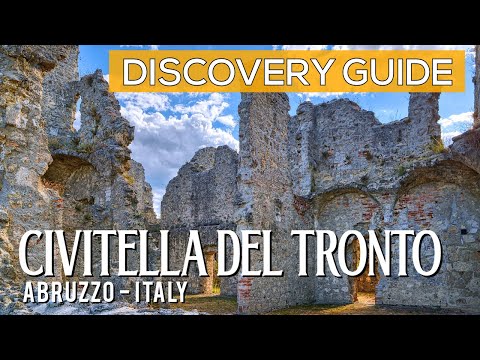 Civitella del Tronto in tre video: il borgo, il restauro e una visita Rai
 Certastampa’s July 2026 report speaks with the architects responsible for the fortress restoration. They describe work on vulnerable walls, stone surfaces, walkways and internal squares, as well as a new lighting scheme, offering a focused look at how the monument was prepared to welcome visitors again. The piece is useful context for seeing the restored site, but it concentrates on the project rather than the fortress’s full history. Confirm current access, tickets and opening hours with the operator before planning a visit.
 Rai’s September 2026 Camper segment offers a concise travel-program introduction to Civitella’s old centre and hilltop fortress. It helps viewers orient themselves among the border-town setting, the narrow lanes and the main landmark, and works well as a preview before a walking visit. The programme’s description uses rankings for the fortress and a lane that are not independently verified here; the editorial review relies on the documented dimensions and history instead. Treat it as a short visitor feature, then check current access and schedules directly with the sites.