Montalto delle Marche stands on a hill between the Adriatic coast and the Sibillini range, where the Piceno’s agricultural landscape rises from the Aso valley toward the mountains. The main settlement sits at about 512 metres; the municipality covers 34.11 square kilometres and includes the historic hamlets of Porchia and Patrignone as well as the cultivated Valdaso. ISTAT’s resident-population estimate for 1 January 2026 is 1,814 for the whole municipality, not just the hilltop centre. That small scale is part of the experience: Montalto is a place to walk slowly through lanes and civic spaces, then continue outward to villages, orchards and vineyards that belong to the same local story.
Older traces, a medieval civic landscape
Archaeological finds from the wider territory include Neolithic and Picene material, Roman objects and later remains. They show that people used and settled this part of the Aso and Tesino valleys across many periods; they do not prove that the present town was founded by Romans or Piceni. The municipal account places the formation of Montalto, Porchia and Patrignone as self-governing communities in the fourteenth century. Montalto elected its own podestà in 1418, a sign of civic authority before the town’s later rise as an administrative centre.
That rise is inseparable from Felice Peretti, who became Pope Sixtus V in 1585. He was born in Grottammare to a family with roots in Montalto, which he called his cherished homeland. In 1586 he raised Montalto to city and diocesan status and made it the capital of the Presidato, a papal administrative district. The distinction matters: Montalto’s identity rests on its long relationship with the pope and his family, not on a claim that he was born here. The resulting period of building and administration gave the town a scale and civic architecture that still shape the centre.
A cathedral designed for a steep site
The Concattedrale of Santa Maria Assunta is the clearest expression of that ambition. Work began in 1589 on a steep slope where the older settlement met a newer quarter. The solution was unusual and practical: a lower church in the form of a Greek cross supports an upper church laid out as a Latin cross. The project continued after Sixtus V’s death, with later work shaping its dome, tower and portico; the interior decoration and chapels add layers from later centuries. Rather than treating the cathedral as a single Renaissance moment, look for the way its two levels answer the hill and connect different parts of the town.
Nearby, the Palazzo dei Presidi became the seat of the new district government and later the municipal palace. Its late-sixteenth-century fabric and former prison rooms help explain why the town was more than a religious centre. The civic and Sistine museum collections are important to the local story, including archaeological finds, paintings, liturgical objects and the history of the old prisons. Access needs care, however: the municipal tourism portal describes the Palazzo as still closed after the 2016 earthquake while a consolidated museum route is being prepared, and the regional listing also marks the Sistine museum closed. Confirm any reopening directly before planning an indoor visit.
Porchia, Patrignone and the working Valdaso
The municipal territory rewards visitors who look beyond the main piazza. Porchia and Patrignone were once independent medieval communes and retain fragments of walls and towers. In Patrignone, the Romanesque church of Santa Maria in Viminato contains frescoes from the fourteenth to sixteenth centuries; in Porchia, the church of Santa Lucia preserves a fifteenth-century Nativity fresco in its crypt. These are separate village visits, so check access and church opening before setting out.
Valdaso offers a different encounter: orchards, vegetable plots, vineyards and small agricultural businesses follow the valley and its tributaries. The local tourism portal identifies fruit, wine, olive oil, preserves and heritage grains among the area’s products, and lists producers that welcome visitors by arrangement. Sangiovese, Montepulciano, Pecorino and Passerina are part of the local wine landscape, while the official portal also points to tastings and farm visits. A weekly market is listed for Wednesdays. These details describe a living rural economy, not just a backdrop for photographs; check with individual producers for opening times and reservations.
Culture in a town rebuilding its public spaces
Montalto’s current cultural life combines longstanding community traditions with a broad regeneration programme. The Teatro della Fiaba e della Poesia hosts a winter season and local arts initiatives, while the Festival degli Appennini brings mountain and popular singing into the cathedral setting. Through Metroborgo MontaltoLab, public spaces, archives, museum collections and cultural venues are being connected in a project supported by Italy’s PNRR. The national Borghi Cultura portal lists a total project value of 20 million euros. This is a programme in progress, not a promise that every planned space is already open; current notices are the best guide to what visitors can attend.
For a first visit, allow time for the old centre and the cathedral, then make a separate loop to Porchia or Patrignone and the Aso valley. The official tourism portal also describes a Sistine itinerary linking the historic core with the old mill in Valdaso. The surrounding hills are better explored by car or with a booked local experience, since the hamlets and agricultural sites are spread across the municipality. Ancona’s airport-to-town public-transport route uses a train to San Benedetto del Tronto followed by local bus or taxi; the tourism portal estimates 30–40 minutes for that final leg. START publishes a route linking Montalto, Cossignano, Offida, Mezzina and Ascoli Piceno. Timetables vary, so check the operator before travelling and confirm the opening of churches, museums and farm visits.
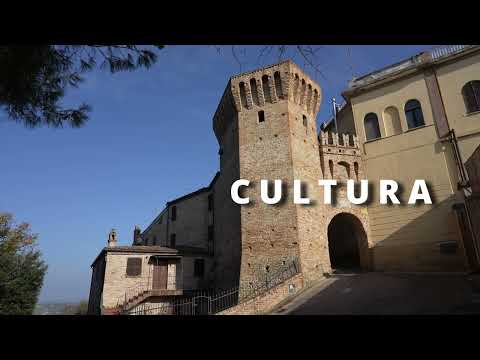 Montalto on film: a historic town, its papal ties and a changing cultural life
 PiccolaGrandeItalia.TV’s ten-minute 4K profile, dated 2021, places Montalto among the hills between the Adriatic and the Sibillini and explains its association with Sixtus V. It works as a broad scenic introduction rather than a current access guide. The distinction around the pope is worth keeping in view: he was born in Grottammare to a family rooted in Montalto, and the town’s enduring connection comes from his patronage and the institutions he established here. The film predates the latest earthquake-recovery and museum plans.
 Cronache Picene’s 2021 anniversary spot uses a deliberately surreal, comic idea: a town waits for its pope to return and then surprises him for his birthday. Actor Ivano Marescotti plays Sixtus V, while musician Elio contributes a song; the production was filmed in Montalto in July 2020. It is a playful piece of local storytelling, not a documentary reconstruction of a historical visit. Seen alongside the town’s careful record of Sixtus V’s birthplace in Grottammare and his affection for Montalto, the spot shows how that relationship remains part of local identity.