A village built into the mountain landscape
Castelli rises on a rocky spur beneath the Gran Sasso, at about 500 metres above sea level. The old settlement sits among clay gullies and wooded slopes, with the high face of Monte Camicia behind it and the valley opening below. Houses stand on substantial stone arches, locally called lo steccato, that hold the edge of the eroded ridge. ISTAT counted 907 people in the entire comune on 31 December 2025. The historic centre is small enough to explore on foot, but it is not a staged heritage set: its lanes, workshops, school and parish belong to a community still shaped by the craft that made the name Castelli known.
Maiolica grew from local materials and skill
The Comune connects the ceramic tradition with the resources around the village: clay, water, silica and beech wood for kilns. It does not give a single secure starting date. The first dated pieces are from the fifteenth century, while the municipality describes the second half of the sixteenth century as the beginning of the craft’s great artistic period. Older accounts associate production with Etruscan times or Benedictine monks, but those stories should not be turned into a precise foundation claim. What is documented is the later rise of workshops and named families whose work carried Castelli maiolica into churches, pharmacies and collections beyond Abruzzo.
Among the artists associated with that history are the Pompei, Grue, Gentile and Cappelletti families. Castelli’s ceramics changed with taste and technique: the museum follows the sequence from medieval and Renaissance production through the styles known as compendiario and istoriato, alongside later pieces and contemporary work. The craft remains more than an image in a display case. Municipal descriptions identify ceramic making as the town’s main economic activity and point to active workshops; a recurring craft market, including its 62nd edition in 2026, continues to link artisanship with the local visitor economy. Those facts show the craft’s central place, without implying that every resident works in ceramics.
Enter the workshop, then look up at San Donato
The Museo delle Ceramiche is housed in a former Franciscan convent. Its route combines a recreated workshop with collections that explain how clay was prepared, shaped, glazed and fired. The museum describes historic works from the fifteenth through twentieth centuries, including pieces connected with Castelli’s principal ceramic lineages, pharmacy vessels and later artistic collections. This is the best place to understand the time and repeated labour behind a painted plate. The municipal page lists seasonal hours and a contact number; check the current schedule before travelling, as the published hours vary by season.
About 1.5 kilometres beyond the village centre, the small church of San Donato holds one of the area’s most distinctive works: a maiolica ceiling made from more than 800 tiles bearing dates from 1615 to 1617. The Comune says the work was created by local ceramicists in a devotional setting and restored in 1968, when damaged or missing tiles were replaced. Nearby, older fragments from an earlier tiled ceiling are preserved in the museum. The church is listed as free and open during the day, but service times and access can change.
Read the village street by street
Begin at Piazza Roma, where four narrow lanes branch between stone houses, doorways and inscriptions. The parish church of San Giovanni Battista faces the square; other parts of the old centre include the church of San Rocco, the former palace associated with Cardinal Silvio Antoniano and working ceramic shops. Near Ponte Grue, the municipal history identifies traces of small water mills once used to prepare glaze. Farther down a path beneath the settlement, it describes a reconstructed wood-fired kiln that demonstrates the firing tradition. These places show why the village’s architecture and production history belong together.
Castelli also opens onto mountain routes. The municipal account says the Sentiero Italia passes through the village between Isola del Gran Sasso and the direction of Rigopiano and Castel del Monte. The Gran Sasso and Monti della Laga National Park surrounds the town with woods, high peaks and open views; Monte Camicia and Monte Prena frame the upper landscape. Walking in the foothills can be paired with a slower visit to the centre, but check trail condition, weather and access before setting out. Wild animals live in the broader park, but sightings are never guaranteed.
Reaching Castelli and planning time
TUA’s line 3006 connects Teramo with Isola del Gran Sasso and Castelli, using the mountain corridor through the neighbouring communities. The operator’s published timetable separates school-day, winter and Saturday services, and recent 2026 notices show that trips can change; check the departure for the exact date rather than assuming daily service. By car, the municipality describes the approach along provincial road 37 through the Casette-Faiano area. Allow time for the museum, the centre and San Donato rather than trying to fit all three into a rushed stop. The best visit combines the objects, the working craft and the setting that supplied its materials.
 Castelli in video: the ceramic tradition, working artisans and market
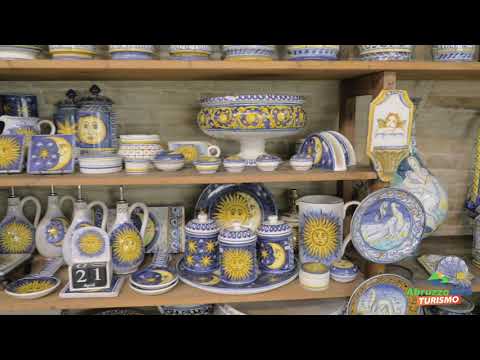 This 2021 report moves from finished ceramics into the workshop, with interviews about daily decoration and the handwork behind a plate. The accompanying article discusses the artist Pia and describes how the makers prepare clay and glaze and use the traditional colours. It gives a close view of craft as living work rather than only a historical style. Its interviews document the people filmed at that time; check current workshop availability separately.
 This four-minute local-news report covers the opening of Castelli's 62nd ceramic craft market on 1 August 2026. It presents the event as a month-long programme of demonstrations, workshops, music and exhibitions, and connects that programme with local identity and visitors. The edition ended on 31 August, so this video is a record of the recent market, not a current invitation. It shows how the town continues to promote ceramics as contemporary culture and work.