Caunay is a small rural settlement in the Pays Mellois, in southern Deux-Sèvres, whose quiet scale is best understood on foot. Its church, woodland edges and old stone-working landscape sit close enough to make a compact visit, while the area remains primarily a lived-in agricultural countryside rather than a purpose-built visitor destination. For orientation, Caunay is now a commune déléguée within Sauzé-entre-Bois, the larger municipality created on 1 January 2025 by joining Caunay with Montalembert, Pers, Pliboux and Sauzé-Vaussais.
A precise population figure
INSEE’s 2023 reference-population table, effective from 1 January 2026, lists a line “dont Caunay” within the new municipal geography. It records 174 residents as the population municipale and 177 as the population totale, including three people counted apart. These numbers describe the Caunay component, not all of Sauzé-entre-Bois; the whole new municipality has 2,271 residents in the same table. The distinction matters because Caunay no longer has a separate commune boundary in the current administrative structure. It also means that broad economic tables for Sauzé-entre-Bois combine five former communes and cannot be read as a Caunay-only business census.
Church and village centre
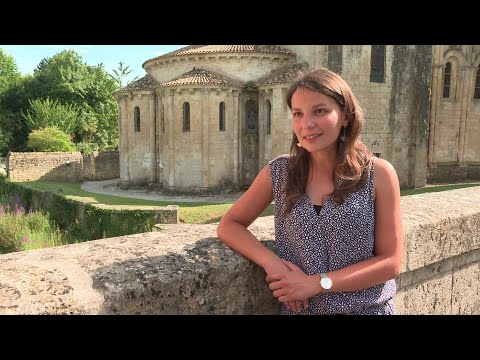
The Church of Saint-Pierre-aux-Liens gives the village its clearest architectural landmark. A regional church-heritage account dates it to the twelfth century and describes a Romanesque building whose parts can be read from outside: a south-side doorway with carved capitals and an apse articulated into three bays by columns. The reported imagery includes birds, a serpent and a double-tailed mermaid, motifs that invite close looking without requiring the visitor to treat every interpretation as certain. Contemporary stained glass by Pierre Bouton, installed in 1998 according to the same heritage account, adds a more recent layer to the interior. The church stands opposite the starting area for the local millstone walk, making the square a natural place to pause before setting out.
What the quarry record says
Caunay’s landscape also preserves the memory of millstone extraction. A local-history page published by the municipality reproduces notes by Dr Boudard and quotes an eighteenth-century description from 1773 that mentions “molières” at Caunay. That is useful documentary evidence that quarrying was known here by that date; it does not establish when the work began, how many people were employed or how far the stones travelled. The Pays Mellois tourism office’s Circuit des Meulières leads walkers through woodland and former extraction places, turning a brief written reference into a landscape that can be explored at a measured pace.
The same municipal history page recounts a local tradition connecting the hermit Saint Junien with the spring at Fontadam. It belongs to the village’s remembered and devotional landscape, but should be presented as tradition rather than as independently verified biography. The spring and the wooded route are still tangible features; the story attached to them is part of how local people have explained the place.
A walk through woods and stone
The marked Circuit des Meulières is described as 7.6 kilometres, moderate in difficulty, with about 21 metres of ascent and an estimated walking time of two and a half hours. Its published route begins near the mairie, opposite the church, and visits the old millstone workings and Fontadam. Blue waymarks are noted on the route sheet. Allow extra time to stop, read the terrain and follow the trail carefully: estimates are not promises, and the walk’s condition, access and markings may change. Wear suitable shoes, keep to public paths and check for current notices before setting off, especially after wet weather.
Daily services and the wider territory
The official public-service directory lists the delegated mairie at 11 rue des Écoliers and displays opening hours on Monday and Wednesday from 10 a.m. to noon. Treat those as directory information, not a guarantee: local-office schedules can change, so call ahead if you need a counter service. Larger everyday services are organized across Sauzé-entre-Bois and the surrounding Pays Mellois, rather than concentrated in Caunay’s small centre. INSEE’s business figures apply to the combined five-commune territory; they show a mixed rural economy with trade, construction, public services and agriculture among its strands, but do not isolate Caunay’s own workplaces. Check current municipal information for shops, health services and transport before planning a longer stay.
Ways to make the visit
Caunay works well as a half-day stop built around the church and the signed woodland circuit. The nearby towns of Melle and Sauzé-Vaussais provide wider orientation and services, while the Pays Mellois offers further heritage and rural walks. The three videos selected for this page look outward to the wider area: one introduces the Pays Mellois, another visits Melle and a third turns to Chenay. They offer regional context rather than footage of Caunay itself. Confirm route access, office schedules and any site arrangements before departure; in a small rural community, practical details can vary by day and season.