A town built into a bend of the Thouet
Parthenay makes its setting part of the visit. Its historic quarter occupies a rocky spur enclosed by a loop of the Thouet, with the medieval citadel looking across the river and the hedged countryside of the Gâtine beyond. This is not a museum town frozen outside everyday life: Parthenay is a subprefecture and a service centre for a rural area, with shops, public services, schools, industry and a regional cultural programme. INSEE counted 10,140 people in the commune in 2023; the figure is the municipal population, not the wider Parthenay-Gâtine community, and these reference figures took effect on 1 January 2026.
The landscape helps explain the town’s history. Local lords grew in influence from the eleventh century, when the Parthenay family emerged as a regional power. The municipality dates the foundation of Sainte-Croix church to Ebbon de Parthenay in that century. It records that Guillaume IV founded a pilgrims’ establishment in the Saint-Jacques quarter after travelling to Compostela in 1174. In the thirteenth century, the Plantagenet rulers John Lackland and Henry III granted funds for the town’s defences and a stone castle on the promontory. The resulting walls and compact street pattern are not decorative additions: they reflect a town that guarded a crossing and the routes through Gâtine.
Parthenay also has a legendary past, best known through Mélusine, the fairy said in local tradition to have built the town. That story belongs to Poitevin folklore, not to the documented account of the castle’s construction. The fifteenth-century Roman de Mélusine, written by the Parthenay monk Coudrette, shows how deeply the figure entered regional literature. It is a compelling story to encounter here, provided it is kept distinct from the town’s archival history.
Read the old town slowly
Begin at the Porte Saint-Jacques, a landmark at the edge of the historic quarter, then follow the lanes toward the citadel, the castle remains and the churches. The town describes its protected historic ensemble as a coherent medieval fabric: fortifications, roughly a hundred timber-framed houses and Romanesque or Gothic churches. Restoration work since the 1980s has helped retain that scale and the relationship between the steep streets, the river and the old defensive line. Parthenay’s designation as a Pays d’art et d’histoire recognises the whole urban landscape, not just one monument.
The municipal Museum of Art and History, set in the medieval district by Porte Saint-Jacques, gives useful context before or after a walk. Its permanent displays cover the history of Parthenay and the Gâtine and include local faience, with temporary exhibitions and public activities added through the year. Admission is free according to the town, but opening times and events change seasonally, so check before setting out. The museum’s faience collection brings visitors into contact with a local craft tradition that flourished alongside the town’s older markets and workshops.
Markets, games and the working Gâtine
For a sense of present-day town life, look in at the covered market. Built in the late nineteenth century, delivered in 1881 and formally inaugurated in 1882, its iron frame and glass-lit interior belong to the period when better transport brought farmers and traders from the surrounding countryside into town. Food markets continue there on Wednesdays and Saturdays. The hall is both a useful stop for local produce and a tangible link between Parthenay’s historic role as a market centre and its current high street.
That rural connection remains visible in the wider economy. Parthenay’s local history describes a long association with textiles, tanning and livestock trading, tied to the bocage and cattle farming of Gâtine; the Parthenaise cattle breed developed in this setting. The modern employment picture is broader. INSEE counted 6,689 jobs located in the commune in 2023: commerce, transport and services accounted for 45.5 percent, public administration, education, health and social action for 35.2 percent, and industry for 12.9 percent. These are jobs in the commune, not a count of residents’ occupations. They show why Parthenay functions as a practical regional centre as well as a heritage destination.
Every July, the Festival Ludique International de Parthenay turns streets and public spaces into places to play. Its 40th edition ran from 8 to 19 July 2026; future editions and programmes should be checked with the organisers. Away from festival dates, the town’s walking routes offer a quieter way to connect the old centre with the river. The tourism office describes a six-kilometre, roughly two-hour circuit from Porte Saint-Jacques toward the leisure base, passing the Saint-Paul suburb and the citadel. It is a rewarding route for visitors who want to see the town as a landscape rather than a checklist of buildings.
Getting there and planning a visit
Parthenay’s former railway station now operates as a bus station; the municipal transport information says there is no passenger train service from the town. Regional coaches provide the useful links: line 146 runs between Parthenay and Niort, while line 100 follows the Nantes–Bressuire–Parthenay–Poitiers corridor. Niort and Poitiers offer rail connections for onward journeys. In town, the free Pybus has two lines and 22 stops, Monday to Saturday, with links to the regional coach station; it does not run on Sundays or public holidays, and the narrow historic quarter is not served directly. Confirm current coach and Pybus timetables before travelling.
Allow at least half a day for the old quarter, museum and market, and longer if you plan to walk the Thouet route or explore the surrounding Gâtine. Cafés, restaurants and everyday shops make it easy to pause between visits, while the local tourism office can advise on current walks, events and accommodation across the region.
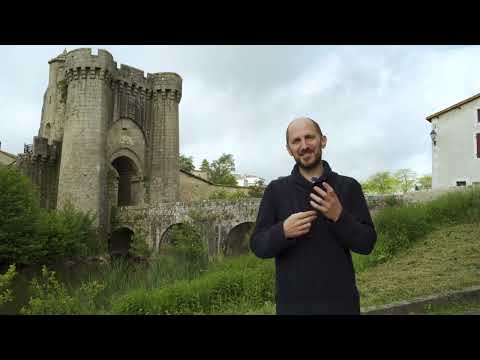 Parthenay in three films: medieval lanes, museum and the FLIP
 The town’s film for the 2020 Night of Museums pairs a virtual look at Parthenay’s museum collections with a video-mapping moment at Porte Saint-Jacques. It puts two parts of a visit in dialogue: objects that tell the town’s story and the medieval gateway that frames its historic quarter. Its date matters: the film documents a particular cultural event, not the museum’s current programme. Check the museum’s own page for present exhibitions and hours before planning a visit.
 Radio Gâtine’s 2026 episode, ‘The FLIP in the world of games’, belongs to a series marking the festival’s fortieth year. Its subject is the event’s wider place in gaming culture, adding a view of contemporary Parthenay to the older streets and collections in the other films. The 2026 edition took place from 8 to 19 July; this recording is a retrospective feature, not a notice of the next dates. It is most useful for understanding why play has become part of the town’s public identity.