Thouars makes its first impression from above. The old town occupies a rocky promontory inside a bend of the Thouet, its pale stone streets looking down toward the river and the bridges that once carried people and goods across the valley. The landscape explains why the place mattered: the height offered a defensible position, while the river connected the town to the surrounding countryside. Today, that same setting gives a visitor a natural route from the historic center down to waterside paths.
A town shaped by a river and a stronghold
The medieval town grew around a powerful viscountcy and its fortifications. The Château des Ducs de La Trémoïlle seen today is chiefly a seventeenth-century residence, commissioned by Marie de La Tour d’Auvergne and designed by architect Jacques Lemercier. Construction began in 1635 on the site of the earlier castle. Its long façade and forecourt still dominate the promontory, but its later life was far from that of a private palace: after the Revolution it passed through several public uses, including a prison, before becoming a school. Aristocratic architecture, civic history and everyday education share the same landmark.
Below the castle, the Saint-Médard quarter keeps the tighter scale of the old town. Timber-framed houses, narrow lanes and the market square invite a slow walk. The medieval Pont des Chouans, formerly called Pont Saint-Jean, crosses the Thouet on seven arches. Its fortified origins and later alterations can be read in the structure; one arch was destroyed during the Second World War and restored in 1985. Across the valley, the bridge links the old center with riverbanks and paths.
Markets, collections and local work
Thouars is not simply a preserved historic district. It serves as a working center for the north of Deux-Sèvres, with commerce, transport and public services alongside industry and agriculture. INSEE counted 7,469 jobs located in the commune in 2023; commerce, transport and services represented 41 percent, industry 21.3 percent, and public administration, education, health and social work 29.3 percent. These are jobs in the municipality, not a count of residents’ occupations. The commune’s population figure also covers a larger territory than the old town: since 2019, the municipality includes Mauzé-Thouarsais, Missé and Sainte-Radegonde as well as Thouars itself. INSEE recorded 13,891 municipal residents in that enlarged commune in 2023.
For a sense of daily life, start at the central market area. The town’s commercial history reaches back centuries, and the covered hall remains part of the weekly rhythm; food markets are held on Tuesday and Friday mornings. The Musée Henri Barré, housed in the former residence of a local doctor built in 1862, brings together art, archaeology, local faience and ethnographic collections. Its seasonal opening pattern changes through the year, so check the current calendar before making it a fixed stop. Other cultural addresses include the contemporary art center in the former chapel of Jeanne d’Arc and the Centre Régional Résistance & Liberté.
How to spend a day
A useful first circuit is the town’s four-kilometer heritage walk, which links 22 points of interest and takes roughly one hour and forty-five minutes to two hours on foot. It begins near Place Saint-Médard and the visitor office. Give extra time to climb between the lower town, the castle precinct and viewpoints over the Thouet. For a quieter extension, follow river paths toward the leisure area; the wider valley also offers walking and cycling routes. The circuit shows how the built town and water fit together instead of treating the castle as an isolated monument.
Thouars lies about 35 kilometers from Saumur, near the meeting edges of Anjou, Touraine and Poitou. The TER station has rail and coach departures serving destinations including Saumur and Bressuire, with some services continuing toward larger regional cities. Check the operator’s live timetable and confirm whether a particular service is a train or a coach. Visitors arriving by car or bicycle can use the river valley and local routes to explore nearby villages and wine-growing landscapes. In the old center, allow for slopes and stone paving; comfortable shoes make the walk easier.
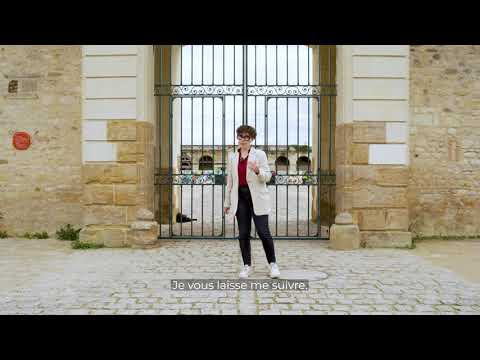 Thouars in three films: castle, museum and town history
 The town museum’s question about Marie de La Tour d’Auvergne gives this film a clear human subject. Instead of treating the castle as a façade alone, the episode links its creation to the woman who commissioned the seventeenth-century residence and to the museum’s collection. That perspective helps explain why the château is part of Thouars’s social history as well as its architectural identity. Visitors can pair the film with the museum and the heritage walk.
 France 3’s local-history feature widens the lens from one monument to Thouars as a lived place. Its value in this group is the regional perspective: it encourages viewers to see the castle, town and later public uses as parts of one story. The film is a useful orientation before walking the old center, while the municipal heritage service remains the source for current access, visits and opening times.