A riverside town that learned to look Italian
Clisson’s character comes from a meeting of landscapes and eras. The Sèvre Nantaise and the Moine join below a rocky outcrop; bridges, wooded banks and steep lanes make the centre feel closer to a small river town than to the Atlantic-facing coast farther west. Above the water stands a medieval fortress. Around it are timber market halls, stone bridges and houses with tiled roofs, arcades and warm brick. That southern French appearance is not an ancient inheritance: much of the town’s Italianate look was deliberately created in the nineteenth century.
INSEE counted 7,452 municipal residents in the whole commune in 2023. Clisson is also the centre of a wider Vignoble Nantais area, where daily life combines local services, industry, vineyards and market gardening. The municipality had 1,054 economically active establishments in 2024; 205 were in wholesale and retail trade, transport, accommodation and food services. The wider intercommunal authority identifies viticulture and market gardening among the territory’s economic strengths. These figures describe a working small town, not a preserved film set.
A border fortress, not a Roman fable
Clisson developed where the historical marches of Brittany, Anjou and Poitou met. The Department’s archaeological account says the castrum appears in written records in 1088. The first known castle was timber; a stone fortress followed, with the oldest surviving section dating from the thirteenth century. Over subsequent centuries it grew from a seigneurial residence into a defensive stronghold, with towers, gatehouses and artillery works. Its position above the river crossings made control of the valley and the southern approach to Nantes the practical reason for its importance.
The family’s story is turbulent and well documented. Olivier IV de Clisson was executed in 1343 after accusations of treason during the Hundred Years’ War. His widow, Jeanne de Belleville, waged a private conflict against the French crown and escaped to England with her children. Later legend turned her into a pirate, but the castle’s own historical account distinguishes that later reputation from the recorded events. In the fifteenth century François II, duke of Brittany, enlarged the fortress and adapted it for gunpowder artillery. Republican troops set fire to it in 1793 during the Wars of the Vendée; the romantic ruin that followed became part of the town’s next transformation.
How Clisson acquired its Tuscan silhouette
After the revolutionary destruction, artists Pierre and François Cacault settled in Clisson in 1798. Their friend François-Frédéric Lemot, a sculptor who had spent time in Italy, bought the old hunting ground beside the castle in 1805 and the ruins themselves in 1807. Together, these men helped recast the damaged town and valley through an idealised Italian landscape. Tile roofs, arcades, garden structures and villas appeared alongside medieval remains. “Clisson the Italian” is therefore a useful description of a nineteenth-century artistic project, not proof that the town was founded by Greeks or Romans.
The Garenne Lemot estate extends that idea into the countryside. Paths lead through a landscape park with ornamental structures, sculptures and a villa inspired by Italian architecture. Its views connect the gardens, the valley and the castle across the Sèvre. The park and the house are not the same experience: the grounds invite a longer walk, while the house and exhibitions explain Lemot’s design intentions. The estate spans Clisson and neighbouring Gétigné, so visitors should check the Department’s current opening and access information before planning a visit.
Market halls, bridges and a walk through the centre
The old centre rewards a route on foot. The fourteenth-century market halls, dated by the municipality to 1376–1377, remain a working market space and are among the rare buildings to have survived the Vendée conflict. On Tuesday mornings the market is chiefly for food; Friday brings a wider street market with food, clothing, tools and garden goods. The town publishes seasonal hours, and its free market shuttle serves villages in the commune on Fridays.
From the halls, walk toward the castle and the old bridges. The Saint-Antoine bridge crosses the Moine, while the Pont de la Vallée spans the Sèvre; both are listed as historic monuments and are generally dated to the fifteenth century. Their stone arches frame a town where water is not a backdrop but the structure of the street plan. Church towers and the landscaped slopes of the Garenne appear between buildings as the route rises and falls. A good first circuit links the market, the castle exterior, the river crossings and the banks below the fortress; allow extra time for the steep lanes and viewpoints.
A living vineyard town and a practical base
Clisson belongs to the Nantes vineyard landscape, where Muscadet, food production and small businesses sit alongside commuter and service activity. The Hellfest Open Air festival, held in Clisson in June, brings a very different scale and sound to the town; dates, transport and accommodation pressure vary each year, so consult the festival’s current information if travelling around its dates. Outside event days, local life is visible in the shops and cafés around the historic centre, the market, and the employment areas near the station and town edge.
The railway station is a regional interchange, served by trains and tram-train services toward Nantes; the exact service and journey time depend on the departure. Free Héoh! buses connect Clisson with Gorges and Gétigné, with a second line serving Saint-Hilaire-de-Clisson; the local authority’s current timetable should be checked. From Nantes, the train is a straightforward alternative to driving. The town is compact enough to explore on foot once you arrive, although the castle, riverside and Garenne grounds involve slopes and stairs.
For a fuller stay, pair the historic centre with the Garenne Lemot and a short excursion among the vineyards of the Vignoble Nantais. A weekend can include a market morning, the fortress, the riverside and an unhurried garden walk. Clisson’s appeal lies in seeing the layers together: medieval borderland, revolutionary ruin, nineteenth-century Italian dream and present-day working town.
 Clisson en trois vidéos : mémoire, forteresse et jardins
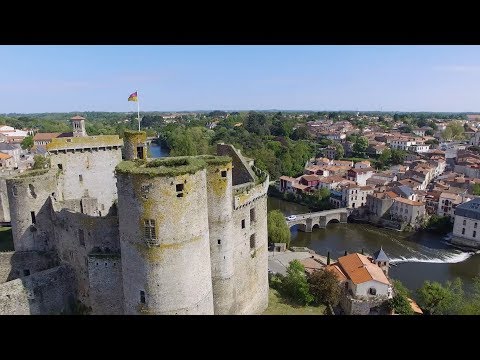 The Loire-Atlantique Department introduces Clisson Castle as a fortified stronghold and highlights its defensive architecture. The brief film is a good way to prepare for the gatehouses, towers and artillery features that are easier to understand on site. It provides an overview rather than a full chronology of the castle’s successive medieval phases; pair it with the Department’s current visitor material and confirm opening arrangements before travelling.
 This Department film turns to the Garenne Lemot estate, describing its Italian-inspired architecture within a landscape park beside the Sèvre Nantaise. It complements a castle visit by shifting attention from military architecture to the nineteenth-century artistic reinvention of the valley. The short presentation is an orientation, not a complete guide to every building or current access; consult the estate’s visitor information, especially for the house and temporary exhibitions.