Tyrnävä’s identity is written across a broad agricultural plain rather than a single monument. The municipality in North Ostrobothnia had 6,470 residents on 31 December 2025, a figure for the full municipality and its villages, not just the central settlement. Rivers cut through the open fields of the Liminka plain, while the old centre gathers church, library and former dairy buildings into a compact walk. What makes the landscape especially legible is its working present: in 2025 the municipality counted 120 active farms, including 34 potato farms cultivating 1,333 hectares.
How potatoes became part of the local economy
Tyrnävä was not always known primarily for potatoes. The municipality’s local history says a State Seed Potato Centre was established here in 1976 to address plant-disease problems in Finnish potato production. The choice of Tyrnävä helped create a concentrated seed-growing sector. Municipal figures for 2025 record 26 farms growing seed potatoes on 701 hectares, alongside food and processing potatoes. This is an active agricultural economy, not a theme park: fields, farm businesses and food production remain part of the place people live in. Perunamarkkinat, the local potato market, brings that connection into public life, while the municipality’s 2026 Perunagalleria programme adds research, food and art events. Dates and programme details change each year.
A former dairy district reused by the community
Meijerikatu offers a walk through the region’s shift from farm production to shared services. The dairy completed in 1906 became Finland’s first training creamery, according to the municipal cultural-environment account. A larger cheese dairy followed in 1918, and a flour mill was built in 1919. The old production cluster has been adapted: the former dairy and mill now accommodate the library, while the former cheese dairy houses the upper-secondary school and apartments. Across the river, the streetscape retains old craft and workshop buildings. The setting connects industrial heritage to current daily life rather than leaving it as a preserved backdrop.
Tyrnävä’s church story reaches further back. It became a chapel parish of Liminka in the 1640s; churches were built in 1647 and 1664. The present wooden, neo-Gothic church was completed in 1873 to a design by provincial architect F.W. Lüchow. Nearby, the old cemetery marks the sites of the two earlier churches. The municipal museum occupies a former loan-grain storehouse from the 1860s and includes local collections; Tihisen pytinki and the agricultural-machinery museum offer another window onto rural work. In Temmes, Wäinölä’s layered history as a community hall, theatre venue and village house gives the outlying settlement its own cultural centre.
Planning a visit from Oulu
Tyrnävä is close enough to pair with Oulu, yet its cultural route is best explored at village pace. OSL lists route 54B between Oulu and Tyrnävä, with other local services toward Murto and Kempele; use the current route planner for days and departure times. Start with Meijerikatu, the church and local museum, then drive or arrange transport to Temmes and its historic surroundings. Museum and church access varies by season, and rural food and accommodation providers may need advance contact.
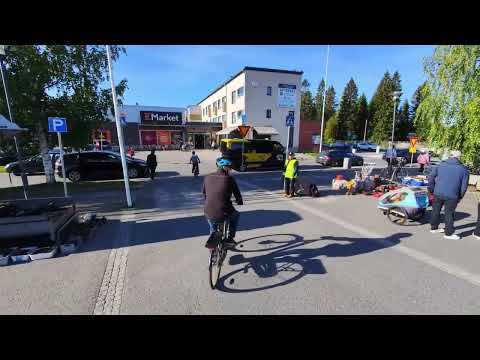 Tyrnävä on film: potato market, Temmes and a visitors view
 Savolaiset seikkailee frames its video as an adventure in Tyrnävä. Its travel-led perspective complements the municipal cultural and agricultural accounts by taking the viewer into the place itself. The title alone does not establish a fixed route or current service details.
 This Tyrnävä TV film names Temmes, one of the municipality village centres, alongside Tyrnävä. It gives the outlying village a separate place in the video set and complements footage focused on the central potato market. Check local cultural venues and seasonal access separately.