Lumijoki sits on Finland's flat northern coast, where farm fields meet a shallow bay and the river that gives the municipality its name. Statistics Finland counted 2,018 residents in the municipality on 31 December 2025. The church village is the everyday centre; small settlements such as Korvenkylä, Lapinkylä, Hirvasniemi and Ylipää extend into the surrounding countryside. The coast is close but not at the village edge: Varjakka, with its marina and beach, lies about 11 kilometres away by road. Lumijoki makes a rewarding slow visit for travellers who want to understand the landscape as a working place as well as a bird-rich one.
The municipality's first known written mention dates to 1496, while Lumijoki became an independent municipality in 1867; these dates refer to a recorded reference and a later administrative change, not the beginning of settlement. The river drains west to east into Liminganlahti. The name's origin is uncertain: a local story imagines wind piling snow into the channel, while another proposed explanation connects it with Swedish flum, or floodwater. They remain interpretations, not proven etymology.
A bay shaped by migration and water
Liminganlahti is the area's defining natural feature. The municipality says a large part of the bay lies within its territory and points visitors to the Sannanlahti and Puhkiavanperä bird towers, both roughly six kilometres from the centre. In spring, especially April and May, the municipality describes fields along the shore filling with migrating geese, swans and cranes. The attraction is not a single lookout with a guaranteed spectacle: it is a broad wetland-and-field landscape whose character changes with the season, weather and water level.
The two towers offer different ways to approach that terrain. Sannanlahti has an access track described as a sand road leading toward the tower, with a campfire place and visitor information nearby. At Puhkiavanperä, duckboards lead across softer ground to a covered tower, and an observation shelter sits partway along. These are practical facilities in a low, open coastal setting, where wind, wet ground and seasonal conditions matter. Liminganlahti's visitor centre is in neighbouring Liminka, an easy regional companion to the Lumijoki bird sites rather than part of the village itself.
Varjakka: a coastal village still tied to the sea
At Varjakka, the shoreline is not just scenery. The municipality records fishing and seal hunting as important older livelihoods; today, boating, recreation and household fishing remain part of the area's life. The marina combines a guest harbour, beach, camper pitches and a sauna and meeting building. The moored Hailuotolaiva offers café service and accommodation in summer, and the vessel can be booked for events. Those services make Varjakka more than a short photo stop, although opening periods and availability are seasonal and should be checked before travelling.
The small harbour settlement gives Lumijoki a different face from its inland fields. Boats enter a coastal landscape of low horizons, channels and broad skies. The fishing harbour and fish hall also point to a continuing local relationship with the water, while the nearby Sähkäle wind turbine adds a modern mark to the same working landscape. It is a place to pause, walk by the shore and see how recreation, fishing and infrastructure coexist; visitors should use signed public access and respect working and private areas.
A brick church built through local effort
Back in the church village, the long brick church is Lumijoki's strongest architectural landmark. Designed by John Lybeck, it was built between 1886 and 1889 and dedicated in 1890. The municipality says local clay was fired into the bricks and records an old armory beside the church dating to 1747. The parish credits the building effort with 14,000 local workdays, a striking measure of how a small community invested in a large shared building.
The present church followed two wooden buildings. A church erected in the 1620s was dismantled in 1814 after it became too small and deteriorated. Work on its successor began in 1816; that building was destroyed in an 1882 lightning fire. These dates explain the present church's place in the village without turning a documented sequence into a legend. Visits are seasonal or arranged with the parish, so do not assume the doors are open every day.
Everyday objects and a countryside that keeps working
The local-history museum gives the village a more domestic scale. It occupies a building from the 1860s that was adapted for museum use in 1999. Its collections come from Lumijoki and local donations, with particular strength in farm and household objects. The museum is a useful counterpoint to the monumental church: one preserves a public expression of collective effort, the other gathers tools and belongings from ordinary lives. It opens seasonally; check the municipality's current dates and times.
Lumijoki's rural economy remains visible in the landscape. The municipality describes agriculture and forestry as strong fields of expertise and says local farms concentrate on strawberries and potatoes, grain, or livestock. This is not an open-air theme park: fields are productive land and farms are workplaces. Local routes also reveal older built traces, including the Kankaanpäänraitti road corridor and historic mills; some mills stand on private property and should be viewed only from public routes unless access is expressly offered.
Getting there and planning a visit
Oulu is about 38 kilometres away, Liminka 10 kilometres, Kempele 22, Raahe 45 and Oulu Airport 35, according to the municipality. Oulu's regional buses serve Lumijoki, including routes 53 and 53A toward Liminka and Oulu. The published winter schedule covers 12 August 2026 to 6 June 2027, but the municipality warns that services can change. Check the live OSL route planner for the exact stop and day; a car or bicycle is useful for reaching the bird towers and Varjakka from the centre. The bay, church, museum and harbour each operate on different seasonal rhythms, so verify opening hours and local access before setting out.
 Lumijoki kolmessa videossa: Varjakka, tiilikirkko ja Liminganlahti
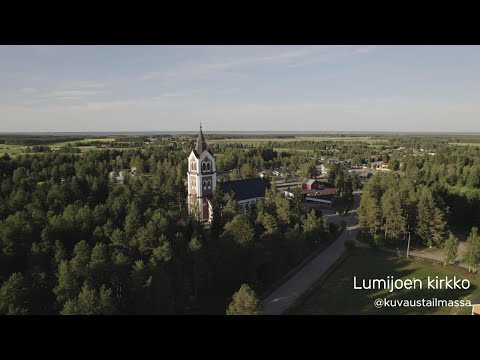 KuvaustaIlmassa's 48-second 4K video is identified as a recording of Lumijoki Church on 16 July 2025. Its subject is the municipality's long brick church, built in the 1880s and dedicated in 1890. The brief aerial-photography format offers a concise visual introduction to the landmark, while the parish remains the source for arranged visits and access; the video itself should not be read as a promise that the church is always open.
 This Luontoon.fi_Official film introduces the Liminka Bay visitor centre and its bird-focused activities, and its description specifically says it explains access by public transport. The centre is in neighboring Liminka, close to Lumijoki's own bird-rich shore and observation towers, so the film complements a visit to the municipality without confusing the two locations. Its travel directions date from 2018; check the current OSL route planner before relying on any schedule.