Stone roofs, a mountain river and a school for living folk music
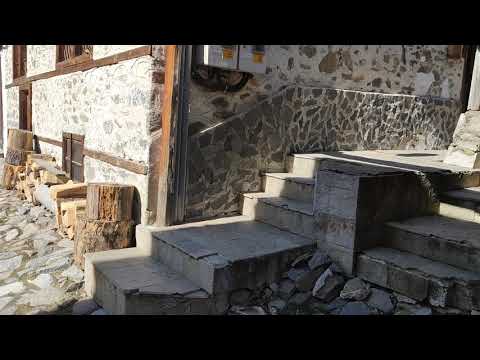
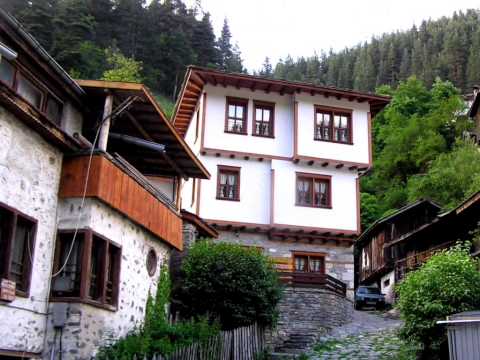
Shiroka Laka follows the Shirokolashka River through the Rhodope Mountains, with houses rising in tiers above its banks. Stone-slab roofs, projecting upper floors and small bridges create a recognisable mountain setting. The village belongs to Smolyan Municipality and Province and had 318 residents on 31 December 2025.
The local tourism guide places it at about 1,059 metres above sea level, approximately 24 kilometres from Smolyan, 22 kilometres from Devin and 12 kilometres from Pamporovo. Those nearby places offer different experiences: a regional service town, a spa destination and a mountain resort. Shiroka Laka’s own character comes from its architecture and the continuing practice and teaching of folk music.
How old is Shiroka Laka?
There is no securely established single foundation date for the present village. The municipal tourism account describes remains from different periods in the surrounding district and explicitly says that its beginnings are difficult to date. Ancient occupation in the Rhodopes should not be turned into a claim that the current village was founded by Greeks, Romans or a named Thracian ruler.
The older surviving houses chiefly bring visitors into the nineteenth century. Their stone foundations and walls, timber elements and heavy roofs reflect a specific Rhodope building tradition. The name is associated with a bend or curve, fitting the settlement’s relationship with the river. Its historical interest comes from the way houses, bridges, churches and streets form an ensemble rather than from one monumental ruin.
A village shaped around education and the church
The local school began in Palamarchov House in autumn 1832. The Church of the Dormition followed in 1834, after permission for its construction. The familiar story of the villagers completing it within a very short deadline forms part of local recollection; the building and its nineteenth-century setting are more secure reference points than every detail of that story.
The church, houses and river crossings can be connected on a walk through the centre. Look at how buildings occupy slopes and narrow plots, and how stone and wood are combined. These are practical responses to a mountain setting as well as the features that now make the village attractive to visitors.
Shiroka Laka also preserves memories of Captain Petko Voyvoda and other figures in the region’s nineteenth-century history. The municipal guide records a memorial plaque on a house associated with his headquarters and a monument erected in 2001. These memorials belong to the later historical landscape, distinct from claims about the village’s ancient origins.
The ethnographic museum in Zgurov Konak
The ethnographic collection opened in 1947 and later moved to Zgurov Konak, a substantial house built in 1853. Its thick masonry, chimney, ironwork and interior wooden stairs make the building itself part of the visit. It sits closely against the rock beneath it, showing how construction adapted to the site.
The displays introduce weaving, dairy production and domestic life, including a traditional everyday room and a room for receiving guests. This is a useful counterweight to a purely picturesque walk: the objects explain how households worked and how the surrounding countryside supported them. Confirm access with the local cultural centre when planning a visit outside the busiest period.
Music as a present-day institution
The National School of Folk Arts is central to Shiroka Laka’s identity. It opened on 1 September 1971 as a music school for traditional instruments and singing. Bulgarian dance was added as a speciality in 2000. Its work continues through the training of singers, instrumentalists and dancers, rather than treating folklore solely as a historical display.
The Rhodope kaba gaida, a low-pitched bagpipe, is strongly associated with this musical culture. The school is an educational institution with pupils and a working timetable, so it should not be treated as an attraction offering unscheduled performances to every visitor. Public concerts and events provide a better opportunity to hear its musicians when they are advertised.
The village is also associated with the Pesponedelnik masked tradition. The museum portal describes gatherings of local participants and visiting groups around the first Sunday in March. Check the actual programme for the year of travel; the existence of an annual custom does not guarantee an identical visitor schedule each time.
Accommodation and Rhodope cooking
It is possible to sleep and eat within Shiroka Laka. Hotel Shiroka Laka offers accommodation in the village and has a restaurant serving Rhodope specialities. The restaurant’s own information lists an indoor dining room and a panoramic terrace. Terrace use depends on conditions, while a restaurant reservation is worth confirming separately from a room booking.
A local stay is particularly useful for visitors interested in the early and late light on the stone roofs, or in spreading a museum visit and a walk over more than one day. Check the exact address, parking and heating arrangements. At this elevation, an attractive summer terrace and a comfortable winter room are different considerations.
Nearby outings and arrival
Smolyan and Devin are the most useful nearby towns for combining the village with broader services and excursions. Pamporovo provides another nearby base for mountain activities. The municipal guide also places Beden’s mineral baths approximately eleven kilometres away in the Devin direction; these are outside Shiroka Laka, not village facilities.
For a journey from a larger city such as Plovdiv, plan the mountain section and the final approach as carefully as the intercity leg. Compare road routes through the relevant Rhodope towns and confirm any local public-transport connection before setting out. The short distances between mountain destinations do not necessarily imply fast or frequent services.
Shiroka Laka suits a stay organised around walking, architecture and music rather than a city-sized entertainment programme. Its small resident population, educational institution and visitor businesses coexist within a constrained mountain valley. For anyone considering more than a holiday, the practical question is how the chosen property connects with Smolyan or Devin throughout the year.
Sources
- Bulgarian National Statistical Institute: village population, 31 December 2025
- Smolyan tourism guide: geography, buildings, education and local history
- National School of Folk Arts: history and continuing musical education
- Bulgarian museums portal: ethnographic collection and Zgurov Konak
- Bulgarian Tourist Union: architectural heritage and village culture
- Hotel Shiroka Laka: accommodation in the village
- Hotel Shiroka Laka: restaurant, terrace and Rhodope specialities