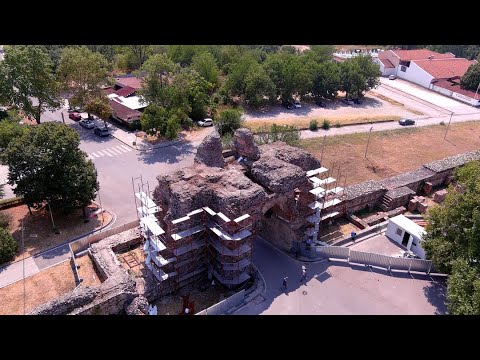
Hisarya is a spa town north of Plovdiv where streets, parks and hotels sit among the remains of Diocletianopolis. Its mineral springs drew people long before modern wellness tourism, and the Roman walls still give the town an unusually legible historic outline. The Bulgarian National Statistical Institute counted 5,844 residents in Hisarya at 31 December 2025. This is a figure for the town, not for the whole municipality or the seasonal guests using its baths.
Older springs and the Roman city
Occupation around the springs predates Rome; local accounts describe Thracian use of the area. That does not mean every Roman wall has a Thracian predecessor or that today's municipality has a known prehistoric founding date. An inscription discussed by the municipal tourism portal records that the springs were declared an imperial estate under Hadrian in AD 135–136. A substantial bathing complex began in the second century near the spring now called Momina Salza. The remains show a water-based urban economy well before the town acquired its late Roman name.
Under Diocletian around AD 293, the settlement became Diocletianopolis. Later Roman builders surrounded it with stone walls, towers and gates. The southern gate, popularly called the Camels, is the easiest landmark for understanding the circuit. Streets, bathhouses, residences, basilicas and a late antique tomb reveal a city with public, domestic and religious spaces. Hisarya's Archaeological Museum dates the tomb to the fourth century and notes its surviving floor mosaic. The bathing complex and walls are substantial remains, but the structures visible now represent phases of building, destruction and conservation across centuries rather than a city frozen in a single imperial year.
The later history is visible in the town's present form. After the decline of the antique city, settlement continued in surrounding quarters. Modern Hisarya grew as a mineral-water resort; the municipal history states that it was formally designated a town in 1964. The ancient walls now enclose public space used by residents as well as tourists. That overlap is one of Hisarya's strongest qualities: a route to a café or park can pass a Roman gate, while a museum visit explains why those ruins are here.
A walk through Diocletianopolis
Start at the southern gate and follow accessible parts of the wall before visiting the Roman thermae in Momina Salza Park. The municipal archaeology listing identifies multiple separate sites, including public buildings and a Roman family tomb, so do not assume that one ticket opens every monument. The Archaeological Museum publishes tickets and guided-tour options; its site specifically notes a separate charge for the baths. Check the museum's present access arrangements, as conservation work may affect which areas can be entered. The tomb's mosaic deserves time, but its interior has controlled visitor conditions and is not an open-air ruin.
Beyond archaeology, the mineral springs, colonnade and green streets make a slower afternoon. The town's spa facilities belong to today's hospitality economy, not to a claim that a spring cures any particular illness. Nearby Starosel has Thracian archaeological monuments and wine tourism, while Karlovo and Plovdiv are useful regional excursions. Keep those nearby destinations distinct from the ancient remains inside Hisarya itself.
Staying, dining and daily life
Hisarya has accommodation in town, ranging from smaller family hotels to larger spa properties. The municipal tourist portal lists, for example, Green Hisarya and hotel Chinar. It also lists restaurants including Provence, Chinar and other independently operated venues. Those names identify choices, not a verified ranking of the “best”. Check current prices, services and whether spa access is included directly with a property. For a prospective resident, year-round public transport and the difference between hotel districts and quieter residential streets deserve attention. The sources available here do not provide a defensible average rental price; a current, comparable sample would be required.
Reaching Hisarya
Plovdiv is the closest major city and the main connection to national and international routes. Hisarya Municipality posts a 2026 intercity bus schedule between the two, with some departures limited to weekdays or temporarily suspended during parts of the year. Use the current municipal timetable for a specific date. Hisarya also has a rail connection on the Plovdiv branch, though a traveller should check Bulgarian State Railways for current train times and changes. By road, Karlovo offers a northern approach, while Sofia travellers generally reach the Plovdiv region before continuing to Hisarya. The availability of buses and trains makes the town easier to visit without a car than many smaller mountain settlements.
Sources
- Hisarya Municipality, town history
- Hisarya Municipality, archaeological sites
- Hisarya Archaeological Museum, Roman tomb
- Municipal tourism portal, Roman baths and inscriptions
- Hisarya Archaeological Museum, visitor services
- Municipal tourism portal, hotels
- Municipal tourism portal, restaurants
- Hisarya Municipality, 2026 bus routes
- National Statistical Institute, settlement population at 31 December 2025