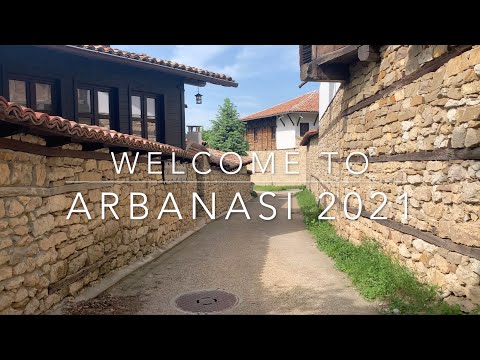
A village of enclosed courtyards above Veliko Tarnovo
Arbanasi stands on the heights near Veliko Tarnovo in northern Bulgaria. Its streets give only partial views of what lies behind substantial stone walls: merchant houses, enclosed gardens and churches with remarkably rich painted interiors. The village had 367 residents on 31 December 2025. It belongs to Veliko Tarnovo Municipality and Province, and its scale is quite different from that of the nearby former capital.
The pleasure of a visit comes from crossing thresholds. The outward appearance can be restrained and defensive, while a room or church interior reveals the wealth and cultural connections of earlier residents. Arbanasi works well as a separate half-day or longer stay alongside Veliko Tarnovo, rather than merely a viewpoint on the way through.
Origins and the trading community
The municipality places the earliest evidence for Arbanasi in the late fifteenth and early sixteenth centuries. Its securely described development belongs to the Ottoman period. Traditions connecting the locality with the medieval royal court should therefore be distinguished from the documentary history of the surviving settlement.
A privileged status connected with guarding a nearby passage helped attract inhabitants and economic activity. The village’s population had Albanian, Bulgarian, Greek and Vlach backgrounds, with Orthodox Christianity providing a shared religious framework. Greek language and writing also played an important role. This mixed Balkan history helps explain why the architecture and household culture cannot be reduced to a single isolated national tradition.
Livestock trading, meat processing, leatherwork, silk production and commerce supported prosperity. Merchants dealt with Constantinople and participated in networks reaching Transylvania and other European markets. The substantial houses were both homes and places from which goods, money and long-distance relationships were managed.
Church building and education developed alongside that economy. Seven churches were built, enlarged or painted between the sixteenth and eighteenth centuries. The settlement’s growth suffered a severe interruption when armed bands devastated it in 1798. Recovery followed, but Arbanasi did not regain the same earlier commercial importance.
Konstantsalieva House: architecture shaped by wealth and security
Konstantsalieva House began in the late seventeenth century and was altered in later periods. Its heavy street-facing construction, enclosing walls and separate entrances express the relationship between a wealthy household and the need for protection. A large gate admitted caravans carrying goods, while a smaller entrance served people on foot.
The lower level accommodated service and storage functions, including space for guards and goods. Upstairs, reception rooms and dining areas were arranged alongside bedrooms and service spaces. The ethnographic display presents nineteenth-century life. Details such as the heating arrangements and a specially organised room for a mother after childbirth make the house more than an exercise in decorative architecture.
Visit the interior rather than relying on the exterior walls. It is the contrast between those protected boundaries and the carefully organised domestic spaces that makes this house such an effective introduction to Arbanasi.
The Nativity Church: an interior built up over generations
The Church of the Nativity of Christ is one of the village’s principal museum sites. Its wall paintings were executed in successive campaigns, with dates recorded between 1597 and 1681. The result is a complex interior in which different spaces carry different cycles of imagery rather than one simple decorative scheme.
Among the subjects described by the museum are the Last Judgement, the Tree of Jesse and the Wheel of Life. A chapel dedicated to St John the Baptist adds another narrative cycle. Allow time to look across the individual rooms and galleries: the church’s exterior does not prepare visitors for the extent of the painted surfaces inside.
The regional museum manages visits and offers guided interpretation in several languages, including English and German. Booking arrangements matter, particularly for guided visits. Seasonal schedules, maintenance periods and holiday notices can affect access, so confirm the intended day with the museum rather than relying on a generic year-round opening time.
Other churches, village lanes and the nearby city
The Church of the Archangels Michael and Gabriel is another major museum stop. Together with the Nativity Church and Konstantsalieva House, it provides a useful core itinerary. Leave time between appointments for the lanes, courtyard entrances and stone fountains; the reserve’s interest includes its street pattern and domestic boundaries as well as its best-known interiors.
Veliko Tarnovo supplies a much wider urban context close by. Its historic hills and museum sites can be combined with Arbanasi, but the two places have different characters. Arbanasi’s merchant houses and painted churches reveal the regional economy and Orthodox culture of the Ottoman centuries, complementing the former capital’s better-known medieval story.
Where to sleep and eat
It is possible to stay in the village itself. Izvora Hotel is in central Arbanasi and combines an older building with newer accommodation in a traditional architectural style. Its listed facilities include rooms and apartments, a tavern, parking, an outdoor pool and a relaxation area. Seasonal availability should be checked when comparing a village stay with a hotel in Veliko Tarnovo.
Izvora’s tavern provides a verified local dining option. The operator lists indoor winter gardens, a summer garden, barbecue cooking, oven dishes and spit-roasted specialities. Garden seating and entertainment are not necessarily available in the same way every day, so discuss the intended meal when booking. The restaurant and accommodation together allow an evening in the village after the museum visits.
Arrival and the practicalities of spending more time here
Veliko Tarnovo is the main nearby base for approaching Arbanasi. Visitors travelling from Sofia, Varna or other larger cities can organise the intercity leg to that area, then confirm the short final road connection to the village. Gorna Oryahovitsa is also relevant when comparing rail itineraries. Do not assume that a ticket to a regional station includes the onward journey to a hotel in Arbanasi.
For a longer stay, compare the precise location of the property with museum entrances, dining options and the connection back to the city. The village’s quiet courtyards and small resident population can be attractive, while many wider services remain in the neighbouring urban area. A protected merchant house and a modern hotel may look stylistically related but offer quite different conditions for everyday living.
Sources
- Bulgarian National Statistical Institute: Arbanasi population, 31 December 2025
- Veliko Tarnovo Municipality: settlement history, trade and architectural reserve
- Regional History Museum: Konstantsalieva House and domestic architecture
- Regional History Museum: Nativity Church, wall paintings and visitor arrangements
- Regional History Museum: tickets and seasonal schedules
- Izvora: village location, accommodation and facilities
- Izvora tavern: dining rooms, garden and cooking