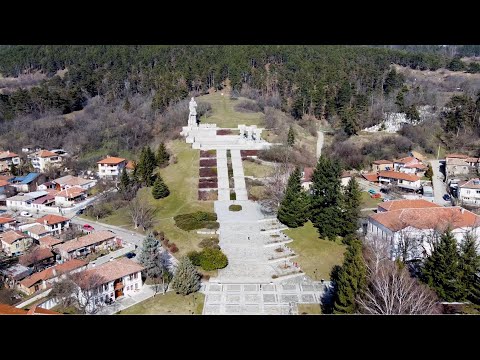
A town of poetry, rebuilding and fine lace below the Balkan Mountains
Kalofer stands on the Tundzha River beneath the southern slopes of the Balkan Mountains. It belongs to Karlovo Municipality in Plovdiv Province and had 2,475 residents on 31 December 2025. Its name is inseparable from the poet and revolutionary Hristo Botev, but a fuller visit also reveals an important history of clothmaking, education, destruction and recovery.
The centre, museum houses and mountain approaches belong to different parts of the experience. Start with the town’s history before heading towards the national park: the buildings explain why this relatively small place became so prominent in Bulgaria’s cultural memory.
Origins: a sixteenth-century town, with a legendary founder
The National Hristo Botev Museum dates Kalofer’s emergence to around the middle of the sixteenth century. It is not presented as a Roman or medieval foundation. The famous story of Kalifer Voyvoda receiving permission to settle the area he could ride around in a day is explicitly identified as a legend, not a securely documented founding event.
Cloth and braid production helped the town prosper during the Ottoman centuries. Its merchants travelled and traded beyond the local valley, and wealthy families supported education and religious institutions. The nickname “Golden Kalofer” reflects that period of prosperity; it should not be understood as evidence of an ancient gold-mining foundation.
In 1877, during the Russo-Turkish War, the town was devastated by fire and violence. Houses, the school and its library were destroyed. Reconstruction therefore forms an essential part of the present town’s history. A building in a traditional style is not necessarily an untouched survivor from before the war.
Hristo Botev and the reconstructed family home
Botev was born in Kalofer in January 1848 and became a poet, journalist and revolutionary. His life links the town with education, exile and the struggle against Ottoman rule. The national museum preserves documents, personal objects, publications and artworks connected with him, his family and his associates.
A particularly important distinction concerns the memorial house. It represents the home where Botev’s family lived for the longest period, not the room in which he was born. The original house was destroyed in 1877. The present building was reconstructed in 1942–1944 using family and local recollections and opened as a museum on 2 June 1944.
The domestic setting is recreated with period material, while the museum identifies original family objects including his mother’s spinning wheel and sewing machine. The separate exhibition hall, built in 1973, presents further objects, printing presses and material on Botev’s activities. This distinction between reconstruction and original exhibits makes the visit more informative than a simple “birthplace” label.
The school and the landscape of remembrance
Botyo Petkov School was established on the initiative of Botev’s father. It too was destroyed in 1877 and rebuilt afterwards. Its exterior was restored to its 1865 appearance in 1980, when the building became a museum. Recreated classrooms, a teachers’ room and displays on education explain the town’s place in Bulgaria’s National Revival.
The building also houses an art section with interpretations of Botev by Bulgarian artists. Around the centre, monuments and the larger memorial setting show how subsequent generations commemorated him. These works belong to the history of remembrance as well as to the nineteenth-century events they recall.
Kalofer lace: a livelihood that became an art
Kalofer’s bobbin lace offers another route into the town’s social history. Its technique developed from the Brussels lace tradition, while local makers introduced motifs such as flowers and leaves. It is a craft with a comparatively modern history here, rather than an unchanged survival from antiquity.
The Trudolyubie lace school opened in 1910 with a two-year training programme. The museum records approximately 1,800 women and girls receiving professional skills through the school. After its closure in 1935, production continued in homes and knowledge passed through families. Ask locally about demonstrations or exhibitions; the continued existence of the craft does not mean a workshop can receive visitors without arrangement.
The mountains and an important access restriction
Kalofer is a base for the southern side of Central Balkan National Park. The Byala Reka gorge trail is described by the park as lying approximately 6.5 kilometres northwest of town near the monastery, with bridges and interpretation panels. A description of the route, however, is not proof of present access.
When checked in November 2026, the park’s temporary-restrictions page continued to list restrictions at the Byala Reka visitor complex until construction work is completed, including visitor stays and motor-vehicle access towards the campsite. Do not plan an excursion on the assumption that an older guide or video shows a currently open facility. Obtain the latest position directly from the park before choosing that outing.
Accommodation and places to eat
There are guesthouses in Kalofer itself. The local tourism directory lists Pri Chorbadzhiykata, described as a guesthouse with a courtyard and its own tavern. Confirm rooms and meal service directly for the intended dates. A central address can be more convenient for the museums than an accommodation listing covering the wider mountain area.
Raiski Kat is in the Panitsite locality outside the centre. Its own information offers breakfast, dinner choices and arrangements for guests wishing to prepare a barbecue. This is a countryside accommodation option, not a restaurant on the central museum circuit. An early walking departure can be discussed when arranging meals.
Byala Reka restaurant, on the I-6 Sofia–Burgas road by Kalofer, provides a separate verified dining option associated with a fish farm. Its menu includes trout and fish dishes. Despite the shared name, the roadside restaurant should not be confused with the national park’s visitor complex or used as evidence that the gorge route is open.
Connections and a longer stay
Karlovo is the nearby municipal centre, while Plovdiv and Sofia are relevant larger-city approaches. The sub-Balkan I-6 corridor links the area with other towns along the southern side of the range. A journey can therefore combine Kalofer with neighbouring cultural destinations rather than treating it as an isolated mountain detour.
There is also a railway station serving Kalofer, with a separate transfer into town. The local tourism site describes a connecting minibus, but some published timetable material dates from 2021–2023. Check the current train and matching transfer rather than copying those departure times into a travel plan. For a longer stay, the distinction between a town-centre property and a mountain locality matters as much as the room itself.
Sources
- Bulgarian National Statistical Institute: town population, 31 December 2025
- National Hristo Botev Museum: foundation tradition, economy and destruction in 1877
- National Museum: chronology of Hristo Botev
- National Museum: reconstructed family house, objects and exhibition hall
- National Museum: Botyo Petkov School and education displays
- National Museum: bobbin lace, training and craft history
- Central Balkan National Park: Byala Reka gorge route
- National Park: current restrictions, including the Byala Reka visitor complex
- Local tourism directory: guesthouses and accommodation
- Local tourism directory: rail station transfer and intercity approaches
- Raiski Kat, Panitsite: accommodation-related meal arrangements
- Byala Reka restaurant: fish dishes and location on the I-6