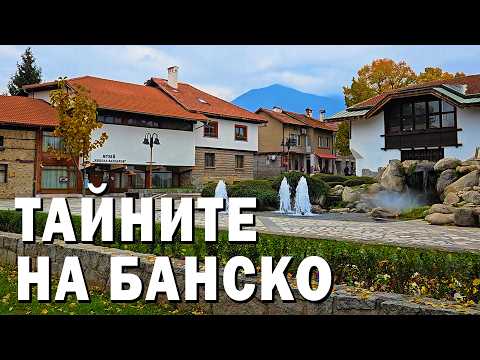
Bansko stands at the foot of the Pirin Mountains in south-western Bulgaria. The ski lifts and apartment buildings draw attention in winter, but the older town around Holy Trinity Church has a different history: trading families, stone-built houses, schools and an unusually dense group of museums. It is also a working municipality with rail access, shops and year-round residents. The Bulgarian National Statistical Institute counted 10,189 residents in the town on 31 December 2025; this is a settlement figure, not a total for the municipality or its winter visitors.
How the town developed
Archaeological remains in Bansko's wider territory include Thracian burial mounds and ancient fortifications at Staro Gradishte and Yulen. They establish occupation in the district, not the foundation date of the present town. The municipal history describes Bansko as a settlement formed through the joining of neighbourhoods in the fifteenth and sixteenth centuries. Its first identified written mention is in a 1576 Ottoman register of sheep breeders. That distinction matters: the ancient remains and the documented community belong to different layers of its past.
Animal husbandry, forestry and crafts supported the settlement until the eighteenth century. During the Bulgarian National Revival, Bansko became a commercial and artisanal centre. Mills, sawmills, cloth-working installations and tanneries lined the Glazne; caravans carried timber, leather and iron goods towards the Aegean and brought other products back. The municipality records merchant connections reaching Central and Western Europe. Prosperity left a visible architectural legacy in the thick-walled houses and painted interiors of the old quarter. Holy Trinity Church was consecrated in 1835; its bell tower followed in 1850 and a clock mechanism in 1865.
The town's intellectual history is as striking as its commerce. The municipality associates Bansko with Paisii of Hilendar, author of the 1762 Slavonic-Bulgarian History, and with the educator Neofit Rilski. The local school developed from a churchyard school in 1838 to secular education in 1847, with a new school building in 1857. In the late Ottoman period Bansko also took part in the struggles of the Razlog district: the 1878–79 Kresna–Razlog uprising, the organisation around teacher Gotse Delchev in 1896 and the 1903 Ilinden–Preobrazhenie uprising. The area entered Bulgaria in 1912, rather than at the 1878 liberation of much of the country.
What to see in Bansko
Begin in the streets around Holy Trinity Church and Nikola Vaptsarov Square. The museum complex makes the Revival history tangible through several separate houses. Neofit Rilski's eighteenth-century family house contains books and teaching material; Velyanova House shows the domestic architecture and interior decoration of a prosperous household. Radonova House presents history and ethnography, while the Nikola Vaptsarov house museum follows the twentieth-century poet's life. The museum's reconstruction of Paisii's Hilandar cell is an interpretation of the Athos setting, not an original cell transported to Bansko. Check the museum operator's current opening hours before combining several buildings in one day.
The gondola and ski area above town provide the most obvious winter excursion, but lifts and slopes are seasonal and their operation depends on conditions. The operator publishes live lift information. Outside the ski season, the town is a base for the Pirin landscape; a mountain walk should be chosen using current park and weather guidance rather than assuming that a ski route is an ordinary summer trail. Razlog and the spa town of Dobrinishte are nearby alternatives for a half-day trip. The old centre remains worth exploring even if no mountain transport is running.
Sleeping, eating and living here
Bansko has accommodation in both the historic centre and the newer lift-side district. For a concrete central option, Bansko Municipality lists the Orekha family guesthouse close to the old town and Holy Trinity Church. Hotels, apartments and guesthouses vary sharply in seasonal demand; the cost of a winter holiday or of a long-term home should be checked directly with a current provider. No single advertised rental can stand for a reliable town-wide average. Restaurants known locally as mehanas offer a more traditional meal in and around the centre, while the lift-side streets have the resort's broader dining choice. Check whether a particular kitchen is operating outside its main season.
For someone considering a move, the contrast between the compact lived-in centre and the visitor-oriented slopes is more useful than a resort slogan. Tourism creates hospitality and service work, yet the old town also has schools, municipal offices and everyday shops. Winter brings busier streets and accommodation pressure. A prospective resident should visit in more than one season and examine a specific neighbourhood, building and transport routine rather than treating the entire town as one uniform housing market.
Getting there
By road, Bansko is reached through the Razlog basin from the Sofia direction and from Blagoevgrad through the Predela area. Allow for mountain weather and road conditions in winter. By rail, Bulgarian State Railways' Septemvri–Dobrinishte narrow-gauge route runs through Velingrad, Yakoruda, Razlog and Bansko station. This is an unusually scenic but slower way to arrive; a traveller from Sofia or Plovdiv must plan a connection at Septemvri. Dobrinishte lies beyond Bansko on the same line. Consult the current railway timetable and lift operator separately, because train service and mountain lifts are different systems.
Sources
- Bansko Municipality, history of the town
- Bansko Museum Complex, collections and visitor information
- Bansko Municipality, Orekha guesthouse
- Bulgarian State Railways, Septemvri–Dobrinishte narrow-gauge line
- Bansko Ski, lifts and slopes
- National Statistical Institute, settlement population at 31 December 2025