Panicale rises on the eastern slope of Monte Petrarvella, between Lake Trasimeno and the Nestore valley. From its streets, the view shifts between water, cultivated hills, olive trees and the broader Umbrian countryside. Istat’s estimate for 1 January 2026 counts 5,317 residents in the whole municipality, which includes settlements beyond the historic centre; it is not a headcount of the hilltop village alone. The distinction matters here: the compact medieval core is a visitor’s first impression, while the larger municipality includes the commercial centre of Tavernelle and a wider rural landscape.
A fortified town arranged around the hill
Panicale’s shape is unusually legible on foot. The regional visitor guide describes an elliptical plan that follows the contours of the hill, entered through the eastern Porta Perugina and western Porta Fiorentina. Three main squares sit at different levels: Piazza Umberto I below, Piazza San Michele in the middle and Piazza Masolino at the highest point. The order links daily life, the church and the old civic centre rather than presenting a single monument in isolation. At Piazza Umberto I, an octagonal travertine cistern dated 1473 was later converted into a fountain in 1903; nearby stands the brick-and-stone Palazzo Pretorio.
The upper square leads to the fourteenth-century Palazzo del Podestà and the ridge-top outlook. The town’s long relationship with Perugia is visible in its civic coat of arms, which combines a tower and millet ears with the Perugian griffin. Local explanations of the name Panicale are less certain: municipal and regional accounts propose links either to panìco, a millet-like cereal once grown in the area, or to the Greek god Pan. These are competing etymologies, not settled fact. The Comune’s visitor history says the earliest settlements probably date to the second millennium BCE, while the regional portal associates the town’s beginnings with Etruscan Chiusi; neither page supplies the excavation record behind those claims. A firmer written point is the first compilation of Panicale’s municipal statutes in 1316. It is better to describe older origins as provisional than to assign the village a precise founding date.
Perugino, a small theatre and the town’s textile story
Panicale rewards visitors who make time for its interior spaces. In the church of San Sebastiano, Pietro Perugino’s large Martyrdom of Saint Sebastian, dated 1505, fills much of the wall. The same church preserves a group of musician angels attributed by the municipal itinerary to Raphael; the attribution should be read as an attribution, not an undisputed signature. In the Collegiate Church of San Michele Arcangelo, the itinerary identifies Giovanni Battista Caporali’s Adoration of the Shepherds, painted in 1519, and an Annunciation attributed to Masolino.
The Cesare Caporali Theatre gives the village another cultural scale. The regional guide traces it to the Teatro del Sole, recorded in 1786, and says the building was remade in 1858 by Giovanni Caproni. Mariano Piervittori painted its curtain in 1859 with a scene of the Perugian city presenting keys to the captain Boldrino da Panicale. Today the theatre is a venue for cultural events, but performances and access depend on the current programme; check before building a visit around it.
One of Panicale’s most distinctive stories is not a single artwork but the craft of embroidery on tulle. The former church of Sant’Agostino, finished in 1502 according to the date above its doorway, now houses the Anita Belleschi Grifoni Tulle Museum. The municipal account traces lacework in local convents to at least an eighteenth-century regulation from 1750. In the 1930s, Anita Belleschi Grifoni developed a locally distinctive form of embroidery on tulle, known as Ars Panicalensis. The Comune’s account describes a school where women worked together and earned income through a skilled craft. That history brings women’s labour and economic independence into a town narrative often dominated by male painters and military figures.
Across the road from the old gate, the church of Madonna della Sbarra holds a collection of liturgical objects and vestments dated from the seventeenth to nineteenth centuries. Beyond the historic core, the sanctuary of Madonna di Mongiovino, consecrated in 1646, is a notable Renaissance destination in the municipal territory. Accounts disagree over its architectural designer: nineteenth-century histories name Bramante, while other documents cited by the Comune point to Rocco da Vicenza. The sanctuary’s story is a good example of why a guide should preserve a documented disagreement instead of choosing the more famous name.
Landscape, food and nearby stops
Panicale looks across two different settings: the distant lake and the broad valley of the Nestore. Olive and oak groves, cultivated slopes and the brick colour of the centre shape the landscape promoted by the regional tourism service. Local accounts connect the area’s agriculture with grain and wine, while Tavernelle is described by the Comune as the municipality’s commercial and productive centre. The town’s annual grape festival and the historic importance of embroidery point to a mix of farming, craft and cultural activity rather than a single industry.
A compact walk can begin at Porta Perugina and Piazza Umberto I, climb past San Michele and finish at Piazza Masolino and the Palazzo del Podestà. Leave by Porta Fiorentina for Sant’Agostino and the tulle collection, then visit San Sebastiano for the Perugino fresco. If time allows, the municipal museum route continues to Madonna della Sbarra. A longer excursion by car can add Mongiovino or the sanctuary of Grondici; confirm access to the rural sites before setting out. Lake Trasimeno’s shore, Paciano and Città della Pieve make natural extensions to a stay, each offering a different landscape and historic centre.
Getting there and practical information
Busitalia’s winter timetable, valid from 14 September 2026 to 8 June 2027, includes Panicale on selected journeys of line E014, which runs between Perugia, Tavernelle, Città della Pieve and Chiusi. The route also lists Chiusi railway station, so a rail-and-bus connection is possible when the services align. Not every departure serves every stop, and many trips operate only on specified weekdays or school days. Check the exact outward and return schedules before travelling. By car, follow current navigation to the town and use signed parking outside the narrow central lanes.
The municipal tourism office is listed at Piazza Umberto I, but its opening arrangements can change with the season. The same applies to the tulle museum, churches and theatre: the Comune’s online museum timetable includes older seasonal notices, so contact the local information office for current access. Panicale is best understood as more than a viewpoint: its layered piazzas, Renaissance art, women’s textile work and working municipal territory show how a small hill town connects cultural heritage with everyday life.
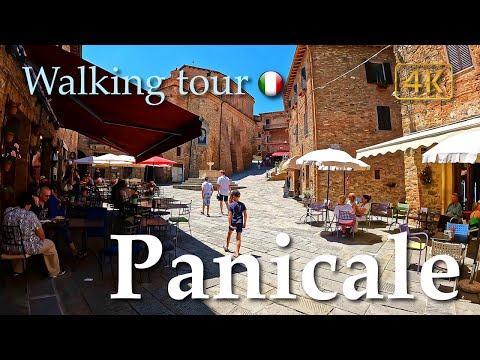 Panicale on film: walking tour, aerial views and the Perugino landscape
 Nicoló Di Benedetto presents Panicale in a short 4K cinematic film and says the footage was made with a small DJI drone. That aerial approach offers a different visual scale from the walking tour: it introduces the village as a built settlement on a hill rather than a sequence of individual streets. The description calls it one of Italy’s most beautiful villages, a promotional phrase rather than a measurable ranking. Use the film for landscape and orientation, then rely on local cultural information for the history of the frescoes, theatre and lace tradition.
 Le Paysage du Pérugin was made for the Paris exhibition Le Pérugin, maître de Raphaël and funded by Umbria’s regional government on behalf of the municipalities of Panicale and Città della Pieve. The towns’ own account says the film brings together places, art, landscape and events connected with the painter. That regional frame is its strength: it invites viewers to see Panicale within a wider artistic itinerary instead of as an isolated postcard. It dates from 2014, so it is best treated as cultural context, not a current visitor-service guide.