Deruta is known through the objects made here: bowls, pharmacy jars, floor tiles, devotional plaques and richly painted maiolica. But the town is more than a label on a ceramic plate. Its craft grew inside a fortified settlement above the Tiber Valley, and its workshops still work alongside churches, museums, shops and residential districts. Italy’s statistics institute estimated 9,562 residents across the whole municipality on 1 January 2026; that is the municipal population, not a count of the historic centre alone. Italian is the official and predominant written language of the local administration, so this is also the local-language edition.
A town shaped by clay, kilns and trade
Deruta occupies a low hill in the Middle Tiber Valley, near routes that connect Perugia with towns to the south. The Comune’s visitor account tells an origin story in which people left Perugia after the city was burned in 40 BC and settled on the hill; it links the name Deruta to the Latin idea of something “ruined” and calls the height “Perugia Vecchia.” This is a local foundation tradition, not proof of a documented migration that founded the present town. Archaeological objects from different periods show that the wider area was inhabited, but they do not by themselves establish a precise founding date for Deruta.
The town’s more traceable history is tied to ceramic production. Regional tourism sources cite a public order for building material in 1277 and records of organised potters by 1336. The municipal archaeological account identifies kiln structures at San Salvatore near the walls, with parts dating from the late thirteenth century onward. These finds make pottery more than a modern souvenir industry: they place production within the medieval town’s economy and built landscape.
Early maiolica was practical as well as decorative. Medieval pieces used a pale glazed surface with green copper and manganese-brown designs, often geometric, floral or zoomorphic. During the fifteenth century, brighter colours and more elaborate motifs expanded the decorative range. Deruta became especially associated with lustre, an iridescent metallic finish created through a further firing. Floral scrolls, grotesques, the “petal back” and the crown-of-thorns motif are among the forms documented by the municipality. The craft evolved with changing tastes and markets; it was not one unchanging style passed intact through the centuries.
The museum and the kilns beneath the streets
The Regional Museum of Ceramics, founded in 1898, is housed in the former San Francesco convent. Its collection numbers more than 6,000 works and follows Deruta’s production from archaic and medieval pottery through the twentieth century. The arrangement includes pharmacy ceramics, votive plaques, maiolica floors, lustreware and contemporary pieces, as well as an archaeological section with Greek, Italic, Etruscan and Roman ceramics from the wider area.
One unusual feature is a four-storey metal structure connected to the convent, where study and storage collections are displayed behind glass. A visit continues underground: a tunnel links the museum to the San Salvatore kiln area, uncovered during construction work in 2008. Archaeological investigation found a sequence of production structures spanning the late 1200s to the early 1700s, including kilns, an area for settling clay and traces of a melting furnace. The combination lets visitors connect an object’s finished surface to the demanding work of preparing clay, firing vessels and controlling heat.
The former Fornace Grazia, a sixteenth-century kiln now restored as a museum and visitor-information space, offers another view of how the craft occupied the town. Several private historic kiln sites are also identified by the Comune, but access is not automatic: ask locally which workshops or sites are open and whether visits need to be arranged. Some contemporary studios offer demonstrations or hands-on sessions in throwing, painting and glazing. Availability depends on the individual workshop, so book directly rather than expecting every shop to operate as a public museum.
Three gates into a compact historic centre
The walled centre can be entered through Porta Perugina, Porta Tuderte or Porta di San Michele Arcangelo. Approaching through the latter, visitors encounter remnants of the old defensive enclosure and the kiln landscape near the edge of the settlement. Via Michelotti leads past the former church of San Michele and a polygonal fountain dated 1848 toward Piazza dei Consoli, the civic heart of Deruta.
The fourteenth-century Palazzo dei Consoli, with its tower and paired windows, faces the town hall. The municipal art gallery is housed in the palace and brings together works that place Deruta within Umbrian painting and devotion: a Perugino fresco of the Eternal Father with Saints Rocco and Romano dated 1476, the Madonna dei Consoli by Niccolò di Liberatore, known as l’Alunno, and the Gonfalone of Sant’Antonio Abate. The collection also includes a Franciscan parchment missal from the late thirteenth century and paintings collected by Lione Pascoli. The church of Sant’Antonio Abate, on the same square, contains frescoes associated with Bartolomeo Caporali and an eighteenth-century choir loft.
Across the piazza, the Gothic church of San Francesco is part of the convent complex that houses the ceramics museum. Its wall paintings, the maiolica altar and the medieval fabric show how ceramic art entered religious space as building material and furnishing, not only as portable tableware. The municipality’s historical page describes some early dates cautiously and notes uncertainty around the building’s earliest phase; it is safer to focus on the documented medieval and later works than to repeat a single foundation year as certain.
Devotion, craft and the outlying settlements
Deruta’s ceramics also preserve acts of private gratitude. At Casalina, beyond the main centre, the Santuario della Madonna del Bagno holds more than 700 votive maiolica tiles commissioned after prayers for recovery from illness, accidents or other misfortunes. The shrine’s origin is told through a devotional narrative set in the seventeenth century: local tradition recounts an image found near a spring and a first grace. The story belongs to the history of popular devotion; it should not be confused with independently documented evidence for a miracle. The ex-votos themselves are material testimony of faith, local workshops and personal experience over generations.
Casalina, Ripabianca, Sant’Angelo di Celle, San Nicolò di Celle, Fanciullata and Castelleone give the municipality a rural dimension beyond the ceramic centre. The Comune documents active and historic kilns outside the main borgo, including a family kiln in Ripabianca. In the town, artisans, ceramic retailers, food businesses, visitor services and the museum economy all contribute to the visitor-facing side of Deruta. The municipality’s 2026 support programme for new shops, craft businesses, hospitality and personal services in the historic centre also shows that maintaining everyday commerce there remains a current concern. The town is a place of production and residence, not simply an open-air showroom.
How to make the visit useful
Start with the museum and kiln tunnel, then walk to Piazza dei Consoli, the Pinacoteca, San Francesco and Sant’Antonio Abate. The municipal visitor service lists guided walks of the historic centre, and the former Fornace Grazia is an information point; check current booking arrangements. If time allows, continue to the Madonna del Bagno sanctuary at Casalina, especially if you want to understand how maiolica served domestic devotion as well as commerce. A workshop visit can add a practical dimension: seeing the clay shaped, the glaze applied and the finished piece fired makes the museum’s technical sequence easier to read.
From Perugia, Busitalia publishes extra-urban services on the Perugia–Tavernelle–Città della Pieve–Chiusi corridor, with Deruta listed among the stops; the operator’s current schedules should be checked before departure. By road, Deruta lies on the Middle Tiber route south of Perugia and is reached from the SS3bis corridor. The historic centre is steep in places, while some museum sections are arranged across several levels. Ask about accessible routes, opening times and workshop visits in advance. Do not assume that a listed kiln, church or studio will be open on the day.
Deruta rewards visitors who look at both sides of its reputation: the skill visible in a finished plate and the physical, economic and devotional settings that made it. The museum preserves centuries of production, the archaeological kilns give that history a place, and current workshops keep craft knowledge connected to a living town.
 Deruta in three views: museum, medieval streets and a working ceramics workshop
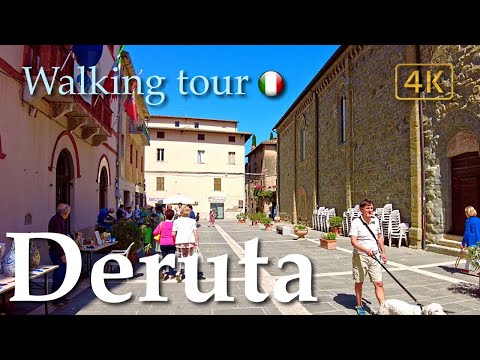 This subtitled walking tour gives a second, street-level introduction to Deruta, helping viewers see the gates, lanes and hilltop layout beyond the museum visit. It is distinct from the first film because it foregrounds the town as a place to walk, rather than a sequence of collection rooms. The upload’s description uses an old population estimate and a broad promotional label for the ceramics; those are not reliable current statistics. For present-day population and historical claims, use the official sources cited in the guide, and check the current municipal visitor service for routes and access.
 Ceramiche Sambuco’s workshop film offers a maker’s perspective on the craft that gives Deruta its name. The company presents the stages of ceramic work and invites visitors to arrange a workshop visit; this makes the film particularly useful for people interested in seeing production rather than only buying finished pieces. It documents one operating artisan business, not every workshop or the whole local economy. Contact the maker directly to confirm whether visits are available, what is demonstrated and whether an appointment is required.