Bevagna sits on the flat floor of the Valle Umbra, where the ancient road across the valley met river routes and the agricultural hinterland. That setting still shapes the visit: the old centre is compact and easy to explore on foot, while the wider municipality stretches into vineyards, olive groves, fields and fortified hamlets. Its appeal comes from the way different periods remain close together. A Roman bath mosaic lies a short walk from a medieval square; active craft workshops recall the work represented in the town’s best-known festival; beyond the walls, country lanes lead to sanctuaries and small hill settlements.
\nIstat’s estimated resident population on 1 January 2026 was 4,736 for the whole municipality, including its outlying settlements, not just the historic centre. The figure belongs to the age-and-sex population estimate aligned with census results and the provisional 2025 balance. The Comune’s older visitor page gives a different, earlier count, so it should not be read as the current total. Italian is the official written language used by the municipality and local institutions; this guide therefore uses Italian for its local-language edition.
\nMevania: a road junction, not a Roman foundation myth
\nThere is evidence of human presence in the area from the Iron Age and archaeological finds associated with the Umbri. The earliest written history cited by the municipality begins with Rome’s conquest of Umbria. Mevania became a Roman municipium in 90 BCE and was assigned to the Aemilia tribe. The Via Flaminia, laid out in 220 BCE, and river transport helped connect the settlement to wider commercial networks. This is a documented Roman chapter in a much older landscape; it does not prove that Rome founded the town, nor does it require a Greek or legendary origin story.
\nThe Roman town is still legible in fragments rather than in a single open-air archaeological park. At the Trivio, the Comune identifies the crossing of the Flaminia, the principal east-west route through Mevania, with the cardo running toward Spoleto and Perugia. Nearby are remains of a temple and public baths. The surviving frigidarium contains a black-and-white marine mosaic, a rare intimate encounter with Roman public architecture inside today’s town. The theatre is another striking example of continuity: its curved footprint can still be read in the line of houses built over the ancient structure. Some remains are integrated into buildings or have limited access, so check locally which spaces can be visited on your date.
\nMevania’s fortunes were tied to changing routes. The municipal account says the town prospered through road and river commerce until the third century CE, when the route of the Flaminia through Terni and Spoleto gained importance. Later, Bevagna formed part of the Duchy of Spoleto and then the Papal States. After the year 1000 it became a free commune governed by consuls. The surrounding plain was marshy in places; reclamation began in 1456, achieved practical results in the second half of the sixteenth century, and developed into a more complete hydraulic system during the eighteenth and nineteenth centuries. That long process explains the cultivated valley visible from the roads around town better than any romantic claim that the landscape has always been unchanged.
\nA medieval square built around civic life
\nPiazza Filippo Silvestri is the natural centre of a first visit. Its irregular arrangement is not a flaw to be tidied away: the Comune dates the square’s overall form to the twelfth and thirteenth centuries and describes it as a meeting point of civic and religious power. Palazzo dei Consoli, built in 1270, has Gothic mullioned windows and a vaulted loggia; since 1886 it has housed the Teatro Francesco Torti, whose interior decoration is associated with Domenico Bruschi and Mariano Piervittori. Across the square, the Romanesque churches of San Silvestro and San Michele make a close pair. San Silvestro is dated to 1195, and its raised presbytery and crypt reward a slower look than a quick photograph from the piazza.
\nFrom there, Corso Matteotti follows the line of the old Flaminia through the centre. The town museum in Palazzo Lepri adds context through three sections: archaeological material from archaic, republican and imperial periods; medieval parchment documents; and paintings from the sixteenth to eighteenth centuries, including works by Dono Doni, Corrado Giaquinto, Joseph Esperlin, Andrea Camassei and Ascensidonio Spacca. The museum’s municipal page says the entrance is accessible for visitors with disabilities and gives a phone number for questions. Prices and opening hours can change; confirm them with the Comune before travelling rather than relying on an old listing.
\nThe Gaite: a community that keeps craft knowledge visible
\nBevagna’s most distinctive contemporary cultural project is the Mercato delle Gaite. Four historic districts—San Giorgio, San Giovanni, Santa Maria and San Pietro—compete in a late-June event that reconstructs civic and everyday life between 1250 and 1350. It grew from a local festival: the Pro Loco added a medieval market in 1983, and the association that organizes the event was formally established in 1989. The Comune describes four contests, devoted to crafts, food, the market and archery, with expert juries assessing different parts of the programme. Dates and access arrangements vary each year, so treat the festival as a seasonal reason to plan ahead rather than as a guaranteed daily attraction.
\nThe more durable legacy is the year-round Circuito Culturale dei Mestieri Medievali. Its four reconstructed workshops show how materials become finished objects: the paper mill makes bambagina paper from textile rags with water-powered machinery; the cereria forms beeswax candles around hemp wicks; the setificio demonstrates silk processing and twisting; and the dipintore explains preparation of panels, pigments and binders for tempera painting. The association currently describes visits as available during holidays and by reservation at other times. Book in advance and verify openings directly. This is not a museum of static tools: the value lies in seeing a person demonstrate a sequence of work and explain why it mattered.
\nBeyond the centre: walls, villages and the working landscape
\nA walk of about 1.7 kilometres follows much of the town’s medieval wall circuit, which overlaps in places with the Roman line. Porta Foligno, Porta Cannara, Porta Guelfa and Porta Molini help visitors read how the town expanded and defended its approaches. The route is a useful pause between museum and lunch, though the Comune’s descriptions note uneven historic surfaces and sections with steps. For a longer outing, an official municipal itinerary climbs about 2.5 kilometres from Porta Todi to the Sanctuary of Madonna delle Grazie, whose first stone was laid in 1583, and continues toward the walled settlement of Gaglioli. Other country routes pass Torre del Colle, Cantalupo, Castelbuono and Limigiano. Some paths are steep or unpaved, and some churches, villas and ruins are not continuously open; check access and conditions before setting out.
\nThe economy of the municipality remains visible in its geography. The Comune describes wheat, maize and tobacco in the plain, with vines and olives on the hills; wooded slopes and watercourses frame the agricultural fields. The Mercato delle Gaite has also helped develop visitor accommodation, food businesses and educational tourism, while the medieval workshops connect cultural activity with skilled craft. This is a useful way to understand Bevagna as a lived-in place: heritage is part of local work and community organization, not merely a backdrop for visitors. Restaurants and lodging are available in the centre and surrounding countryside, but opening periods can be seasonal; the municipal visitor office at Piazza Filippo Silvestri can help with current information.
\nGetting there and planning a day
\nFor a public-transport approach, take a regional train to Foligno and connect with the Busitalia Montefalco-Bevagna Link. The operator says the bus leaves from the square in front of Foligno station, takes about 20 minutes to Bevagna and stops at Piazzale Trattati di Roma; a stairway leads from there through Porta Cannara into the historic centre. From Rome, the municipal guide lists rail service via Orte and Foligno; from the Adriatic side, trains reach Foligno from Ancona. By car, the Comune’s directions use the SS75 from the north and the SS Flaminia from the south. Bus days, stop patterns and seasonal services can change, so check the current timetable and train connections for the exact date.
\nA balanced day starts at Piazza Silvestri, visits the Roman remains and museum, and follows the wall walk before lunch. If a workshop visit is available, reserve it; otherwise, use the afternoon for a countryside route or a short trip to nearby Foligno or Montefalco. Bevagna is not a place that needs a fabricated legend to hold attention. Its layers are already compelling: an Umbrian landscape, a Roman road town, a medieval commune and a present-day community that has made historical craft into a shared cultural practice.
\n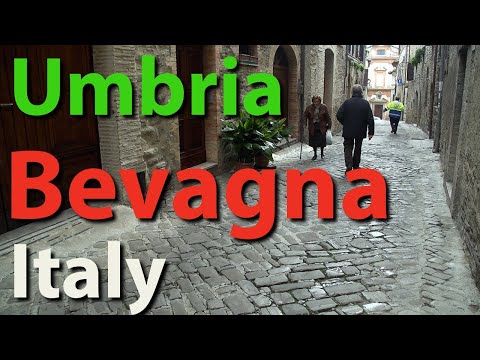 Bevagna on foot, through its crafts and from above
 Monferrato Web TV’s report focuses on the Mercato delle Gaite and the reconstructed medieval crafts in Gaita San Pietro. The film offers a closer view of how Bevagna’s historical festival is built from hands-on demonstrations and workshop knowledge, rather than only costumes and street scenes. Its subject connects directly with the permanent craft circuit, where visitors may see techniques associated with paper, candle making, silk and painting. The feature is especially useful for understanding the work behind the event and why the four districts matter to local identity. It was published in 2023 and describes the festival period and practices of that year; current dates, workshop openings and reservation rules should be confirmed with the association before a trip.
 Aerial Pictures’ 4K drone film gives a different scale of view, showing Bevagna as a compact settlement within the open Umbrian landscape. The overhead perspective helps explain the relationship between the enclosed historic centre, the plain and the surrounding agricultural countryside. It works well as a visual introduction before following the town’s walls on foot or travelling onward toward Foligno and Montefalco. Aerial footage is strongest at showing form and setting; it cannot replace a close look at the Roman frigidarium, the medieval buildings or the working craft shops. The source identifies the film as a DJI Mini 4 Pro drone video, but a dependable original upload date was not available, so no date is stated here.