Bettona looks across the broad Umbrian Valley from a hill on the northern edge of the Monti Martani. From its lanes, Assisi and Perugia appear across the plain, while the surrounding countryside alternates between olive groves, cultivated fields and small settlements. This is not only a viewpoint above the valley: the compact old town grew on an ancient site, and its present character is the result of Etruscan and Roman traces, a severe medieval destruction, and a careful reconstruction behind fortified walls. A visit makes most sense on foot, with time for the museum and the quieter streets between the two central squares.
Istat’s estimated resident population for 1 January 2026 is 4,247 for the entire municipality, including its outlying settlements, rather than only the hilltop centre. The estimate is based on census results and the provisional 2025 population balance. The ancient name Vettona is recorded in historical sources, and archaeological finds support an Etruscan presence and later Roman municipal life. Local and regional accounts associate the settlement with the Etruscans and say it became a Roman municipium in 90 BCE. The proposed meaning and origin of the name are less certain: a regional tourism page connects it with Vetumna, while the municipal history records a popular explanation involving the betonica plant. Neither explanation should be treated as established fact.
A town rebuilt after the siege
The walls are the clearest visible record of Bettona’s strategic position. The surviving circuit combines medieval fabric with sections attributed to an earlier Etruscan fortification. Official regional descriptions do not agree on the precise date of the ancient wall: one places it around the sixth century BCE, while its dedicated wall account estimates the third century BCE by comparison with other Umbrian circuits. What is well documented is the later rupture. In 1352, Perugia captured and largely destroyed Bettona after a siege. The papal legate Cardinal Egidio Albornoz ordered the town rebuilt in a smaller but more heavily defended perimeter; the civic account places that reconstruction in the later fourteenth century. The Palazzo del Podestà, completed in 1371, belongs to that renewed civic centre.
Two linked squares organize the historic core. Piazza Cavour is the setting of the medieval palace and the Museo della Città; Piazza Garibaldi gathers civic and religious buildings around its fountain. Narrow stone lanes connect them, opening now and then onto a small garden or a view between houses. The local visitor portal describes a panoramic walk of about 1.5 kilometres along the walls. It is a rewarding way to read the town’s shape and look over the valley, though the slopes and stone paving call for comfortable shoes.
From Etruscan finds to Renaissance painting
The town museum occupies the Palazzo del Podestà and the nineteenth-century Palazzo Biancalana. Its archaeological rooms contain Etruscan material, architectural terracotta, ceramics, funerary and boundary markers, Hellenistic sculpture and Roman marble. The nearby Colle necropolis adds an important link between the hill town and its rural surroundings: a chamber tomb cut from local sandstone dates to the second or first century BCE. Finds from the tomb, including grave goods, are now held at the National Archaeological Museum in Perugia; visitors should not expect to see those objects in Bettona’s collection unless a temporary exhibition is announced.
The museum’s picture gallery gives the visit a second focus. Its collection includes sacred art from the fourteenth through nineteenth centuries, with works attributed to Pietro Perugino, paintings by other Umbrian artists, glazed terracotta associated with the Della Robbia workshop, and a signed bust of Antonio Canova dated 1812. One of the works most closely associated with the town is the Madonna della Misericordia, in which the Virgin shelters a group of worshippers. The museum is housed in historic buildings, so the art is encountered within the civic spaces that shaped Bettona’s later life. The municipality announced a temporary change to museum and library opening hours on 28 September 2026; check the latest municipal notice before planning a visit.
Nearby churches add layers rather than a single uniform style. Santa Maria Maggiore was enlarged and reconsecrated in 1225, then substantially altered in later centuries; the surviving Gothic chapel of Santa Rita contrasts with the church’s later appearance, and Gerardo Dottori painted the apse in 1939. San Francesco has a twelfth-century origin and a richly reworked interior. The Oratory of Sant’Andrea preserves a Passion cycle dated 1394 and a coffered ceiling. San Crispolto remains central to local devotion, but the saint’s life belongs partly to hagiographic tradition: the municipal history itself points out a chronological conflict in accounts that place his arrival with the apostle Peter and his martyrdom in the third century. The historic cult is real; those legendary details are not secure biography. Check church access locally, since opening is not guaranteed throughout the day.
Beyond the walls: Colle, Passaggio and the countryside
Bettona is a municipality of several places, not just its hilltop centre. North of the old town, the former Franciscan monastery of Sant’Antonio dates to 1502 and is associated with the January feast of Saint Anthony and a traditional horse procession. In the Colle area, the Etruscan tomb sits near a bend of the Chiascio. Along the Sambro, the small Romanesque church of San Gregorio is linked in local accounts with medieval care for the sick; at Cerreto, the surviving church of the former Benedictine abbey of San Quirico retains a medieval fresco on its façade. Lower down, Passaggio di Bettona has a different scale and a more dispersed layout. Its landmarks include the medieval Molinaccio tower and Villa del Boccaglione, an eighteenth-century country residence attributed to architect Giuseppe Piermarini. Some sites are private or open only for events, so check access before making them the purpose of a trip.
The surrounding economy remains closely tied to the land, food and wine. The official tourism portal presents local extra-virgin olive oil, wines and the work of growers and food producers as part of Bettona’s current identity. The local cooperative winery Vetunna and the Decimi olive mill offer tasting experiences by arrangement; these are working businesses, not walk-in museums, so contact them first. In summer, the Sagra dell’Oca brings goose dishes and community events into the historic centre; its 2026 edition was the forty-second. The municipality’s “Bettona Produces Excellence” project also connects local producers with food-focused visitor experiences. This gives the visitor a way to understand the countryside through its products, without mistaking a promotional brand for a full picture of employment in the municipality.
Getting there and planning a visit
Bettona is close to several better-known Umbrian stops. The local visitor portal lists Assisi and Bevagna at about 17 kilometres, Spello at 22, and Montefalco at 25. It also places a railway station around 12 kilometres away, the regional airport around 16 kilometres away, and the SS75 road about 11 kilometres away. These are useful orientation figures, not travel times. By public transport, Busitalia’s current E006 route runs between Assisi and Perugia via Bettona. The timetable valid from 14 September 2026 to 8 June 2027 marks many services by school-day, weekday and holiday conditions; some runs use different stops in the municipality. Check the exact departure and stop for your date, especially if arriving at Assisi railway station or transferring from Perugia.
A practical day can begin with the museum, continue through Piazza Cavour and Piazza Garibaldi, then follow the wall walk and pause at the panoramic outlook near Porta San Giacomo. Add a meal or a booked tasting, and use a car or a carefully checked bus connection for Colle or Passaggio. Restaurants, accommodation, local routes and experiences are listed by the official visitor portal, but smaller businesses may keep seasonal hours. Bettona rewards a slower itinerary: its art, old stonework, food traditions and landscape make more sense together than as a quick stop between Assisi and Perugia.
 Bettona: walking streets, valley views and local life
 This second 4K video is framed as a view of Bettona’s medieval village and the Umbrian Valley. It complements the walking tour by putting the settlement and its outlook at the centre, offering a visual introduction for someone deciding whether to add the hill town to a trip around Assisi and Perugia. Its short tourism-style presentation is best treated as a preview: consult current municipal information for access, transport and the temporary museum schedule.
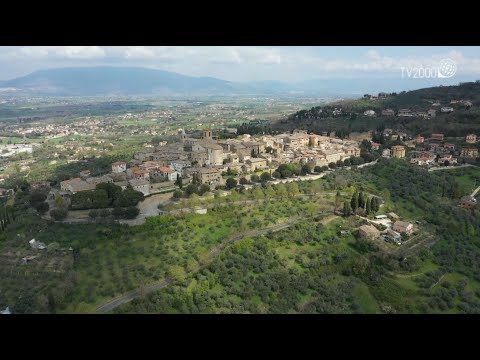 TV2000’s 27-minute Borghi d’Italia episode gives the broadest editorial portrait of Bettona in this selection. Its published description says the programme meets the mayor, parish priest and other residents, and visits the old town, churches, oratories and city museum before turning to local olive oil, wine, cheese and cooking. That combination of public life and cultural sites makes it useful for understanding how heritage and food production shape the town’s identity. The report dates from 2019, so use it for context rather than today’s visitor details.