Monte Castello di Vibio is a walled hill town above the Tiber Valley, close to Todi in central Umbria. Its best-known room is not a church or a palace but a theatre: the Teatro della Concordia, a compact Italian-style auditorium with 99 seats, built in 1808 by local families. The scale is part of the story, yet the theatre makes more sense when seen as an expression of a community that wanted a place for gathering and performance. Istat’s estimate records 1,378 residents in the whole municipality on 1 January 2026; that figure covers the town and its outlying settlements, not the historic centre alone. Italian is the official and predominant written language of the area.
A fortified settlement above the Tiber
The village’s medieval outline still shapes the visit. Streets narrow and bend inside the old defensive perimeter, and the remaining Porta di Maggio tower stands at the edge of the settlement. From its upper level, when open, the view runs over the Tiber valley toward Todi. The town’s official history describes a long relationship of rivalry and dependence with Todi: the elevated position mattered strategically, and successive conflicts damaged or altered the fortifications. The visible medieval character is therefore not a decorative set; it reflects a real history of defence, political pressure and rebuilding.
The name has a Roman echo, but it should not be turned into an unsupported foundation story. Umbria’s regional tourism portal reports an origin in the Roman gens Vibia, said to have held property in the area. That etymology is one explanation for the place-name; by itself it does not prove that the present hill town was founded in Roman times. The municipal collection in the Porta di Maggio tower includes Roman weights among later historical objects, while the more securely recognisable urban form is that of a medieval fortified borgo. The distinction matters in a place where several periods meet within a short walk.
The tower itself is more than a lookout. The Comune describes a small display of archival and civic objects: medieval holy-water vessels, weapons from different periods, helmets from the First World War and an original letter from Giuseppe Garibaldi dated 1862. A group of four muzzle-loading rifles from 1822 is associated, with appropriate caution, with local participants in the Expedition of the Thousand. These objects tell a local story through what the town preserved, rather than through a grand narrative imposed from outside. Access to the upper tower and its collection can depend on opening arrangements, so check with the municipal information office before planning around it.
Churches, chapels and a view across the valley
Several religious buildings add a more intimate scale to the centre. Sant’Illuminata, also called the church of the Holy Crucifix, stands on the site of an earlier building; regional tourism material dates its origins to the fifteenth century and notes a wooden crucifix from that period. Local devotional accounts explain how the crucifix arrived in Monte Castello, but those accounts are traditions preserved in manuscripts rather than independently verified episodes. The church’s subsequent changes, including nineteenth-century rebuilding, show how worship spaces were adapted as the community grew.
The church of Santi Filippo e Giacomo is a larger, neoclassical building with three naves, painted decoration and devotional works recorded by the Comune. The small chapel of Madonna delle Carceri, dated to the sixteenth century by the regional tourism service, offers another stop in the compact centre. A short pause at Piazza Vittorio Emanuele II is worthwhile even for visitors who are not following a church itinerary: the terrace looks south across Umbria, toward the distant ranges of Lazio and Abruzzo on clear days. These places reward a slow circuit rather than a checklist, and opening may depend on services or local arrangements.
The Teatro della Concordia: 99 seats and a civic idea
The Teatro della Concordia is the town’s defining cultural landmark. Nine well-to-do local families financed its construction, and it opened in 1808, during the Napoleonic era. The theatre’s own historical account says the name evoked the idea of concord among peoples after the French Revolution; this records the founders’ intended meaning, not a claim that the building was a political institution. It was conceived as a place for performances and meetings, with a café-salon as part of its social life. Its modest scale was a decision: the founders described it as a theatre built to suit the town.
Inside, 37 seats occupy the stalls and 62 sit in two tiers of wooden boxes. The arrangement preserves the proportions and features of a traditional Italian theatre in miniature. The painted decoration also has a family history: Cesare Agretti worked on the theatre’s scenery, and his son Luigi painted the auditorium in 1892 when he was fourteen. That early work gives the room a particular identity, but the building is not simply a preserved interior. It was used by local performers, closed in 1951, suffered the loss of its roof in the following decades, and was restored between 1986 and 1993. It reopened to the public in the 1990s and remains an active cultural venue.
After a later restoration project, the theatre reopened again in December 2023 following work on the building, energy efficiency and safety. Today the managing foundation offers guided visits, performances and other cultural events. The visitor experience is unusually direct: in a room of this size, the boundary between audience and stage feels close, and the wooden boxes and painted ceiling can be studied without the distance of a large auditorium. It is also a working venue, so visits may be suspended during rehearsals or events. Check the foundation’s current calendar, prices and reservation rules before travelling, especially for groups.
Doglio and the rural municipality
Monte Castello di Vibio is a municipality, not only the hilltop settlement that shares its name. Doglio, a smaller outlying village, gives visitors another reason to look beyond the theatre. Regional tourism sources identify the Abbey of Santa Maria in Monte and the seventeenth-century oratory of Santa Maria alle Rotelle in the Doglio area; remains of the Romanesque Abbey of San Lorenzo in Vibiata are also noted in the wider territory. These sites have different access conditions and may not be open on demand, so contact local visitor services before making a dedicated trip.
The surrounding slopes remain agricultural. Olive groves mark the local landscape, while the municipality is part of the Strada dei Vini del Cantico, a route that joins food, wine and rural destinations across the Tiber valley. The regional tourism service also connects the area to Grechetto di Todi and to itineraries among neighbouring towns. This is a better way to describe the local economy than treating the theatre as the whole story: farming, small businesses, hospitality and cultural tourism coexist in a small municipality. Seasonal events bring activity into the historic centre as well. The town organised a Christmas programme from late November 2025 through 6 January 2026, with music, markets and activities spread through the streets; dates and format change each year.
How to arrive and make time for the place
Monte Castello di Vibio is most easily reached by road from Todi and the middle Tiber Valley. Busitalia’s published extra-urban timetable includes line E031 between Doglio, Fratta Todina and Marsciano, with a stop in Monte Castello di Vibio; service days vary by timetable and school calendar. RFI also listed replacement buses on the Terni–Todi–Perugia corridor and the Fratta Todina/Monte Castello di Vibio stop as active from 12 September 2026 after road circulation resumed at Montemolino. Public transport is possible, but the calendar and precise stop matter: check the operator’s latest timetable before choosing a departure or relying on a connection from Todi, Marsciano or a railway station.
For a first visit, walk the centre from the gate to the main square, climb the tower if it is open, and reserve time for the theatre rather than arriving just before closing. A longer stay can add the churches, Doglio and a drive through the olive-growing countryside. Todi is close enough for a combined day, while Marsciano and Fratta Todina are natural transport and itinerary links. Ask about food and lodging locally if you want to stay overnight; the regional visitor portal lists accommodation and experiences, but bookings and opening times should be confirmed directly. Monte Castello di Vibio’s appeal lies in the balance between its remarkable theatre and the quieter places around it: a compact fortified town, a view over the valley, and a rural community with reasons to linger after the curtain falls.
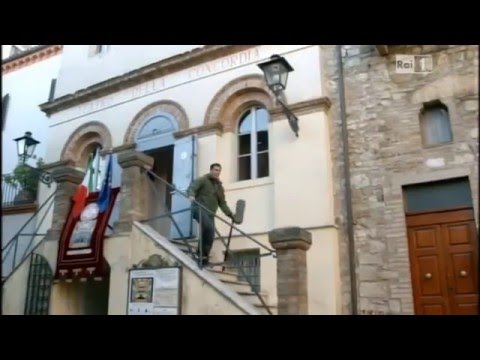 Monte Castello di Vibio on screen: theatre, cultural tourism and Christmas in the village
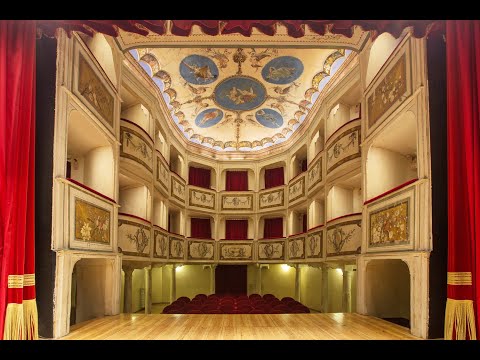 The theatre’s own cultural-tourism film puts atmosphere and guided visits at the centre. It is more promotional than the first video and follows the institution’s invitation to experience the Concordia as a living heritage site. Its images help viewers understand the intimate scale and painted interior, while its historical narration should be treated as the theatre’s interpretation rather than an independent source. The film is most useful alongside the official history and current calendar: opening hours, events and visitor rules can change.
 TV2000’s L’Ora Solare visits Monte Castello di Vibio during the Christmas season and presents the village as the “Christmas town,” while also introducing its famous small theatre. This broadcast adds a community and seasonal perspective to the two theatre-focused films: the historic streets become a setting for a particular winter programme, not a year-round attraction. The episode is useful for seeing how local events bring activity into the centre, but its 2025 coverage should not be used to infer this year’s dates or schedule. Check the Comune’s latest event notice before travelling for Christmas.