A hill town with two centres
Macerata Feltria sits in the eastern Montefeltro, among green ridges between the Foglia and Conca valleys. Its character comes from a clear physical division: the older, fortified Castello crowns a hill, while the lower Borgo grew around the market quarter. That is more than a picturesque distinction. It gives a visitor two different scales of place: steep lanes, gates and civic buildings above; a more open street pattern, theatre and former workshops below. Istat’s provisional demographic balance records 1,880 residents in the whole municipality on 31 December 2025. This is the municipal population, not a count of people living only in the historic centre.
The hills are still a working landscape, not simply a scenic frame. Local administration, schools, cultural venues and care services support a wider rural catchment, while farming, food production, small commerce and visits to heritage sites all contribute to the area’s life. The local visitor guide highlights regional meats and cheeses, cured pork, woodland mushrooms and truffles, saffron and wine. Those are useful clues to the table and countryside, rather than evidence that one product dominates the local economy. The Antica Fiera di San Giuseppe, traditionally held in March, brings together agriculture, plants and local food; check the municipality’s current calendar before travelling for it.
What archaeology can—and cannot—say about the origins
About a kilometre from the present centre, near the medieval Pieve of San Cassiano in Pitino, stood Pitinum Pisaurense. The Marche regional cultural service identifies it as a Roman municipium of the first century BC; the museum account traces occupation from the late third century BC to at least the sixth century AD. Excavations have revealed sections of a Roman road, residential remains, a necropolis and traces of a structure interpreted as probably thermal. The regional archaeological entry is careful about that last identification, and the surviving evidence does not justify imagining a fully exposed Roman city. Reused stone in the Pieve and finds kept in the museum help visitors read a site whose remains are fragmentary.
The town’s own story is also layered. The municipality describes the hilltop Castello as the older fortified settlement, with origins in the Lombard period. A popular account links the name “Macerata” to rubble from the ancient town and tells of a sixth-century destruction followed by a move to safer ground. That story is part of local memory, but the detailed sequence is not established by the archaeological evidence cited for Pitinum. The Arco dei Pelasgi, also called Porta di Mezzo, carries another foundation tradition: the connection with the pre-Hellenic Pelasgians is a legend, not a demonstrated account of the town’s beginnings. What can be said securely is that the nearby Roman municipium and the medieval hill settlement are distinct archaeological and urban layers.
From the Borgo up to the Castello
A good walk starts in the lower Borgo and climbs toward the castle. The Teatro Angelo Battelli, inaugurated in 1932 according to the municipality, reflects a long local taste for public performance; the theatre remains part of the regional programme, although dates and access change by season. Nearby, the eighteenth-century Palazzo Antimi Clari and the former Filanda linked to Palazzo Gentili Belli recall the civic families and productive life that shaped the lower quarter. The old wool and agricultural economy left not only grand houses but also working structures, including a former mill associated with the Clarisse community.
Continue past Santa Chiara and the former Franciscan complex of San Francesco, where the Museo della Radio d’Epoca occupies a hall in the old convent. Its collection of more than a hundred restored radios made in several countries between the 1920s and 1960s offers a surprisingly modern counterpoint to the medieval setting. The climb along Via Gaboardi reaches the upper gate and the Castello. Here the Torre Civica and Palazzo del Podestà anchor the square; the civic museum’s eight rooms place prehistoric objects, Roman finds from Pitinum and medieval material from the castle in a regional story. The tower also houses fossils collected in Montefeltro. In the upper quarter, look for the fourteenth-century church of San Giuseppe and its Madonna of the Rosary, and Palazzo Evangelisti, whose sixteenth-century frescoes give the civic architecture a domestic scale.
San Michele Arcangelo, in the lower town, is a later church with an older treasure: a painted crucifix dated 1396 and attributed to Olivuccio di Ceccarello. The Romanesque Pieve of San Cassiano, outside the centre at Pitino, makes a worthwhile second stop. Its three-nave basilican plan and reused architectural fragments sit amid the archaeological area; the two places are best understood together, rather than as an isolated Roman ruin and a separate church.
Country walks, nearby places and practical arrival
For a slower day, the municipality’s visitor information describes a marked path from the Borgo to a small artificial lake, as well as walks and cycling on the surrounding hills. The road climbs toward Monte Carpegna, while the wider Montefeltro circuit includes Carpegna, Sassocorvaro and Piandimeleto. These make natural companions for a multi-stop trip, but terrain is hilly and rural services are spread out; check route conditions and transport connections before setting off. The sulfurous springs and Pitinum Thermae remain part of the town’s tourism story, but published information about the establishment’s present operation is not consistent. Contact the operator or municipality before planning a treatment or spa visit.
Adriabus’s current extra-urban timetable, valid from 1 October 2026, lists Macerata Feltria on line 45 between Carpegna, Mercatale, Sassocorvaro, Montecchio and Pesaro. Line 44 also runs through Macerata Feltria toward Mercatino Conca, Morciano, San Giovanni in Marignano and Pesaro. These are useful regional links, but services vary by school day and season; confirm the latest departures, return journey and any changes before travel. The compact centre is most rewarding on foot, with a steep climb between its two quarters.
 Macerata Feltria in tre video: paesaggio, archeologia e borgo
 VIAGGIARTE is a cultural-heritage project associated with the Province of Pesaro and Urbino. This six-minute film focuses on the archaeological route at Macerata Feltria, offering a useful companion to the museum and the Roman remains at Pitinum Pisaurense. It dates from 2015, so current excavation access and visitor arrangements should be checked locally.
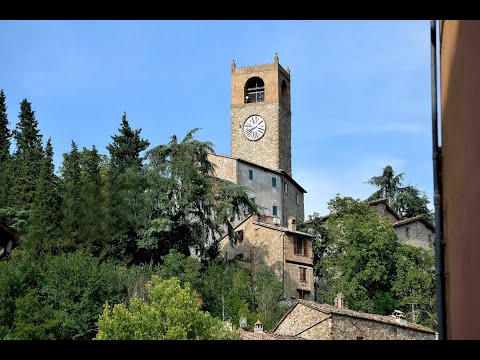 Elio Rossi’s short “Cities and Villages” presentation describes Macerata Feltria as a place with two distinct parts, the upper historic settlement and the lower Borgo. That framing matches the town’s topography and helps viewers understand how to plan a walk between the two. It is an older video and should not be used for current opening hours or transport details.