Bertinoro stands on a ridge above the Romagna plain, with the Adriatic often visible beyond the fields on a clear day. The view explains its familiar name, the Balcony of Romagna, but the town is more than a lookout. Its old centre climbs toward the Rocca, while the municipality spreads across a wider landscape of villages, vineyards and the thermal district of Fratta. ISTAT counted 11,102 residents in the whole Comune on 1 January 2025; that figure includes the surrounding settlements, not just the compact hilltop centre.
A medieval centre on an older landscape
Begin in Piazza della Libertà, where the civic buildings gather around the open edge of the hill. Palazzo Ordelaffi, the municipal palace, faces the square beside the civic tower and the Hospitality Column. From here, paved lanes and stairways rise toward the Rocca, passing houses whose position follows the narrow crest rather than a modern street grid. The walk is short in distance but steep in places, and the changes in elevation keep opening new views across the plain.
The evidence points to a long human presence in the surrounding territory, not to a proven Roman foundation for today’s town. The Ministry of Culture’s archaeological catalogue records prehistoric finds and Roman-period rural settlement on the slopes. It notes that some scholars have proposed a connection with Pliny’s Forum Truentinorum, whose location has never been securely identified. The hilltop settlement is associated with the medieval name Castrum Cesubeum. A local historical account places the construction of the municipal palace in 1306 and recalls a visit by Frederick Barbarossa in 1177; such details belong to the town’s historical tradition and should not be confused with evidence of a Roman city on this exact site.
The name itself has attracted stories. A local explanation links “Bertinoro” to Galla Placidia, who supposedly praised Albana wine after it was served in a rough cup, saying that such wine deserved to be drunk in gold. It is a memorable legend, not a verified origin of the name. The suggested link between Castrum Brittinori and pilgrims travelling to Britain is likewise a possibility offered by local tradition, not a settled etymology.
Hospitality with a documented history
The column in the square gives Bertinoro its civic emblem. The Ministry of Culture’s record of the Festa dell’Ospitalità connects the original column to a custom used from around 1200: a traveller tied a horse to one of twelve rings, and the associated noble household offered a welcome. The column now in the piazza is a replica made in 1926 from remains of the earlier monument. The idea survives in a changed form during the September festival, when local families and associations receive guests, including visitors from the town’s partner communities. The ceremony is a living civic ritual, not a literal reenactment of a medieval scene; the program changes each year, so check the current dates before travelling.
Above the square, the Rocca gives the ridge its strong silhouette. Today it houses the University Residential Centre and the Interreligious Museum. The museum’s collection and interpretation bring Judaism, Christianity and Islam into conversation through art, objects and texts. It is a rewarding stop for visitors interested in the cultural history of the Mediterranean, but admission arrangements and hours can vary; contact the museum before setting out. The nearby cathedral of Santa Caterina d’Alessandria and the civic tower add another layer to a compact walk through the historic centre.
Wine, food and the working hills
Vineyards are not simply a backdrop here. The Forlivese visitor service describes roughly a thousand hectares of vines across the surrounding hills, with Sangiovese and Albana especially prominent. Albana di Romagna received DOCG recognition in 1987; the local wine route and wineries make tasting a practical way to understand how geology and farming shape this landscape. Some cellars welcome visitors by arrangement, so book directly rather than assuming walk-in access. In town, the Ca’ de Bè wine shop and its displays provide a starting point for local labels. The area’s food culture is recognisably Romagnol: piadina, seasonal produce, fresh pasta and regional cheeses such as squacquerone appear alongside the wines.
For a wider visit, head to Polenta, a small settlement in the municipality whose Pieve di San Donato is a Romanesque church documented in local heritage material from before the tenth century. The building’s quiet interior and rural setting make a useful counterpoint to Bertinoro’s central piazza. Giosuè Carducci’s 1897 poem “La Chiesa di Polenta” is a documented part of the church’s modern cultural history. The claim that Dante was welcomed there by the da Polenta family is a longstanding local tradition and literary association, not a visit proven by a surviving eyewitness record. A nearby cypress is also tied to the story of Francesca da Polenta and Paolo Malatesta; that, too, belongs to legend.
Fratta Terme and a note for planning
Fratta Terme lies below the ridge and gives the municipality a second, very different visitor landscape: springs, a park and a long thermal reputation. Archaeological finds support Roman-period use of the waters in the area, but they do not establish the Trojan foundation story sometimes attached to the district. At the time of this check, the local tourism service lists the spa and park as closed following the floods of May 2023. Treat the thermal heritage as a reason to learn about the area, not as a promise of an operating spa; verify reopening and access directly before making plans.
Getting there and making the most of a visit
By road, Bertinoro is reached from the Via Emilia through the Panighina area, then by the rising local road to the historic centre. For public transport, Start Romagna’s route 121 serves Bertinoro Centro and Forlimpopoli. The Forlimpopoli-Bertinoro station is on the regional rail network, but a convenient station-to-bus transfer is not guaranteed by the route information; check the complete connection and service for your date. Visitors arriving through Forlì or Cesena can use the rail corridor to reach the Forlimpopoli area, then confirm the final leg. Timetables, seasonal service and event diversions change, so check the operator before departure.
Allow time to walk uphill, pause at the viewpoints and explore beyond the main square. Reserve the museum, arrange winery visits, and check church access and festival dates in advance. Bertinoro works well as a half-day historic-centre visit, but its villages and vineyards reward a slower itinerary by car or bicycle. Useful starting points for current information are listed below.
 Bertinoro in three films: town, hospitality and landscape
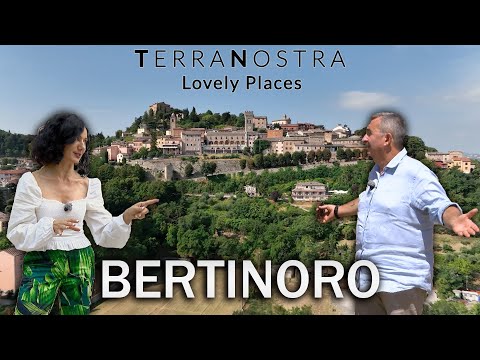 San Marino RTV’s Terranostra feature approaches Bertinoro as a lived landscape of medieval streets, viewpoints, local hospitality and countryside paths. Its description highlights the town’s wine identity and natural itineraries in nearby settlements. The programme offers a longer, regional television portrait than the town-focused TV2000 episode. Because it predates current visitor notices, verify specific services, especially the status of Fratta Terme, with local providers.
 Le Romagne’s short film follows the Pedemontana, a route through the foothills interpreted as a trace of the ancient Adriatic coastline and the changing Po plain. The Bertinoro visitor office has presented this project as a way to read the area’s geology, settlement and agricultural landscape. It adds context to the vineyards and panoramas rather than serving as a current navigation guide; check route conditions and access locally.