ISTAT counted 2,361 residents in the whole municipality of Bagnara di Romagna on 1 January 2025. In the flat countryside southwest of Lugo, the town’s defining feature is unusually easy to read: a compact historic centre held within a circuit of walls, towers and a moat, with the Rocca Sforzesca at its heart. The setting gives Bagnara a different character from the hilltop castles often associated with Romagna. Here, the defensive outline remains part of the everyday townscape, close to fields, roads and the small piazzas of the lower Ravenna plain.
A castrum rebuilt for a new age of warfare
The visitor history dates an earlier castrum to 1354, when Barnabò Visconti fortified the settlement; it was destroyed in 1428. The later Rocca took shape under the Riario-Sforza rulers of Imola. Girolamo Riario began its reconstruction in the late fifteenth century, and Caterina Sforza oversaw the completion of the keep and loggia after his death. The fortress was not simply a residence: its circular bastions, thick walls and moat reflect the changing demands of artillery warfare. Inside, the central court, vaulted casemates, well and surviving fittings for a drawbridge make the architecture legible at close range. The entrance gate was rebuilt after the Second World War on the earlier design; the present western access is documented from at least 1603.
Since 2008 the Rocca has housed the Museo del Castello. Its displays connect the fortress with the wider territory, using archaeological material, historical interpretation and multimedia to trace local life across very different periods. The museum is the natural starting point for understanding why the walls form a complete urban enclosure rather than a dramatic backdrop alone.
Older ground at Prati di Sant’Andrea
Bagnara’s story reaches further back than the surviving Renaissance walls, but the dates need care. At Prati di Sant’Andrea, outside the present centre, archaeological work has identified a raised early medieval settlement mound, a surrounding defensive depression and traces of palisades, dwellings, hearths, wells and craft activity. Municipal information records investigations in 2005 and 2021, and the museum’s archaeological route follows the territory from Bronze Age and Roman-period evidence into the early Middle Ages. These layers show repeated occupation of the area; they do not establish that the present walled village was founded in Roman times. The park around the site mixes maintained paths with areas left more natural, so visitors should stay on marked public routes and check for any local access notices.
Churches, archives and a musical connection
The parish church of San Giovanni Battista and Sant’Andrea Apostolo stands near the Rocca. Local records attest a Christian community here in 855 and mention the parish church in writing in 1484; the building grew through several phases, including major work in the eighteenth century. Its parish museum brings together sacred objects, historic furnishings and paintings associated with the area. Another less expected collection is the Museo Pietro Mascagni, installed in the parish buildings in 1975. It preserves memorabilia and about 5,000 letters connected with the composer and Anna Lolli, a Bagnarese who left her collection to the parish. The museum currently asks visitors to book ahead for Sunday visits, so confirm access before setting out. The Torrioncello, a former defensive tower, now contains the municipal library and historical archive.
A small town with room for an unhurried visit
Bagnara’s visitor offer joins its architecture to the cultural calendar and to the food traditions of Bassa Romagna. The local portal lists trattorias and accommodation in the village, and highlights events including the Sagra del Castrato and the summer Popoli Pop Cult Festival; dates and programs change from year to year. These hospitality and event activities are visible parts of local life, while the surrounding plain remains an agricultural landscape. A walk can take in the gate, the moat, the Rocca and the nearby Prati di Sant’Andrea area, then continue toward the church and the town’s smaller streets. Lugo and Imola are the closest larger service and rail centres; Ravenna and Bologna make longer regional approaches.
Getting there and what to check
By car, the local visitor service lists the Imola exit on the A14 and the Cotignola-Lugo exit on the A14 bis as the nearest motorway approaches. Its distance guide places Bagnara about 11 km from Lugo station and 16 km from Imola station. TPER line 151 connects Imola, Mordano, Bagnara, Massa Lombarda and Lugo, but departure patterns depend on the date and service calendar. Check the operator’s live timetable before relying on a rail-and-bus connection. Confirm museum reservations and event dates directly with the local organizers; this is a compact town that rewards a planned visit, especially if you want to see more than the exterior of the fortress.
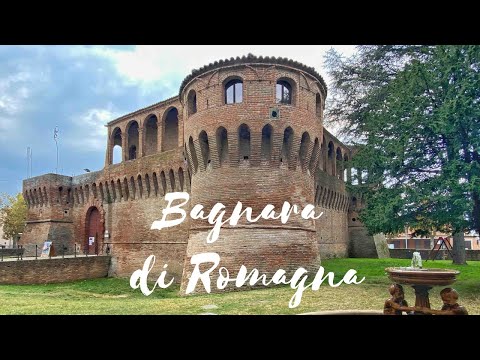 Bagnara di Romagna: walls, fortress and local museums
 Ravenna24ore’s short item is specifically about the Museo Pietro Mascagni in Bagnara. The title gives it a focused subject, distinct from a general village itinerary: the town’s connection with the composer and the collection preserved in the parish building. The available metadata does not describe individual scenes, so this review makes no claim about them. It is a useful prompt for readers interested in the museum, who should confirm the current appointment arrangements directly.
 The Unione Bassa Romagna tourism video is titled “Visita Bagnara di Romagna” and is embedded on the local visitor website. Its official local context makes it a concise introduction to the destination, complementing the independent day-trip video and the museum-specific report. It is short, so it works as a first visual orientation rather than a detailed history or visitor guide. For practical information such as transport, event dates and museum access, consult current local pages.