A small commune, best approached at a village pace
Bancigny is a rural commune in the Aisne department of Hauts-de-France, in the Thiérache landscape of northern France. INSEE’s 2023 reference count is 26 municipal residents for the whole commune, with no population counted separately; the figure took legal effect on 1 January 2026 and follows the commune’s boundaries as of 1 January 2025. It is a very small place, and its defining visit is not a busy attraction district but the Saint-Nicolas church and the fields and lanes around it. The church is a landmark in a dispersed village setting rather than one stop in a dense urban centre.
Thiérache is known regionally for a bocage landscape and a network of fortified churches. The Pays de Thiérache tourism office describes dozens of these buildings across the territory, often strengthened in periods of insecurity. Bancigny fits that wider architectural story, but its own records are more specific about the surviving fabric than about the exact episode that prompted it. The best way to read the village is therefore through the building, its setting and its connection to nearby Jeantes and Plomion, without turning a regional pattern into an undocumented local legend.
Saint-Nicolas: worship space with a defensive front
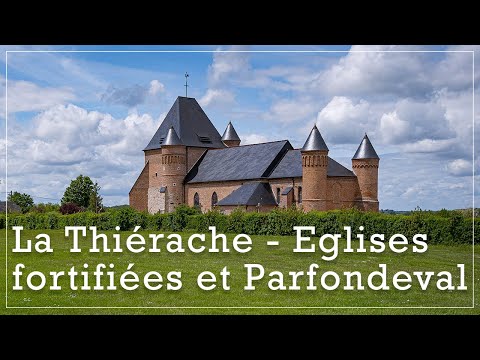
The Ministry of Culture’s Mérimée record dates the church’s principal building campaign to the sixteenth century. Its description notes a modest structure made partly of pale stone and partly of brick, with two short, heavy round towers flanking the portal. Those towers are not merely decorative: the ministry identifies them as defensive works and records their partial protection as historic monuments by ministerial order on 11 May 1932. The protection applies to the façade’s defensive towers, not automatically to every part of the church.
The interior also carries different dates. The official record attributes the stone baptismal font to the twelfth century and a polychrome wooden Calvary group to the sixteenth. A restoration campaign and stained-glass windows by Jeroen Dykhuizen both date to 1992. This layered evidence gives a more reliable account than an exact foundation story unsupported by the record: medieval religious furnishings, a later fortified envelope, then modern conservation and art glass. The regional tourist-office listing currently labels Saint-Nicolas as open by appointment. Arrange access in advance; do not assume the door will be open or that a key-holder can be reached without notice.
Working life and the limits of local statistics
Bancigny’s scale makes its economic profile easy to overstate. INSEE recorded two economically active non-agricultural market units in 2023: one in construction and one in other services. That dataset excludes agricultural activity and non-market services, so it cannot describe every farm, commute or household livelihood. A separate 2024 equipment inventory lists no shop, medical professional, pharmacy, school or library in the commune. These are useful planning facts, not a judgment on village life: the statistical snapshot simply shows why visitors should bring what they need and identify services in the surrounding area before setting off.
The town hall is the identifiable local public-service contact. The state directory gives its address as 7 route de Jeantes and publishes contact and reception details, which should be reconfirmed before a visit because office hours can change. For regional visitor information, the Pays de Thiérache tourism office is based in Vervins. There is no basis for promising a restaurant, shop or regular visitor facility inside Bancigny itself; ask locally about current provision instead.
A verified walk linking nearby villages
The official tourism office lists La Nigaudière, a 9.6-kilometre pedestrian loop starting and finishing at the square in Plomion. Its published duration is about two hours thirty minutes, and its description says it passes through Bancigny and Jeantes and by the Val Saint-Pierre state forest. This is a practical way to place Bancigny within a wider walk through the Thiérache rather than treating the church as an isolated detour. The town is part of the route, but Plomion—not Bancigny—is the stated trailhead.
Use the current route sheet for its exact line and markings, and check weather, path condition and any temporary access notices before departure; the posted duration is a guide, not a guarantee. The tourism office also promotes regional circuits to fortified churches, making Jeantes and Plomion natural companion stops, although opening arrangements differ from church to church. Bancigny rewards a quiet, deliberate stop: notice the contrast of brick and stone, then continue only on confirmed public roads or paths. Confirm appointments, transport and municipal-service schedules shortly before travelling.