Laon announces itself from a distance: a limestone ridge rises above the Aisne plain, carrying an upper town crowned by the cathedral. The commune counted 24,220 residents in 2023; this figure covers the entire municipality, not only the historic plateau. Below it, the station and newer neighbourhoods form another part of the same working city.
A medieval centre shaped by its height
The old city is not a staged set. Its position made it a place of power and refuge, and its streets still follow the hill’s long crest. The local destination office describes about seven kilometres of ramparts around the upper town and dozens of protected monuments. Walking between gates, towers and stone houses gives a fuller sense of Laon than stopping at the cathedral alone. The southern ramparts open wide views over the basin; wooded Saint-Vincent offers a quieter walk inside the city.
Notre-Dame de Laon is the architectural anchor. The present cathedral was begun in the mid-twelfth century after an earlier Carolingian church was destroyed during the communal uprising of 1112; building continued into the early thirteenth century. Pale stone, a four-level interior and sculpted oxen on the western towers make it distinctive. The neighbouring former Hôtel-Dieu now houses the visitor office, a practical first stop for maps and guided visits. Saint-Martin Abbey, the Templar chapel and the art and archaeology museum add other layers; check their opening arrangements.
A living administrative centre
Laon serves the Aisne with public administration, shops and cultural venues beyond its best-known skyline. Tourism is only one part of local life: Insee’s 2023 establishment data records varied activity, while the surrounding department remains closely tied to agriculture. The difference between upper and lower town matters to visitors too: services are found on both levels, and the steep paths called grimpettes make the topography part of the experience.
Arriving and planning a day
Laon station lies at the foot of the hill. TUL bus line 4 links it with the medieval city via Vaux; the operator lists frequent service, but timetables and disruption notices change. Walking up the station steps or a grimpette is an option for visitors ready for a climb. By road, the tourism office identifies the N2 corridor from Paris and Soissons; check current conditions. A first circuit can combine cathedral, ramparts and former Hôtel-Dieu, then leave time for the museum or Saint-Vincent. Confirm access and opening times before travel.
 Laon: cathedral ridge, fortified streets and upper town
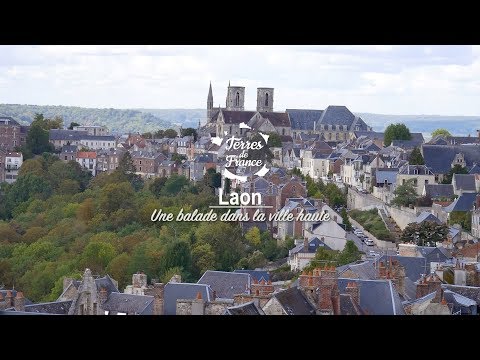 Terres de France takes viewers on a walk through Laon’s upper town. The focus is the lived route through the historic quarter rather than a single close-up, helping visitors imagine how lanes and viewpoints fit together. Use it for orientation, not current hours or transit.
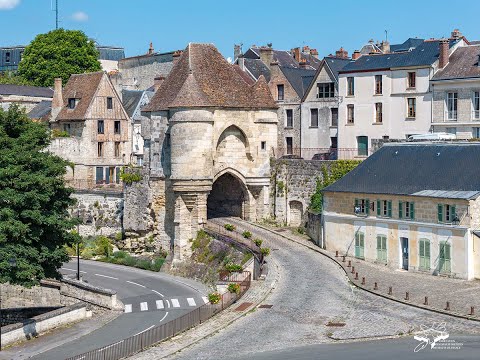 Tourisme Laon’s Laon, ville fortifiée focuses on the fortified city and its defensive landscape. It complements the cathedral-centered report with the walls and historic urban form. Follow current local maps and access notices before walking the ramparts. Its emphasis on defensive form helps viewers read the hilltop town as a whole rather than as a collection of isolated monuments.