Le Quesnoy is a town whose defenses have become part of its everyday landscape. Ramparts, moats, ponds and tree-lined paths form a green edge around the centre, though they were built to control a frontier. A walk here passes through layers of power: the counts of Hainaut, the Spanish Habsburgs, the French monarchy and the twentieth-century memory of New Zealand soldiers. The commune had 4,878 residents in the 2023 census; this is the population of the whole municipality, not a visitor estimate, and the reference figure took legal effect on 1 January 2026. French is the town’s official and predominant written language, so the local-language edition is French.
A Hainaut town shaped by borders
Municipal and regional heritage accounts trace Le Quesnoy to the twelfth century, when Count Baudouin IV of Hainaut established the town and its castle. The municipality dates the first fortifications to about 1150; later medieval walls were strengthened by towers, and the surviving Tour Bauduin preserves a fragment of that defensive history within later works. The Saint-Martin Gate, built around 1398, offers another tangible medieval point of reference. These dates describe documented stages in the town’s development, not a Roman or legendary foundation.
Its position made the place repeatedly strategic. In 1477, Louis XI’s forces took the town and damaged its defenses. Under Charles V, ruler of the Habsburg Netherlands, the medieval perimeter was adapted to artillery; a 1527 record cited by the municipality describes funds sought for repairs. French forces captured Le Quesnoy in 1654, and the 1659 Treaty of the Pyrenees formally brought it into the French kingdom. Its military role shifted with the border, and its buildings still make that political history legible.
From 1668 to 1673, Vauban reorganized rather than simply replaced what he found. The town describes an octagonal fortified enclosure of roughly 3.5 kilometres, with eight bastions, outer works and water-filled ditches. Canals, sluices and ponds could direct water across the approaches, turning wetlands into part of the defense. The ramparts were permanently decommissioned in 1901, yet the municipality retained them and maintains the surviving works and two former defensive basins. The result is not a frozen military diagram: it is a public landscape used for walking, recreation and remembrance.
Walk the ramparts and read the details
Start near the centre and follow the rampart route at an unhurried pace. The Imperial Bastion looks over Lac Vauban; the Fauroeulx bridge and gate connect the fortified town to its former suburb, while the Green Bastion recalls the practical functions inside the defenses. The municipal orientation table helps visitors identify these structures and understand how water, earthworks and masonry worked together. The full outer system is larger than a quick circuit, so choose a section that suits your time and check local access information.
At Porte Saint-Martin, restoration work in 2013 revealed remains of a fourteenth-century sandstone tower and a drawbridge. The vaulted rooms now form an interpretation space with a film in French and English about the town’s history. The municipality lists this interior as open from April through the end of September, so confirm seasonal dates before setting out. Nearby, the Tour Bauduin contains a vaulted chamber that once regulated water in the ditches and, according to the town, served as a briefing point for New Zealand troops before the assault of 4 November 1918.
That assault is central to Le Quesnoy’s modern identity. After four years of German occupation, New Zealand forces entered the walled town on 4 November 1918, using ladders to scale the ramparts. The relationship between Le Quesnoy and New Zealand has continued through visits, commemorations and civic links. The New Zealand Liberation Museum, Te Arawhata—the Māori name means “the ladder”—opened in 2023. Its storytelling, artworks and sound installations connect the military episode with people and memory on both sides. The museum currently lists Wednesday to Sunday opening, 10:30 a.m.–6 p.m., with Monday and Tuesday closed; check its visitor information for holidays, tickets and temporary access changes.
A living small town, not only a monument
The centre remains useful to residents as well as visitors. The municipality lists independent food shops, cafés, restaurants and everyday services; its Friday market takes place on Place Leclerc from 9 a.m. to 12:30 p.m. The former Lowendal barracks now house community and cultural uses including a social centre, a digital third place and library services. These details give a visit a local rhythm: arrive on market morning, walk the old streets, then spend time beside the ponds instead of treating the ramparts as a photo stop.
Work in the commune is broader than heritage tourism. Insee counted 3,337 workplace jobs in 2023 in its sector breakdown: public administration, education, health and social work represented 49.1 percent, while commerce, transport and varied services accounted for 36.8 percent. Industry, construction and agriculture also appear in the local employment mix. These figures help explain Le Quesnoy’s role as a service centre for surrounding communities; they do not mean that tourism is the town’s only economic base.
Getting there and planning a day
Le Quesnoy has a TER station with direct regional services toward Valenciennes and Lille Flandres, as well as trains on routes toward the Avesnois. Check the timetable for the chosen day, because service patterns and connections change. From the station, the centre and fortifications can be explored on foot. Drivers can use the town as a base for the surrounding Avesnois landscape and nearby Forêt de Mormal, while the fortified circuit itself makes a satisfying half-day outdoors. Shops, cafés and restaurants in the centre make it practical to pause between the museum and the walk.
Le Quesnoy rewards a visit that leaves room for both scale and detail: the long line of ramparts, then a tower chamber, a gate, a pond or a market conversation. Its history is not a single heroic story. It is a place repeatedly reshaped by border conflicts, later preserved as a townscape, and remembered through its relationship with New Zealand since 1918. Confirm train times, the seasonal opening of Porte Saint-Martin and the museum’s current schedule before travelling.
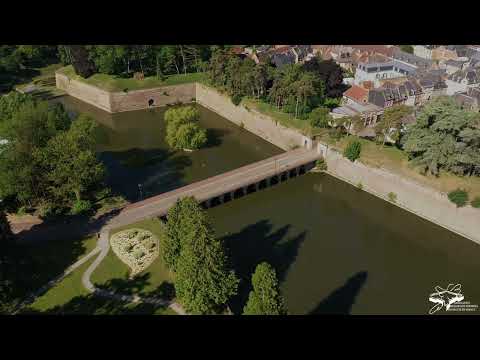 Le Quesnoy in three films: ramparts, town life and New Zealand memory
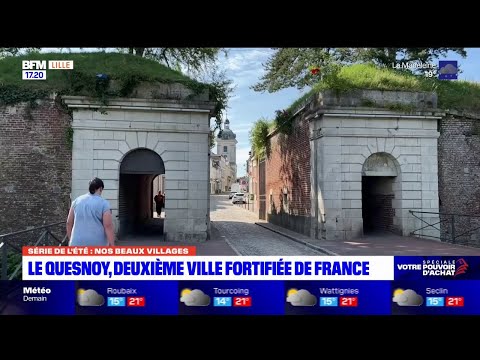 BFM Grand Lille’s short feature is a television-style introduction to Le Quesnoy. It gives viewers a quick sense of the town and its fortified identity, complementing the more architectural focus of the first film. Treat its promotional superlative as the programme’s framing, not as a verified ranking; current access and visitor details belong with the municipality.
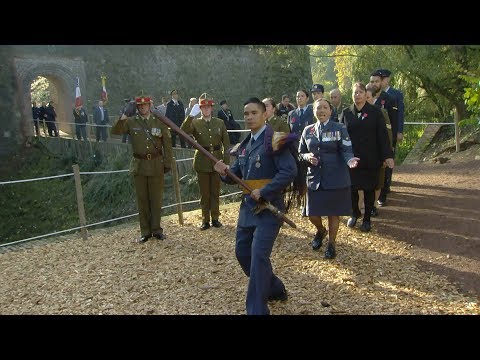 The New Zealand Defence Force records the 2018 centenary service at the New Zealand Memorial set into Le Quesnoy’s ramparts. The ceremony places the town’s connection with New Zealand in a contemporary civic setting, with participants and memorial traditions visible on site. It is a commemoration rather than a reconstruction of the 1918 assault, and its footage adds a distinct memory-focused perspective.