a monastery, miners’ memories and the woods of Monte Amiata
Abbadia San Salvatore combines a settlement grown around a monastery with a town reshaped by mercury extraction. Old stone streets, the crypt and miners’ accounts create a varied cultural visit. Monte Amiata’s wooded slopes offer separate outdoor excursions, while local hotels and restaurants make an overnight stay within town possible.
| Municipal population at 1 January 2026 (estimate) | 6,117 |
|---|---|
| Municipal area at 1 January 2025 | ≈ 58.99 km² |
ISTAT population estimate at 1 January 2026, aligned with the provisional 2025 demographic balance. Area at 1 January 2025, from the classification updated in February 2026. Both figures cover the whole municipality, including outlying settlements, rather than only the historic centre.
An early medieval monastic origin
Abbadia developed around the Lombard monastery of San Salvatore in the eighth century. Tradition associates its foundation with King Ratchis and a vision during a hunt. That devotional account is separate from documentary reconstruction. Popular sources give differing dates, making the early medieval setting more secure than an exact foundation date based on the legend.
Settlement grew beside the abbey and later gained a medieval castle. The Castellina and central streets retain the relationship between monastery, defence and civic life. Modern avenues and neighbourhoods add a later economic chapter alongside this older nucleus.
The abbey, crypt and sacred-art collection
Architecture, worship and successive alterations shape a visit to the abbey. Its crypt, with varied columns and capitals, is a particularly distinctive space. The visible building has several phases and restorations; every element should not be assigned to the original foundation.
The sacred-art museum preserves reliquaries and works linked to monastic history, including a reliquary bust of Pope Saint Mark and an early Irish-Scottish reliquary. They reveal religious connections extending beyond the immediate area. Confirm museum access separately from the church’s opening for worship.
The Codex Amiatinus and its reproduction
The Codex Amiatinus was produced in the monastic world of Wearmouth–Jarrow in Northumbria around the end of the seventh and beginning of the eighth century. This major witness to the Latin Bible became closely associated with the abbey that kept it for centuries. Its English connection broadens the story beyond Amiata.
The original is preserved at Florence’s Biblioteca Medicea Laurenziana. A full-size facsimile returned to the abbey museum, rather than the original manuscript moving back permanently. The reproduction allows visitors to appreciate the scale and layout of a volume whose preservation requires special conditions.
Mercury and the working community
Industrial mercury extraction transformed Abbadia from the late nineteenth century. Cinnabar ore supported an activity connected with international markets and uses. Production ended in the 1970s, leaving buildings, machinery and personal memories.
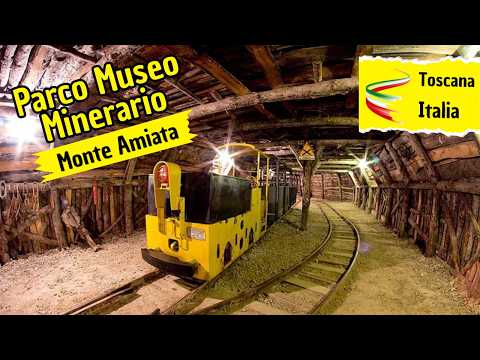
The mining museum includes the Clock Tower, the multimedia interpretation in the former workshop and Level VII Gallery. Its account places effort, danger and solidarity alongside extraction techniques. Reconstructed working environments within the managed gallery visit are different from unrestricted exploration of former production levels.
Booking the mining visit and heading outdoors
Fondazione Musei Senesi publishes a 2026–27 calendar with seasonal variations. During November and December, weekends and holidays predominate, with other arrangements for booked groups. Organise guided access and any mine-train experience before arrival.
Amiata’s woods and refuges offer a completely different setting afterwards. Reaching the summit is a separate outing from the town centre. Snow, lifts and suitable routes cannot be assumed available on every winter day. Check current conditions with the relevant operators before planning a walk or sport activity.
Christmas fires and mountain food
The Christmas Eve Fiaccole involve local groups in building and lighting large wood stacks. The Pro Loco lists the event on 24 December 2026. Each edition’s programme establishes arrangements, while explanations tracing the custom to very ancient times belong to tradition.
Amiata chestnuts, mushrooms and mountain dishes feature in local cooking. Ricciolina, a shortcrust cake with chocolate, hazelnuts and meringue, is a specific town speciality. Trying it in a bakery or after a meal adds a more precise food experience than a general list of Tuscan products.
Rooms and dinner close to the abbey
La Bocca di Bacco operates a hotel, restaurant and pizzeria on Via Cavour near the monastery. Its operator lists private-bathroom rooms, a lift and stair assistance. Visitors with particular access needs should explain the required route and confirm the suitable room directly.
The cooking includes porcini and polenta with wild boar. Combining accommodation and meals here makes a town-based overnight visit practical, subject to the intended service day, arrival time and actual routes to the museums and abbey.
Connections and exploring everyday life
The FT9 links the Abbadia area with Radicofani, Sarteano and Chiusi, a railway gateway on the Florence–Rome corridor. Check the particular operating day and boarding point. Local roads connect the mountain with the Cassia and southern Tuscany’s motorway approaches.
During a longer exploratory stay, compare the historic centre with modern neighbourhoods and mountain-slope accommodation. Mining belongs to the industrial past: present tourism, services and other employment should not be described as though an operating mercury mine still supports every job. Testing ordinary journeys helps reveal what living here would mean beyond a holiday.
Sources
- Regione Toscana: borgo, montagna e prodotti locali
- Ufficio turistico: formazione del centro e Castellina
- Abbazia: il Codice Amiatino e il facsimile
- Abbazia: Museo di Arte Sacra
- Fondazione Musei Senesi: storia della miniera e visite 2026–27
- Ufficio turistico: percorsi del museo minerario
- Pro Loco: Fiaccole del 24 dicembre 2026
- La Bocca di Bacco: camere e cucina
- Ufficio turistico: accessi al paese
- Autolinee Toscane: collegamenti verso Chiusi
- ISTAT: resident population estimate, 2026
- ISTAT: classifications and municipal area