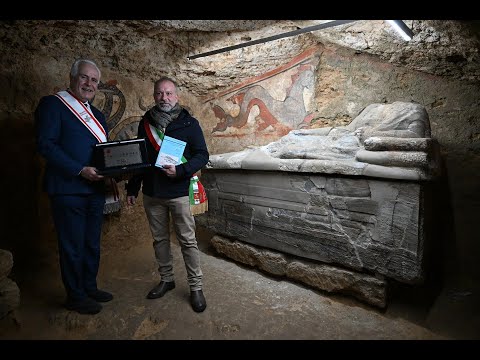
the Infernal Quadriga tomb, a Sienese fortress and the country between two valleys
Sarteano combines a medieval fortress reshaped in the Renaissance with remarkable Etruscan funerary archaeology. Between the Valdichiana and Val d’Orcia, its centre contains museums, churches and a theatre, with woodland, hamlets and swimming pools beyond. A successful visit distinguishes the original painted tomb from its museum reconstruction and allows for advance reservations.
| Municipal population at 1 January 2026 (estimate) | 4,494 |
|---|---|
| Municipal area at 1 January 2025 | ≈ 84.84 km² |
ISTAT population estimate at 1 January 2026, aligned with the provisional 2025 demographic balance. Area at 1 January 2025, from the classification updated in February 2026. Both figures cover the whole municipality, including outlying settlements, rather than only the historic centre.
A landscape occupied before Rome
Finds from Grotta dell’Orso document prehistoric activity. Necropolises then reveal a substantial Etruscan presence between the ninth and first centuries BC. This evidence concerns the wider ancient territory rather than assigning the same age to every street in today’s settlement.
The medieval fortified centre was associated with the Manenti counts and Siena. The castle’s first documented mention dates from 1038. The visible town combines medieval, Renaissance and later building within a landscape whose human history reaches much further back.
The fortress and its wooded park
Much of the present fortress reflects Sienese reconstruction in 1467–1469. Keep, walls and rounded towers show a defensive arrangement adapted to its period. Visiting includes steep stairs: the summit view requires a climb rather than providing a level-access roadside viewpoint.
Following Medici rule and the long Fanelli ownership, the municipality bought the castle in 1997 and restored it. Holm oaks in the park complement the interiors and wall walks. Exhibitions and events add cultural uses to a building originally designed for defence.
Palazzo Gabrielli’s archaeological museum
The civic museum occupies Palazzo Gabrielli on Via Roma. Canopic urns, pottery and carved stones introduce the area’s Etruscan communities. Local production and imports reveal social distinctions, ritual and connections as well as craftsmanship.
Notable objects include a female canopic urn holding a model axe and a funerary group showing the deceased with the demon Vanth. A full-size reconstruction downstairs introduces the Infernal Quadriga paintings. It is an interpretive reproduction, separate from the excavated tomb in the necropolis.
Visiting the original painted tomb
Discovered at Pianacce in 2003, the fourth-century BC burial presents an underworld populated by demons and fantastic animals. The chariot associated with Charun is its best-known image, but the wider funerary setting deserves attention alongside that single scene.
Fondazione Musei Senesi places the necropolis about one kilometre from town and lists Saturday visits to the tomb by reservation. The museum also reduces its openings in winter. Arrange the tomb, museum and castle as separate appointments, confirming availability instead of assuming that arriving on any weekday will cover all three.
Churches, theatre and community events
San Lorenzo collegiate church and San Martino in Foro carry the itinerary beyond archaeology. Beccafumi is an important name in the local painting heritage. Palazzo Piccolomini, Palazzo Cennini and other historic buildings help connect the principal attractions through the town streets.
Teatro degli Arrischianti represents continuing cultural life. The Giostra del Saracino and associated processions involve local districts and community traditions. Films of past editions introduce their character; attending requires the programme for the actual year. Performance dates and monument opening calendars are separate matters.
Pools and woodland excursions
Piscine di Sarteano uses thermal-mineral water and provides pools and bathing facilities. Arrange access with the operator according to the seasonal calendar. A natural source does not imply unrestricted access to every part of the site at any hour.
Castiglioncello sul Trinoro is a separate panoramic hamlet towards the Val d’Orcia. Spineto and Pietraporciana offer further outings, with the latter’s beech woodland providing a setting unlike the town centre. Walking plans need current surface and access advice, particularly after rain or during short winter days.
A local hotel and restaurant
La Gustea operates a hotel and restaurant at Via Adige 19, providing an overnight option within Sarteano. Its restaurant presents Tuscan tasting experiences and lists Tuesday as its weekly closing day. Confirm the desired evening directly before arranging the rest of the stay around dinner.
Accommodation in a hamlet or the countryside changes the logistics: staying at Castiglioncello sul Trinoro does not put a room beside Sarteano’s main square. Establish the trip to meals and museums, any stairs and parking before booking. Location may matter more than the hotel category alone.
Connections and exploring a move
Chiusi-Chianciano Terme station is a useful gateway for arrivals from Rome or Florence. Autolinee Toscane’s FT5 connects Chiusi, Cetona, Sarteano, Chianciano and Montepulciano. Check the relevant journey and operating calendar rather than carrying summer times into a winter itinerary.
The position between two valleys supports varied outings, while a longer stay also requires testing ordinary shopping, services and weekday travel. Compare the main town with outlying settlements through actual journeys. Tourist room rates describe short stays and cannot establish a reliable average for residential rent.
Sources
- Regione Toscana: centro storico, paesaggi e frazioni
- Comune: documenti e trasformazioni del castello
- Comune: raccolte e scoperta della Quadriga Infernale
- Fondazione Musei Senesi: reperti, visita alla tomba e calendario 2026–27
- Piscine di Sarteano: vasche e servizi
- La Gustea: albergo nel paese
- La Gustea: ristorante e giorno di riposo
- La Gustea: ubicazione
- Autolinee Toscane: collegamenti di Chiusi, Sarteano e Montepulciano
- ISTAT: resident population estimate, 2026
- ISTAT: classifications and municipal area