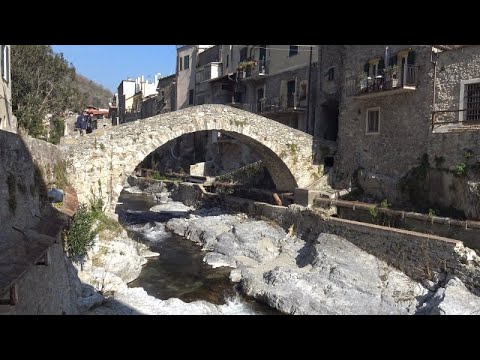
Zuccarello is a small village in the Neva Valley inland from Albenga. Its main street runs beneath medieval arcades between fortified entrances, and a stone bridge crosses the stream. Ruins of the Del Carretto castle stand above the houses. The village has an unusually precise origin: a charter kept in the municipal archive documents its foundation on 4 April 1248. People lived in the valley before that, and the castle preceded the new village, but the community built along the arcaded street has a recorded founding moment.
The charter and the medieval settlement
According to the I Borghi più Belli d'Italia association, the agreement was signed in the castle by the Marquises of Clavesana and residents of the Neva Valley before a notary named Martino. In return for protection, the valley inhabitants promised labour to build the new village by Christmas 1249. The castle and valley position explain the defensive plan: controlling this passage meant watching routes between the coast and the interior. There is no reason to recast this documented medieval foundation as a Roman colony.
Statutes were drawn up in 1281, evidence of an organised community. In the fourteenth century, Zuccarello passed to the Del Carretto family through marriage with the Clavesana and became the centre of a marquisate. Carlo I Del Carretto was marquis from 1397. His daughter Ilaria married Paolo Guinigi, lord of Lucca, in 1403. She died after childbirth in 1405, and her funerary monument, carved by Jacopo della Quercia, stands in Lucca. Ilaria's early life belongs to Zuccarello's history, but her tomb is elsewhere.
Rival powers and work in the valley
The marquisate was divided in the sixteenth century, and rights over it became a point of dispute between Genoa and Savoy. I Borghi più Belli d'Italia records the sale of shares to both powers in 1561 and the war of 1625, after which Genoa gained control of the castle. The Savona provincial authority describes the village's later link to Genoa. Strategic position mattered to ordinary livelihoods as well as rulers: mills, olive presses, ovens and inns served residents and travellers. During Napoleon's Italian campaign, General Masséna set up his headquarters here, according to the provincial account.
In 1815 Zuccarello entered the Kingdom of Sardinia. The shift from marquisate to modern state did not erase the structure of the village. The arcaded street and smaller side lanes remain easy to read. Its population is now far smaller than the historic variety of businesses might suggest. The contrast is striking, but this remains an inhabited community, not an empty open-air museum.
Walking through the village
The simplest route follows the main street beneath arcades with varied arches and columns. Look for the gates, the Mill Tower, the bridge across the Neva and facades facing the water. San Bartolomeo parish church holds artworks noted in the villages guide. The marquises' palace is another historic landmark, although access to interiors depends on opening arrangements. Old channels known as beudi once carried water to mills and presses. They make visible the practical connection between river and village work.
A longer walk follows the path dedicated to Ilaria del Carretto towards Castelvecchio di Rocca Barbena. The association's guide describes about three kilometres and roughly one hour and fifteen minutes in one direction. Along the way are the castle ruins above Zuccarello. Their surviving tower and stonework show the relationship between the older stronghold and the thirteenth-century settlement below. Wear suitable shoes and check trail conditions. Other walks and outdoor activities are possible in the Neva Valley, subject to local rules.
Food, accommodation and access
The independent guide turismo.liguria.it lists I Portici restaurant, a café and B&B La Zagara in Zuccarello. This indicates a modest local selection; confirm whether each place is open before booking. Albenga and other coastal centres offer more overnight choices. A reenactment connected with Ilaria and the feast of San Bartolomeo appear in traditional event listings, but dates need checking each year. The villages association mentions the savoury torta Pasqualina and a local sweet called rocche di Zuccarello.
ISTAT figures reproduced by Tuttitalia give 284 residents on 1 January 2026 and an area of 10.81 square kilometres. From Albenga, the road climbs the Neva Valley through Cisano sul Neva; it also links the village to Castelbianco and other inland communities. Albenga, on the Ligurian rail line, is a practical gateway from the coast, Genoa or France, followed by a road transfer for the final stretch. A short visit to the centre takes much less time than a walk to the castle and onwards to Castelvecchio.