Zocca stands on a ridge in the Modena Apennines between the Panaro, Reno and Samoggia valleys. Chestnut woods, stone-built villages and mountain air define its landscape, but its centre did not begin as a Roman fort or an early medieval castle town. Local sources place its founding around a market established by Borso d'Este in 1465. This later origin, compared with some neighbouring settlements, helps explain Zocca as a meeting and trading point for communities across the hills.
How a market became a town
The Terre di Castelli association of municipalities states that Borso d'Este established the market in 1465 to encourage trade. The area was already called Zoca, a name associated with chestnut stumps. VisitModena notes earlier market activity in the district. The fifteenth-century foundation describes the organisation of the centre, not the first human presence in the surrounding mountains. The new settlement developed through exchanges between communities on either side of the ridge, rather than through the military role of the older castles found in some outlying villages.
Its administrative history developed in stages. According to Terre di Castelli, Zocca belonged to the municipality of Montalbano until that entity ended in 1797. It then became attached to Montecorone and later to Guiglia, before becoming a municipal centre in 1859. This sequence separates the origin of a market place from the establishment of a modern municipality. Settlements within today's territory have their own earlier streets and stone houses; their histories cannot simply be dated to the market's foundation.
Chestnuts, borlenghi and the museum
The chestnut tree belongs to both Zocca's landscape and its food traditions. The Chestnut and Borlengo Museum, housed in the former Ospitale di San Giacomo, uses three rooms to explain cultivation, gathering and tools used in the woods. A path continues outside through the chestnut trees of Monte San Giacomo. VisitModena also describes a workshop devoted to the borlengo. The museum thus links food, agricultural work and a living landscape, rather than presenting chestnuts only as an autumn souvenir.
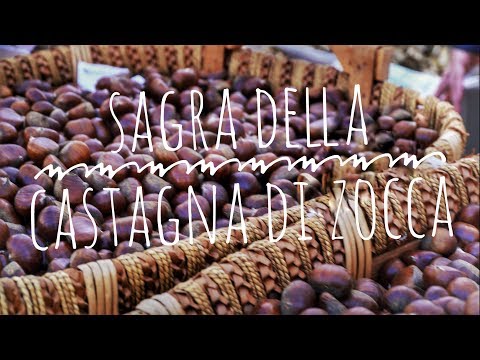
The chestnut and local marron festival traditionally takes place in October, although each year's dates and programme should be checked. A borlengo is a very thin flatbread served with cunza, a dressing of lard, garlic, rosemary and cheese. Crescentine and other Modena Apennine dishes appear on local menus. Restaurants, bars and inns are distributed between the main town and its villages, so the best place to eat or stay depends on the walking route and transport available.
Villages, nature and a modern musical identity
Montalbano and Montecorone retain historic centres on the hills. VisitModena describes Montalbano as a village beneath Monte della Riva, with winding lanes and a small church, and Montecorone as a medieval group of stone buildings. Monteombraro is another important village, while the sanctuary of Verucchia is documented from at least the fifteenth century. Visiting them takes time: they are not all part of a single short walk through central Zocca.
The Sassi di Roccamalatina Regional Park extends into Zocca's territory. Near the town are Sasso di Sant'Andrea and Bosco delle Tane, among rocky outcrops, woods and eroded slopes. VisitModena also describes the roughly 48-kilometre Percorso Belvedere between Casona di Marano and Montese. For a shorter outing, choose a section and check climbs and signs in advance.
Zocca is widely known in Italy as the birthplace of musician Vasco Rossi. His career has brought fans and a modern cultural story to the town. That identity is real, but it sits alongside the history of the market, the outlying settlements and work in the chestnut woods. A visit can combine the central streets and music-related places with the museum and one of the older villages.
Population and getting there
ISTAT figures reproduced by Tuttitalia give 4,846 residents on 1 January 2026 and a municipal area of 69.36 square kilometres. The centre stands at about 759 metres above sea level. VisitModena places it roughly 50 kilometres from Modena. Travellers from Bologna can approach the opposite side of the Apennines by road, while those starting in Modena, Vignola or Guiglia should check the route and local bus timetable for the final leg. From abroad, Bologna is a useful air and rail gateway before travelling towards Modena or Vignola and then Zocca. Mountain roads and travel between villages require more time than a straight-line map distance suggests.