Zafferana Etnea is a municipality on Mount Etna's eastern slopes, among woods and lava with views towards the Ionian Sea. The present town is not an ancient Greek colony with a single known founding date. Local records connect its growth with a medieval priory and surrounding farming settlements. The volcano has continued to shape daily life, both through the landscape and through episodes of danger.
A Roman route and a medieval priory
The town council describes a foothill road used in Roman times between Tauromenium and Katane. It mentions a surviving paved stretch at Dagalone and Roman coins found in the area. These traces establish travel and activity in the territory, not a Roman foundation for today's built-up centre. The first nucleus clearly tied to Zafferana in municipal history grew from the Benedictine Priory of San Giacomo. A document by the bishop of Catania mentions it in 1387; a papal bull of 1443 records its church. Monastic life ended in 1464, although the place of worship remained in use longer.
The 1693 Val di Noto earthquake and Etna's eruptions reduced the older physical evidence. The name Zafarana appears in a document of 1694. The Church of Madonna della Provvidenza, still a landmark in the town centre, was built in the eighteenth century. On 21 September 1826 a decree combined Zafarana Etnea with other settlements, separating them from neighbouring authorities to form a municipality. Its bicentenary in 2026 thus marks a documented administrative event, not an assertion that the territory has only been occupied for two hundred years.
The volcano as part of history
Etna's flank provides scenery but also a history of eruptions and earthquakes. Italy's National Institute of Geophysics and Volcanology records an eruption beginning on 14 December 1991 and ending in March 1993. Lava descended through Valle del Bove and Val Calanna, threatening Zafferana. In May 1992 the Civil Protection authorities diverted the flow. This was a documented technical intervention during a real emergency; unsupported stories of the town's destruction should not be added. Lava fields, woodland and inhabited places have continued to share the same slope.
Etna Park publishes maps and conditions for its trails. Some routes cross historic or recent lava. Trails marked as out of service are closed to public access. Before climbing, check current rules and distinguish a walk within the municipality from an ascent towards the summit craters. Weather changes rapidly with altitude. Zafferana's centre stands at about 574 metres according to the council and makes a base for seeing the eastern flank, but a mountain trip requires its own equipment and information.
Church, local produce and the October market
In town, a walk can take in the main church, town hall and streets leading towards the mountain roads. The settlement stretches along the valley rather than forming a compact walled hill village. The municipality includes Valle del Bove, Val Calanna and Valle San Giacomo in its territory. These are large volcanic landforms, not three ordinary neighbourhoods, and should be approached only by suitable permitted routes.
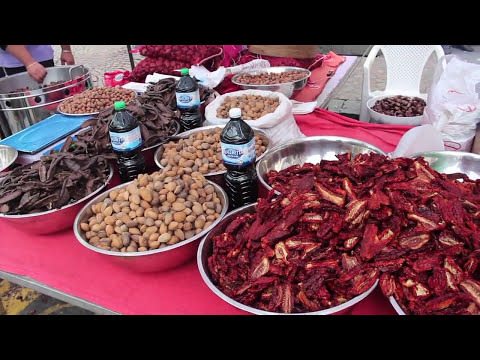
Honey, local biscuits and woodland produce are among the foods described by Sicily's tourism portal. The Ottobrata Zafferanese is a market exhibition begun in the 1980s, featuring grapes, honey, apples, mushrooms and chestnuts. Its 2026 edition took place on four Sundays in October. It is not an unbroken medieval festival, but a modern event bringing together producers, cooking and crafts. Anyone planning a later edition should check that year's official dates.
Population, lodging and access
The council's geographical profile describes a population of around 9,000 without a precise census date. This is an order of magnitude rather than an up-to-date official count. The same profile puts Catania 24.6 kilometres away, Acireale 13.7 kilometres away and Taormina 36.6 kilometres away. These are useful approach points, including for international travellers using larger transport connections. An Etna provincial road links Zafferana with visitor access towards Rifugio Sapienza and Piano Provenzana, but traffic, snow and restrictions can alter a route.
Lodging and restaurants operate in the town and municipal area; Visit Sicily lists places to stay at Zafferana. An overnight visit is possible without returning to Catania after every outing. Check the precise position of a property, since a room higher on the slope and one in the centre imply different travel times. For meals, confirm service before a festival day or an Etna excursion.